I’m not usually interested in judging video games by what they cost, but with Welcome Tour—and given the wider pressures facing the gaming world—this topic feels unavoidable. Let me address the money side immediately: Welcome Tour essentially functions as a pack-in experience, and once it was confirmed you’d have to pay real money to play this otherwise fairly ordinary, hands-on console instruction booklet—especially when you can get the free Astro’s Playroom included with the PS5—there was an entirely reasonable reaction. The takeaway was simple: this title probably won’t set the charts on fire.
That said, predicting how well Welcome Tour will do isn’t my job. What I can share is this: Welcome Tour is genuinely enjoyable. Behind its pared-back surface, there’s plenty of humor and warmth—some classic Nintendo flavor, no matter how you choose to define it—and it also feels unexpectedly heartfelt. The clearest way to describe it might be to explain what it actually is. Welcome Tour treats the Switch 2 console like a museum, turning it into a space with various scattered interactive displays and distinct takes on learning-through-play. The smart touch is that it really does come across as Nintendo’s version of a decent museum you’d want to explore. It isn’t flashy or thrilling in the usual sense, but I can’t deny I haven’t played anything quite like it before.
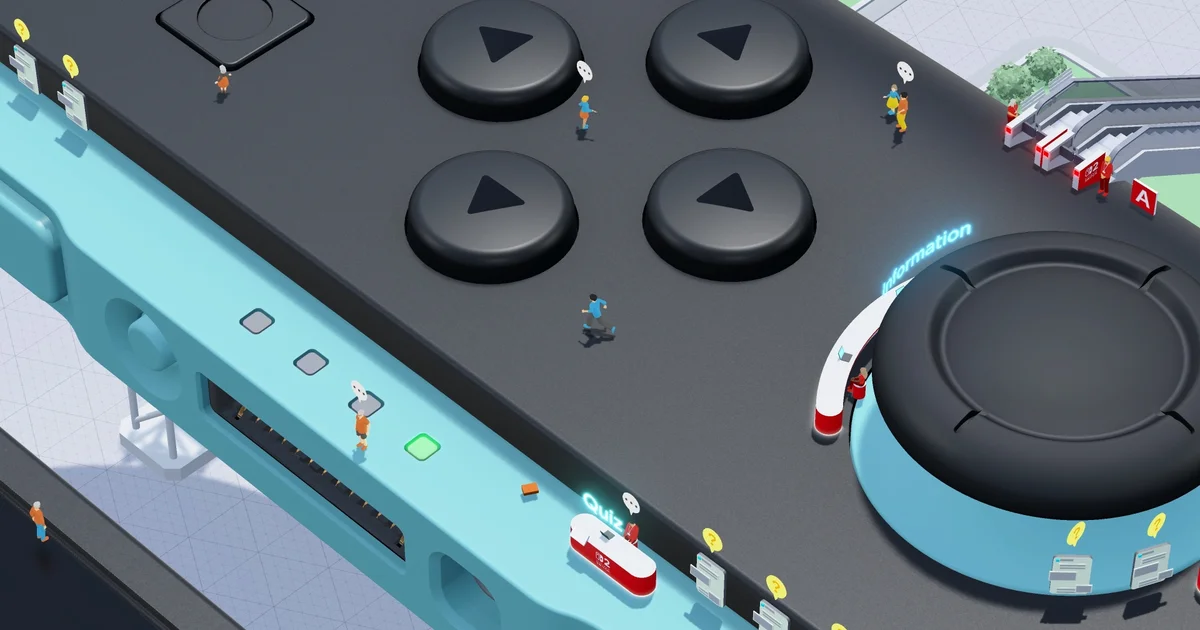
The basic idea is also pretty easy to grasp. You play as a tiny visitor moving around a slightly dismantled Switch 2 setup, as though it’s all one big location. The console is broken into areas—such as the left Joy-Con, the screen, the right Joy-Con, and more. To move from one zone to the next, you have to uncover the hidden pop-up explanations scattered around the space you’re leaving. To reach minigames and demonstrations, you need to gather enough stars, which you earn by completing the earlier minigames—yes, it’s exactly that. There’s also a lost property area where you can drop off anything you’ve found and forgotten along the way. And beyond that, at least from my time with it, that’s essentially the whole structure.
I don’t think I’m explaining this properly! The exciting part is that the minigames are genuinely excellent. None of the ones I tried felt especially unforgettable—this isn’t the chaotic WarioWare style—but the understated visuals are at least balanced out by how satisfying it is to learn about how a gaming console works through interactive play. In the end, the game will likely appeal to Nintendo’s most loyal fans—people who met the unusually high bar for pre-ordering the Switch 2 through a Nintendo invitation, for instance—along with anyone determined enough to track down a console on launch day, even if it ends up seeming sold out. For many, the only truly original, full-price, first-party launch release is Mario Kart World. So everything clicks: those who already have Switch 2s on day one are probably the exact audience who find the ideas behind HD rumble genuinely fascinating. (Or, of course, they’ll just be kids—who will likely enjoy a bundle of minigames regardless.)
And for the record, yes—it’s engaging. Do you happen to know how the rumble feature is produced inside the Switch 2’s Joy-Con? I do, because Nintendo made me sit through a quiz about it. It uses a linear resonant actuator, meaning it vibrates along just one axis, and I’m not going to spoil the fun of discovering the details yourself. I’m only half-joking here: if you have even a small curiosity about the subject, there’s real enjoyment to be had. You start by reading a few short explanations—say, three to six—on a topic, like the HD rumble mentioned earlier. Then comes a quick quiz for a gold star—congrats!—and after that, you may get a brief minigame to bring the concept to life. For rumble, the one I played had you slide the Joy-Con across the tabletop in mouse mode, trying to spot where the vibration is strongest, then tapping when you think you’ve found the peak. It’s surprisingly tricky—and that’s probably the point, too, since it really underlines how “HD” the HD rumble is. It took me several tries to get close to right.

Some sections almost feel like they could stand alone as straightforward games. One minigame used the Joy-Con as a mouse, and it instantly made me appreciate how responsive it is—steering a small ship to chase a high score while dodging spiked hazards that become more and more packed onto the screen. Another was a putting setup where the goal wasn’t simply to reduce strokes; instead, you had to sink the ball into the hole as quickly as possible. Honestly, it was a bit of a grind—so not every minigame hits the mark. There was also one that had me tapping into my inner Tom Morgan, guessing the frame rates of various sports balls as they flew across the screen. (And yes, the “no one needs more than 60fps” conspiracy theorist in me showed up too—but we’ll leave that alone for now.)
Elsewhere on the screen—where your tiny visitor could slip if you move too fast for too long, like sprinting across an ice rink—there’s also an enjoyable exploration into the other Joy-Con, with its inner components laid bare. The delivery is, once again, a touch more restrained than you might hope for, but that may be deliberate.
From my somewhat long, though still limited, time with it, it looks like Nintendo has aimed to create something that isn’t necessarily the wildest kind of entertainment, but is perhaps the most faithful-feeling recreation of visiting a real museum devoted to a gaming console. You read a bit, mess around for a while, pause to say, “huh,” think about what you just learned, then keep going. If not for all the Joy-Con gestures, I’d even prefer to experience it with my hands clasped behind my back and my head slightly tilted, like a proper museum visitor following the rules. Welcome Tour may not show much bold personality, and it doesn’t offer the bright, energetic style you often expect from Nintendo games, yet it’s undeniably original and clearly the result of careful thought. In many ways, that’s about as Nintendo as it gets. Still, I’m not going to reveal what I think that’s worth.