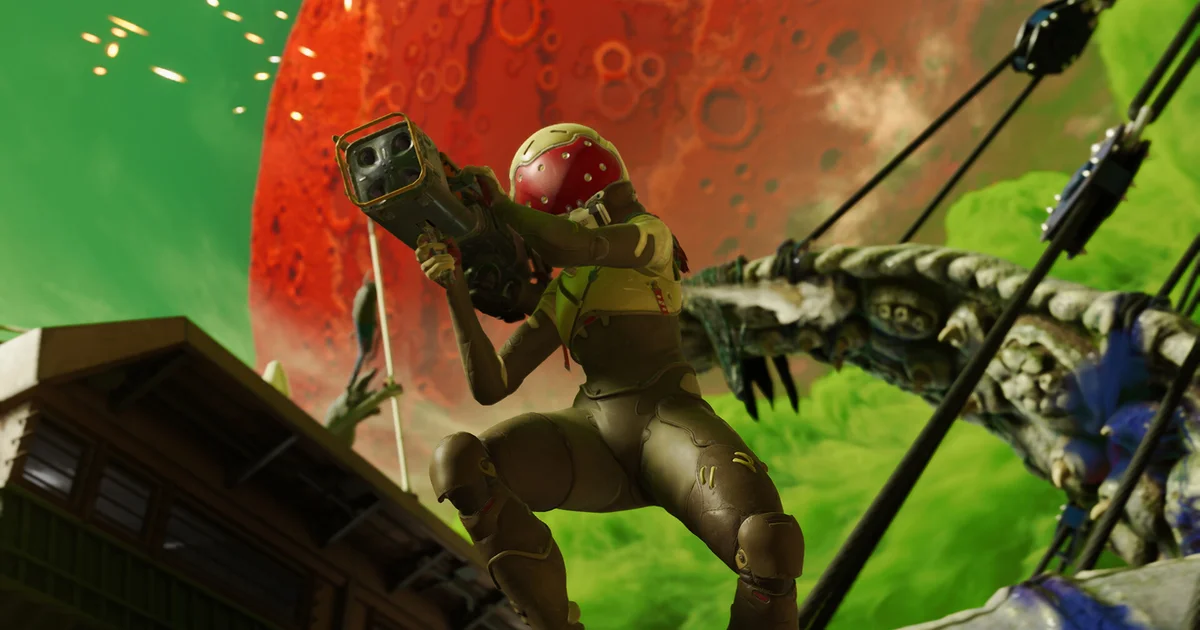
Setting everything else aside, Concord really does pose an interesting challenge. If you perform every distinct, individual task in a game as well as possible, does that automatically add up to a great game on its own? We’re teetering right on the edge of “what actually makes a game good?”—and honestly, that’s a huge, tangled subject. It’s a can of worms, to put it mildly. I’m not touching that right now, but Concord has me thinking.
A 5v5 hero shooter built entirely around online multiplayer, Concord’s first showing felt clumsy. Its real character only came into focus after an extended, flashy Guardians of the Galaxy-like narrative cinematic, packed with a range of fresh characters exploring an unfamiliar new universe. When you watched, you could see what was going on—and once people clocked Sony’s involvement, it clicked what it was meant to be. That sparked debate about live service fatigue and bait-and-switch tactics, along with some unusually fast dismissals before anyone had even played. The encouraging part for both Concord and the young studio Firewalk Studios is that those rejections have been just as quick as they seemed. Concord is fun. The catch is that I still can’t say how fun it truly is after only a couple of hours—and the way it delivers that fun may be exactly what threatens its long-term success.
Concord is entertaining because it feels—almost on purpose—like a blend of several other, standout multiplayer experiences. The first, and maybe most surprising, point is that it reminds you less of Overwatch than it does of a few matches in Destiny’s Crucible. You’ve got floating, airborne casters, charging tanks, gun-and-grenade sharpshooters, and a constant sense of chaotic movement as the maps shift and fight for space. That impression becomes even stronger when you understand where Firewalk’s know-how comes from. Bungie, for instance. And there’s also input from teams behind Overwatch, Halo, Call of Duty, Apex Legends, and more.
At this stage, I should probably spell out what it actually includes. Concord is a straight-up multiplayer team shooter. You pick from sixteen maps and six modes, then choose one of 16 characters at launch—“Freegunners” in this case—and jump into 5v5 online matches, earn a bit of currency for small meta-progression, skim through a text-based lore collection during downtime if you want, and watch a one- or two-minute story clip when it drops each week. That’s essentially the whole package.
Firewalk’s team clearly put significant effort into highlighting the care and attention behind its worldbuilding and storytelling—and at first glance, it shows. That lore library is genuinely “lore heaven,” as Kim Kreines, Firewalk’s director of IP, told the group of journalists on hand. It looks like a broad galactic map where every planet and star functions as an interactive node, giving you bits of backstory or deeper treasure to dig into. The commitment to those weekly cinematics also stands out, especially since these productions clearly aren’t cheap.
Kreines went on to explain that the studio has been working toward regular story “vignettes,” treating them as important as new gameplay additions. “We’ve had an opportunity to really optimize our pipeline and strategize how we’re going to accomplish this in the long term,” she said, “and I’m enthusiastic. It’s a significant opportunity. Yes, it’s a massive undertaking, but it’s something we have strong faith in, and it’s a way to make the story feel concrete.”

Trophy Hunt works the same way as CoD’s Kill Confirmed—you only earn a point when you collect a fallen enemy’s “trophy” by running over it after they’ve been eliminated. Cargo Run is basically capture the flag: you take a small blue item, bring it to a designated area, and then defend it for a short stretch.
No matter how important the focus on storytelling and character depth may be, Concord’s core moment-to-moment gameplay is what matters most. Even though a lot of it feels familiar—the lineup of heroes, the structure of the modes (we played minor variations on king of the hill, kill confirmed, and capture the flag), and more—there’s one notable twist. Concord includes a system where each character class grants a class buff, and that buff continues for the full round, even if you swap to a character from a different class. On top of that, the buffs stack, which adds a tempting sense of growth while you’re still inside each match.
As lead character designer Jon Weisnewski explained, the idea comes from another highly successful competitive title: League of Legends. “I play a lot of MOBAs,” he said. “I watch a lot of RTS esports. There’s a lot of strategy layered at the macro level, and games like that are incredibly inspiring to me. I think we’ve managed to bring some of that into this game with the crew builder and other exciting bonuses that unlock over time—giving you those little bursts of strength.”
He pointed to League of Legends as an example: “You get to the end of a League match and you’ve gone really deep into your build path, turning into a stronger version of your character. Then you jump into the next game and you start over from nothing, and it’s like ‘argh!’” That’s the feeling the team wanted to create: “Just small, gradual power unlocks that happen over time, so you kind of notice them, and then you finish the match thinking, ‘Okay! I’m more like a super soldier now.’”
Concord’s approach to map layout is genuinely impressive. Take Star Chamber, for example—it strongly echoes Destiny, especially thanks to a smart split-level layout at the center that you have to steer through with care, depending on how mobile your chosen character is.
While I was playing, I’d say “super soldier” comes off a bit too strong. When incremental stat gains land at the same time for everyone, the resulting effect is a mostly…
Stepping back from my own experience makes it clear that players are steadily getting more powerful at nearly the same rate. Toward the end of matches, things feel slightly more thrilling, but the change isn’t dramatic. These upgrades, for instance, are fairly minor. One adds a small improvement to reload speed. Another reduces the cooldown on how often you can pull off a dodge. If you apply those benefits to the right Freegunner as the game winds down, they can make a noticeable difference—at least to some extent. They were especially useful for me on Star Child, the relentless tank that uses a slow-firing, high-damage shotgun. Still, “somewhat” is really the key word here.
Ultimately, this is Concord’s central problem. It is, without question, fun to play—just the way any well-built first-person multiplayer shooter should be. The movement borrows from Destiny, with a touch of buoyancy and an emphasis on maintaining momentum and using height, which is a polarizing direction if there ever was one, though I happen to enjoy it. The large roster stands out for its encouraging variety and lively character traits, drawing directly from the Overwatch model. That said, I’d argue it doesn’t quite reach the same immediate recognizability in its archetypes that Blizzard still manages even today. The core gunfeel is satisfying and refreshingly varied: Teo, for example, fits the very typical FPS mold and brings a Call of Duty–style rhythm—snappy and quick—while Daw, designed to be beginner-friendly, is a medic character carrying a minigun that fires lightly homing projectiles, which may bring you closer to that Overwatch sensation again. The maps themselves use a pleasant three-lane structure, making each one well suited for flanking and loosely organized teamwork. Beyond that, some other characters offer truly distinct playstyles—I really liked 1-Off, a sentient trash bin that uses a weapon capable of absorbing every enemy projectile. It supports your team while also functioning as your ammo: you can redirect that stored firepower back as a narrow beam of refuse, or release it as a short-range explosive that hits with massive damage.
Still, on the whole, Concord does feel like it’s echoing a number of other polished releases made by extremely capable former developers of other well-known multiplayer franchises. In other words, it showcases plenty of moments of high-level skill across multiple areas—distinct, thoroughly developed characters; enjoyable gunfeel; verticality handled with care; sensible map and level structure; and no gameplay-affecting microtransactions—yet it falls short of a single, unified sense of originality that ties everything together. Each piece is executed exceptionally well, but not necessarily in service of something bigger than simply getting it right. I suspect Concord’s real appeal will show up once its player base starts putting it through its paces, testing combinations and strategies as the meta settles into place. That’s often when the true character of an online game comes into view—but for certain titles, by then, it may already be too late. I’m hoping this one earns enough time to find its own identity along the way.