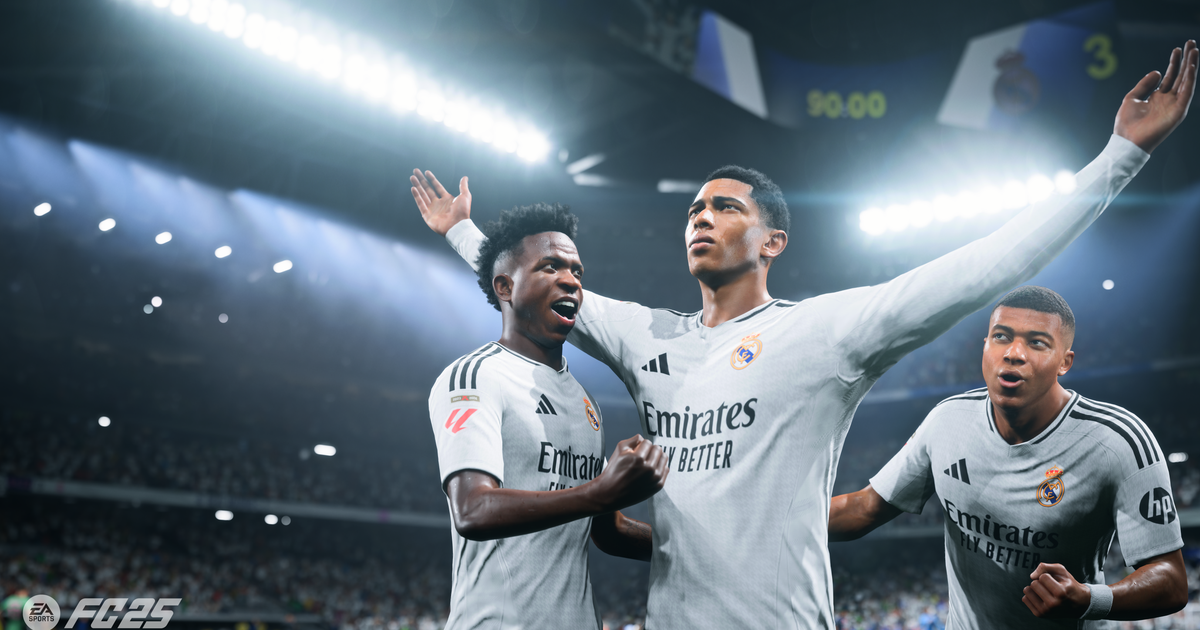
EA Sports FC 25 has now been officially unveiled, with England’s breakout talent Jude Bellingham named as the cover star for this year. As usual, EA Sports has outlined plans for a range of major changes to the game’s featured systems, plus plenty of smaller tweaks across the experience. Still, there are a few surprises in the mix. For one thing, FC 25 is moving toward a more tactical style, introducing a behind-the-scenes system called FC IQ. And perhaps just as notably, there’s also a real update for career mode.
We were invited to EA Sports’ studio in Vancouver for a preview, where we also talked about the company’s view on whether a FIFA rival is even on the horizon. There’s a lot of ground to cover, so we’ve split this rundown into sections that address the most relevant elements. On top of that, there’s a brand-new mode called Rush, which is available inside all of FC 25’s different modes—serving as a mix of Volta and Pro Clubs and acting as a replacement. We’ll share a separate practical preview of Rush soon, so you can get a closer look at how it plays.
FC IQ: the key tactical overhaul in FC 25, with Football Manager-like vibes
Match experience producer Thomas Caleffi described this update as the “most significant change to tactics in over a decade,” calling it a “massively important gameplay shift.” On the surface, it certainly looks like it will bring a genuine change in how matches operate.
In essence, it’s a shift in how players and their responsibilities are handled through the game’s tactical menus, paired with an adjustment to the core mechanics that influence what players do on the pitch—right down to how and why they carry out certain actions.
First, the previous approach to work rates—an explanatory way of describing a player’s willingness in both attacking and defensive moments—has been removed, since it was the key piece that influenced where a player lined up at any given time. Instead, positioning is now guided by a player’s “role” and the “focus” assigned to that role. That framing should feel familiar to Football Manager fans, since it mirrors the “roles” and “duties” you’ll see in FM.
For example, a central midfielder can be set to the “Playmaker” role, with several alternatives available (other listed roles include Box-to-Box, Half-Winger (also known as Mezzala), Holding, and Deep-Lying Playmaker). They can then choose a focus such as Balanced, Attack, or Roaming. Each role comes with different focus options. The Box-to-Box role, for instance, is restricted to Balanced only—matching Football Manager’s Box-to-Box midfielder style, which also limits duties to Support.
We haven’t yet played a full 11-a-side match using these roles, but during a studio presentation Caleffi showed a clip demonstrating how it could play out in real match conditions. The lineup shown included a right back on the Falseback setting, a center back set as Centre Half, a left back configured as Attacking Wing Back, a right winger assigned as Half Winger, and an attacking midfielder chosen as Shadow Striker. As the ball moved from defense into midfield, the left back sprinted high along the flank, the right winger drifted into a tight “half space,” and the attacking midfielder broke forward through the middle beyond the striker.
Crucially, all of it happened at the same time, representing a major departure from the prior style of gameplay. FC—and previously FIFA—has often relied on manually triggering runs when you press a button, so this more automated style of movement feels like a meaningful step forward.

Alongside this main overhaul, EA has added plenty of other tactical adjustments. Team-wide tactics now include preset options such as Tiki-taka and Gegenpressing, making it easier to set your approach quickly. There are also more advanced sliders you can tweak across a 99-point range, with the maximum and minimum limits influenced by your wider tactical selections. A helpful code-based system for tactics is included as well, letting you create and share tactic codes with friends or online across console platforms.
A new set of “smart tactics” has also been added, built to make in-game tactics feel “more intuitive and adaptive.” Using the D-pad, players can access options for their overall tactical mindset and set quick custom tactics, adjusting plans you’ve already prepared while also receiving tactical suggestions in real time during matches. The game adds an updated commentary system that reacts to strategic changes, while FC 24’s colorful—but somewhat distracting—AR visuals remain, continuing to highlight tactical information on the field live. There’s also a new substitutions system, giving you the ability to set custom subs or rely on the game’s recommended options as the match progresses.
Bringing it back to how this affects individuals, there’s another layer to consider: role familiarity. Each player now has a level of familiarity tied to a given role. Base familiarity means they can perform that role, based on their position—for instance, any left winger can cover all LW roles at a baseline level. Role+ reflects stronger competence, with every player starting with at least one role at that higher standard. Role++ indicates “world-class” performance for a role, and at launch only “a few” players are expected to hold that tier. If a player is assigned a role they’re out of position for, they’ll be given a “simplified” status instead.
Overall, FC IQ appears to have real weight, especially for a franchise that hasn’t always nailed the finer points of player intelligence and tactical nuance. Exactly how well it works in practice is still to be seen, but the concept looks encouraging—despite the fact that Football Manager fans might roll their eyes at the notion of any true rivalry in tactical depth.
EA
Career Mode gets its first major refresh in years
The Career Mode in FC 25, which has often been criticized, is finally getting the attention it needs. When starting a new save, you’ll now be able to use “live start points,” letting you take control of a club at a specific point in the season rather than only at the very beginning. EA explained it as being similar to the live-service approach used in Ultimate Team: as major moments unfold in real-world football, the goal is to bring those into Career Mode as fresh starting scenarios.
These include relegation scraps, big derby weeks, real-life managerial departures, or situations like Jurgen Klopp confirming he’s leaving Liverpool—within the game, such moments are labeled “Snapshots.” The game aims to replicate the full details of that actual stretch, covering injuries, scored goals, current form, and other relevant stats. You can also jump into these ongoing situations in both player and manager careers—if you want, for instance, you could enter partway through a Golden Boot race as a leading striker.
A further addition to Career Mode is the ability to handle training and development for youth players, marking the first time this type of system appears in the series. These training sessions will largely take the form of Rush matches with young athletes, and the youth player models have also been meaningfully updated. More broadly, EA has reworked player visuals as well, using what it calls EA Sports Cranium—machine learning that helps generate a more lifelike representation for players who haven’t been fully scanned. That includes both male and female players. The difference from the previous year’s more generic faces to these new models is noticeable, though the new options still don’t look as accurate as fully scanned ones. On top of that, there’s a striking custom character creator for building your own players, even though we didn’t have the chance to review it in depth during our visit.
Scouting is improved too: you can now scout more than 160 nations worldwide, which is over 90 additional countries compared with last year. You can also refine searches more precisely by targeting specific roles like False Nine, instead of focusing on striker alone. When it comes to transfers, well-known insider Fabrizio Romano is now included via a new scrollable social media-style news feed, where he’ll share his trademark “Here We Go” updates for in-game deals.
Finally, the FC IQ system has been brought into Career Mode through training. In the example EA discussed, Manchester City forward Erling Haaland already has a starting rating for the False 9 spot, since it’s not his main role. Through training in that specific position, though, he can be upgraded to a “Role+” rating. Notably, switching the team to the Gegenpressing tactical preset automatically shifts him to a Poacher—his natural “Role+” setting—showing how these choices can change formations and the players placed within them. The general idea is to align players with their most natural roles and spots, but you can still use training to adjust things if you’re looking to experiment.
Ultimate Team gets small tweaks, though not much more
Based on what we saw at EA Vancouver, FC’s well-known Ultimate Team mode is mostly the same as in earlier versions. The key changes we noticed are relatively modest: you get more room for duplicate untradeable player cards, with roughly 100 slots for them, and there’s improved menu navigation that lets you store items directly from the Squad screen. A dedicated SBC storage section also lets you move them into Squad Builder Challenges without friction. It’s a helpful adjustment for people who frequently engage with those features, but it’s hardly a major overhaul.
Evolutions—introduced last year—have also been adjusted. You can now evolve more players, with about seven times as many evolution opportunities, which in turn reduces how common evolved cards become on the marketplace. EA has also added new ways to customize card colors and appearances, responding to complaints about the purple look seen in FC 24.
Related to that, FC IQ is present here as well. Players can receive refreshed roles on special cards based on real-world form. One example was Jude Bellingham’s standout performance in a deeper midfield role during the week, which led to a special card carrying the “Role++” modifier for the Deep-Lying Playmaker position in Ultimate Team. Manager cards have been reworked as well: each manager now includes a button that lets you recreate their tactics immediately, making it possible to instantly apply Pep Guardiola’s Tiki-taka approach if he’s in charge of your team.
In an interesting shift, the competitive structure has been changed: Friendlies and Rivals have been “decoupled,” with the aim of making Friendlies feel more relaxed. As Richard Walz, executive producer for Ultimate Team, explained, the previous setup “essentially meant that when you played a match, the pool of opponents was not varied at all” between Rivals and Friendlies. “So the results—if you’re matched against equally skilled players, it’s a 50-50 chance—every mistake you make could lead to a loss. With this matchmaking system, you’ll regularly end up playing teams with different skill levels.” Put more simply, “sometimes you’ll come out on top more easily, while other times you might be up against tougher competition.”
There’s also a points-based weekly rewards system now, modeled after the real-world sport: three points for a win, one for a draw, and none for a defeat. The intent is to help make draws feel less like a missed chance. Relegations have returned in Rivals mode as well, following multiple requests from the community.
Still, the biggest headline here may be the addition of a single season pass for FC 25 that covers all modes at once—Career Mode, Ultimate Team, and the updated Clubs. That means progress toward the pass should, in theory, keep pace whether you play across all modes or focus on just one. “You can earn season points through Career Mode,” Walz said. “So no matter where you’re playing within those three areas, you’ll be able to complete objectives—some will be doable across all formats.” One example he shared was scoring a set number of goals, which can be handled in either Career Mode or Ultimate Team, and across the game. Still, “mode-specific objectives” will remain in some form.
Lastly, the new Rush activity will be included in Ultimate Team as well, since it’s appearing across all the other modes. You will be
You can also bring players from your FUT lineup into this mode, along with…
Absolutely! Here’s the rewritten version with synonyms and a refreshed structure, while keeping the HTML tags exactly as they are:
Live events are already happening, including “La Liga Rush,” which runs for a limited time. This particular event focuses on a Spanish side winning the Champions League this year. There are also activities described as something akin to lighter Squad Builder Challenges—though you can skip them. If you do take part, you’ll naturally accelerate the rewards you’re able to collect from this mode. On top of that, you can earn a new in-game currency called Rush Points, which goes toward these Rush objectives, along with weekly rewards tied to them.
A range of smaller tweaks across the game
Finally, EA has rolled out a broad set of changes across many of the game’s modes. On the visual side—along with the standout new Cranium enhancements—HyperMotion V, the well-known term introduced last year, now adds full “lower body mimicry” for players. In other words, their legs look more lifelike. There are also more women from the Women’s Champions League included, plus higher “goal post interactions,” leading to several entertaining, yet surprisingly painful-looking, animations when players accidentally slam into the frame.
New weather effects have been added, meaning players may occasionally slip when the pitch is wet (though this is switched off automatically during online matches). Stadium wind is also back in play—its strength is influenced by the venue size, with smaller stadiums having a bigger impact—affecting the ball’s path during set pieces. Staying with the presentation updates, there’s now a set of visual options that let players choose between sharper visuals or preserving resolution. The second option disables ray tracing, jersey cloth simulation, certain shadows, and some pitch details to keep more pixels on screen, while both modes still target 60fps.
Goalkeepers have received a few updates, including multiple new playstyles. The Footwork trait helps keepers make saves with their feet that would normally be missed. The Deflector ability allows them to block shots even farther from goal—often to a nearly comical degree—rather than sending the ball straight toward an attacker. Other styles now available include Rush Out, Cross Claimer, Far Throw, and Far Reach, though EA didn’t go into further detail on them.
A new mechanic is also in place: the Professional Foul. This lets you deliberately foul an opponent to stop them from sprinting through during a counterattack, similar to the sort of tactical approach you might see from a veteran Manchester City side. You can perform it by pressing R1 + X on PlayStation, or RB + A on Xbox. That said, unlike Manchester City, you will always get a yellow card for using it—so use it carefully.
There are additional gameplay refinements too. Dribbling has been adjusted for a smoother 180-degree cut, and “blind” 180-degree passes—those aimed at teammates positioned directly behind you—are now noticeably less accurate. EA has also added five new skill moves: the toe drag stepover, big feints, the step over the ball, the heel nutmeg, and the drag turn.
So, in summary? There are plenty of changes, and FC IQ stands out as the most important—and most exciting—addition. As always, the real measure will come once you’re on the pitch.
This preview is based on a visit to EA Sports in Vancouver. EA provided transportation and lodging.