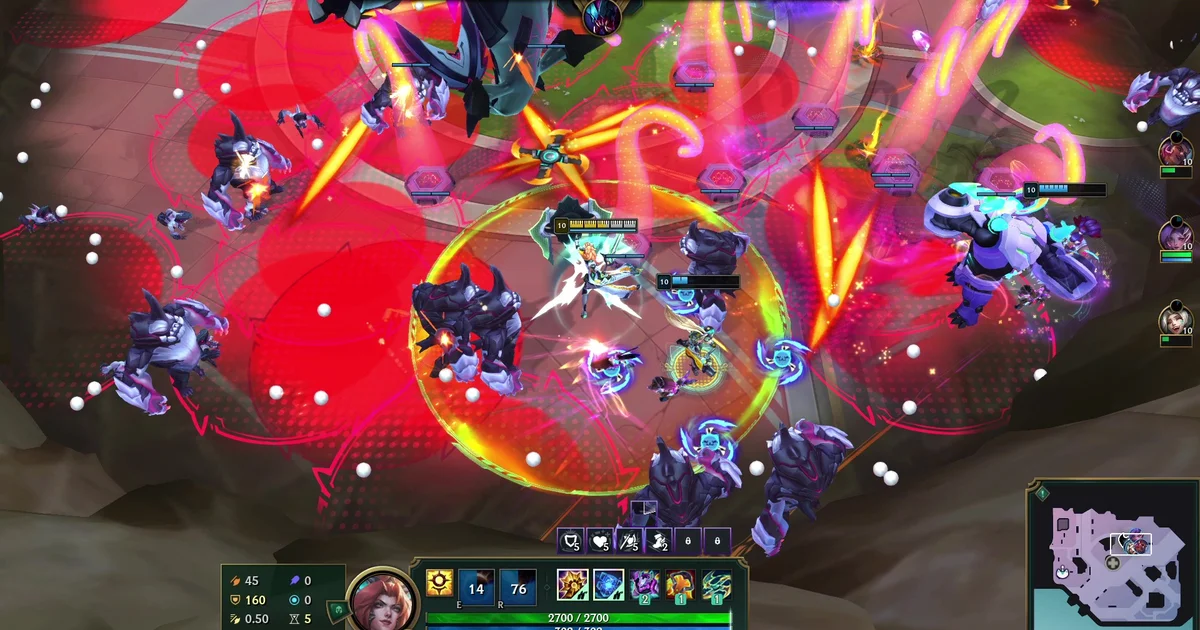
In an unexpectedly calm twist, mixing League of Legends with Vampire Survivors has produced something that feels almost soothing. The notorious, full-throttle MOBA is rolling out a limited-time option this summer called Swarm. It blends playable characters from League with visual and mechanical flair drawn from the recently popular “bullet heaven” survival style. What makes it especially striking is that, despite the sheer disorder on-screen — and yes, there’s a great deal of on-screen chaos — the end result is oddly relaxing.
Like many recent additions to League of Legends, Swarm leans into a lot of in-game storytelling and worldbuilding. The mode takes place in the alternate universe of Anima Squad. If that name isn’t familiar, Riot Games often builds its premium character skins around other dimensions or short fictional premises — for instance, the cyberpunk-flavored PROJEKT skin lineup, or the K/DA skins that connect champions to Riot’s imaginary pop group of the same title.
The Anima Squad setting comes across as a bright, futuristic anime-sci-fi take. A team of heroes, armed with animal-enhanced abilities, works to defend what remains of Earth from an alien assault. For this new version, Riot has widened the universe with multiple enemy factions pulled in from the invading Primordians: purple, shark-like minions and their various bosses. These foes see themselves as the “white blood cells,” determined to wipe out humanity’s virus. The mode also uses several different maps, each set in a post-apocalyptic Runeterra.

While the lore is enjoyable, the real appeal of Swarm — as you’d expect — is the gameplay. The basic structure works much like other roguelite wave survival games. After you pick a character, you start out as a fairly fragile contender, slowly becoming stronger while holding back bigger and bigger waves, until your screen is not just crowded but absurdly filled with the massive, armored automatons you were worried about only moments before. The thing that sets Swarm apart, though, is Riot’s signature approach: giving you variety in how you play without forcing you to leave the confines of a single mode.
Take the maps, for instance: each one calls for a different approach. The first I tried — shared with three other players in a four-person co-op squad, though solo play is also fully possible — had a big circle in the middle that powered up on a schedule. By charging it during those moments, you could trigger a healing burst for your whole team. Boss fights and quests served as optional side goals around the edges. The next map I entered featured an AI-controlled roaming Miss Fortune (another LoL champion) that would occasionally unleash her ultimate: a huge damage cone. Ideally, you’d guide enemies into it for longer survival.
More differences show up through your champion choice. At launch, a set of characters are available, including Riven, Seraphine, Leona, Jinx, Illaoi, Yasuo, and the newly revealed mage Aurora. Each one feels like a tightened, polished take on their original form from the main game, with fewer abilities and many effects working passively. So some familiarity may speed things up, but it isn’t required (after all, this is a casual mode). Jinx, for example, stays a fragile but high-damage carry, using a minigun with fast attack speed and a powerful rocket for her ultimate. Leona, a famously sturdy support in the main game, keeps a similar tank-focused support identity here, centered on shielding abilities that pair well with Jinx.
Switching to Riven makes the connection to the original character clear. She still leans on low-cooldown movement, dashes, small defensive shields, and an ultimate that boosts damage. Even so, the play pattern becomes meaningfully different. With Jinx, you’re constantly dodging enemies and trying to keep your distance. With Riven, you need a more daring mindset, juggling automatic abilities that trigger after you’ve moved enough, shown by a cooldown bar that fills gradually. And no matter which champion you choose, they all rely on the quality that makes this genre so inviting: an unexpectedly absorbing sense of calm.
Riot developers, including the well-known champion designer August Browning, who has been working on Swarm leading into its release, said their goal is to create a casual option you can enjoy between more intense League matches. Swarm runs through the LoL launcher, similar to Teamfight Tactics, rather than standing alone as a separate Riot product like Valorant. It also uses a simple meta-progression system. Each time you finish a map, you unlock the next one, and during each run you earn currency to spend on upgrades tied to things like damage and health. Once you clear all the maps, you’ll gain access to play them at a higher difficulty. Riot also states that the mode is free to play, with monetization not being a central focus. Instead, it seems designed to keep players engaged and coming back. If you’re already taking a break from League of Legends after a few matches, why not just stay in the launcher and jump into a round or two of Swarm?
I completely get why it could be appealing. I can even picture a path where fans of this kind of peaceful chaos discover Swarm for the first time, then decide to give League of Legends a try afterward. Whatever the route, the takeaway is that it’s genuinely fun. Riot Games has repeatedly shown that they don’t treat new modes or titles with half-hearted effort. You can feel a clear dedication to smart design choices here. For me, it’s another solid way to keep my attention engaged when I’ve got a few spare minutes — even if avoiding another League session ends up being harder than I expected.