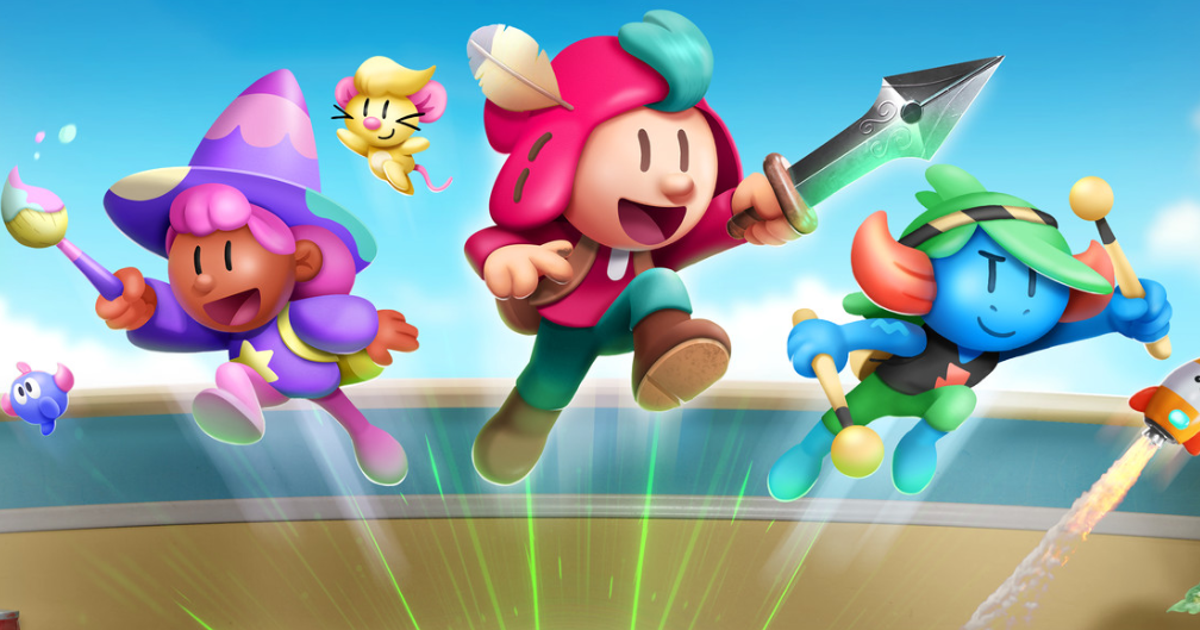
I’m inclined to think joy is a bit overlooked, yet this year’s Summer Game Fest made it hard to deny that it was the dominant feeling everywhere. Astro Bot and Lego Horizon Adventures both lean into a bright, family-friendly spirit—fun, upbeat games that focus mainly on delivering a good time. Still, The Plucky Squire, an action title with a dimension-hopping twist, likely clinched the award for the happiest experience I had during the entire week.
Honestly, it’s been one of the most enjoyable stretches of play I can remember in a long time. The Plucky Squire feels genuinely delightful.
The story begins with a scene set inside the game’s 2D portion of The Plucky Squire, the central storybook. What really stands out is that, while the page borders are always there, they fade away smoothly as you play. Before long, you’re drawn into a top-down adventure with the vibe of Zelda—swinging your sword at enemy blobs or using a handy throw-and-recall trick similar to a boomerang you summon yourself. You hop over ledges and across gaps marked by green swirls on the floor, and those swirls act like portals, carrying you to matching swirls on the other side. Then comes a jolt: a massive, whirring mincer appears—intimidating, and honestly a little awkward in this cozy, pastel-toned tale. You leap to another swirl anyway, only to find you’ve hopped right out of the page.
Scenes like that never stop surprising me. I think of how Fez shifts the world, how Portal treats portals like a language of its own, or how Superliminal and Manifold Garden play with overlapping viewpoints. The Plucky Squire’s transitions have their own flavor, too. They aren’t something you trigger on demand; instead, they happen when you reach specific spots. Even so, they land with the same sense of wonder—fast, seamless, and enough to keep me smiling for the rest of the moment.
The first transformation pulled me into a 3D desktop setting. In a heartbeat, you’re no longer playing Zelda—you’re dropped into a space that looks like it belongs to Toy Story or A Bug’s Life. You bounce across stacks of notepads, stride over playing cards, and step on rulers that seem to be balanced on a whim. It’s unmistakably the desktop of a procrastinator, and I felt oddly seen. On top of various stationery scattered across the desk, a small wizard waits to steer you. Meanwhile, enemies taunt you from ledges just beyond sword distance—or from heights too high to jump. It all clicks into place: this is a classic 3D platformer, and I can already feel an unlockable skill coming.
And it’s not just a hunch. Throughout the world, characters you meet are waiting for help, and each success comes with a new ability. The most memorable is a jetpack that trails a long ribbon of flame as you rise—the flame is rendered beautifully, flickering and glowing, and it throws shadows across a world that somehow feels like it’s been set at twilight.

Getting that jetpack took a bit of work. I spotted another glowing warp swirl, this time sitting on top of a mug. I climbed up onto it—wrapped in a space-themed cartoon where a tiny rocket is in trouble. Its components are scattered across the desk and need to be collected. (If you’re wondering how this 2D-to-3D crossover fits together, there’s a charming explanation: the villainous wizard, Humgrump, is using his magic to meddle with the story of the book you start in, and that disruption seems to spill over into everything else too.)
Once I’d gathered those parts and secured the jetpack, I kept moving forward. On a vertical wall, a portal carried me into a retro 2D platformer with a sketchy, coloring-pencil look—complete with doodles on the wall. I jumped between ledges and avoided more roaming enemy spikes and blobs. One objective asked me to use the jetpack to track down and, with its fiery flair, light several candles hidden around the world. Then there was a moment of pure magic from a plastic toy tub: it plays like its own contained mini-game.
It’s essentially a round of Resogun—Resotub?—as Jott is transformed into an 80s-style action hero wearing shades, armed with a jetpack and laser gun. From there, you navigate around the cylindrical tub while pushing through waves of enemy spaceships and rescuing civilians. Another visual style—maybe closer to retro cartoons?—another gameplay twist, and another hit of irresistible charm.
As you explore The Plucky Squire, it becomes clear that this is the work of an exceptional artist—and it absolutely shows. James Turner, previously responsible for Pokémon like Golurk, Sinistea, and Gigantamax Pikachu during his time at Game Freak, is one of the co-founders of developer All Possible Futures. Turner shared some genuinely wonderful details about how the game came together, including how the 2D minigames and storybook sections were made by projecting those 2D elements into a 3D space—something I find nearly impossible to picture. Once you hear that, you can suddenly feel the artist’s fingerprints everywhere: the art styles shifting, the perspectives changing, and even the framing and camera angles adjusting as you move. Even the collectibles feel thoughtfully designed: each one is a poster featuring a different character from the game, and that poster doubles as the actual concept art created for those characters during development.
What you mostly notice is the care an artist puts into their creations. The Plucky Squire is upbeat, magical, and inventive, but it’s also a game made with real attention to detail—so much so that you can almost see it leap off the page.