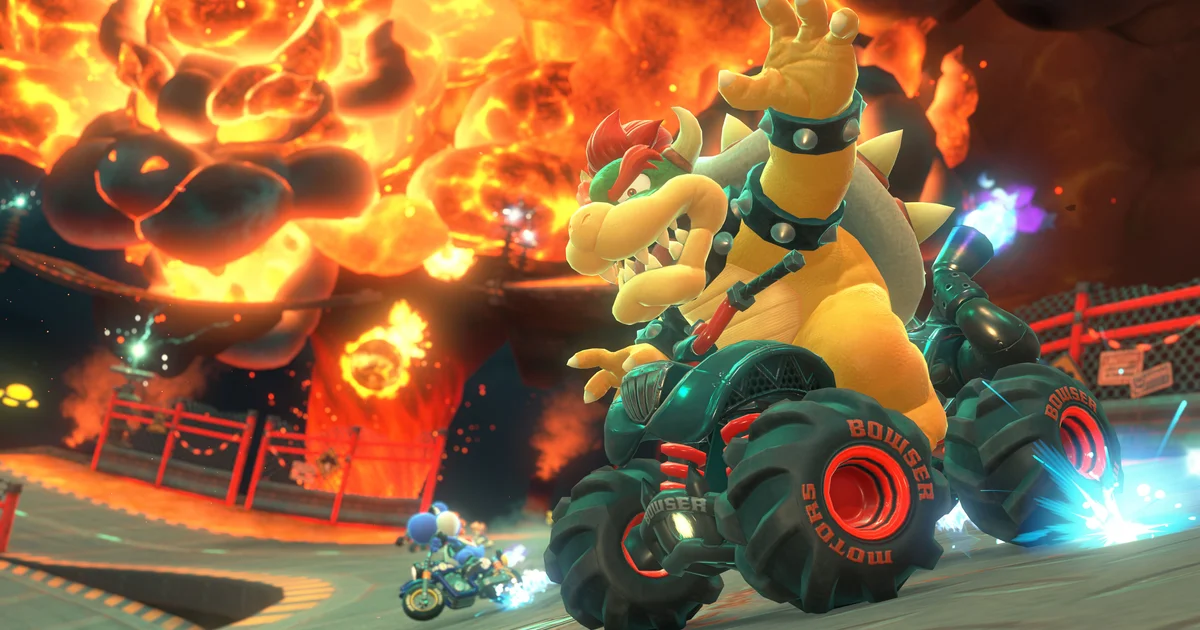
I get the sense that I’m about to say something indefensible. I’ve spent the last few hours with Mario Kart World, sampling a handful of fresh additions like Knockout Tour and its open-world structure, and in the end I honestly enjoyed it. There were moments full of laughter—usually from grimacing at my friends as I watched their faces through the Switch 2’s new camera while I kept hammering them with blue shells—alongside the familiar, old-school panic that comes with any kart race. Still, quite surprisingly, there were also times when I wondered if I should be playing something else instead (the oddly compelling Welcome Tour might be a good candidate).
It’s still Mario Kart, of course, so if you’re jumping into the usual fare—thrilling races against friends, CPU rivals, or random players online—there’s a good chance you’ll have a great time. If I had to guess, you’ll probably walk away with a level of enjoyment that feels close to what you got from Mario Kart 8 Deluxe. Not much has truly changed beyond adding wall driving and grind rails (more on that soon), and that alone doesn’t make it a drawback. Deluxe is widely regarded as one of the best kart racers ever, and as Tom Phillips pointed out in his earlier preview of Mario Kart World, it’s sensible to avoid straying too far from a formula that clearly works. The cracks only show up when you’re away from the core Mario Kart loop—specifically, when you’re not actually racing.
In fact, the most satisfying moments in Mario Kart World are the ones that don’t disrupt the fundamentals, but instead polish them just enough to make them shine. Local co-op is a particular highlight, especially with the camera mentioned earlier. Naturally, a lot of attention has gone to this camera and to the placement of the mysterious C-button, in part because it seems designed to appeal to Gen Zs and Alphas—but setting that aside, it also feels like a reflection of how face-to-face behavior shifted after Covid-19 and how social media habits changed right after. These days, a lot of content is built around another person’s face—or your own—framed neatly in the corner. In Mario Kart, that’s oddly brilliant.
A live feed of your camera—yes, all four of your faces in split-screen—gets attached to your avatar. You can see it on leaderboards, during pre-race montages, or hovering just above the back of your kart as you streak by. It sounds like a simple idea, and it is, but those little flashes of creativity really matter. I can’t remember laughing more in a video game recently than I did while making faces at friends as I whizzed past them with no particular skill to speak of, obsessing over my leaderboard position, or awkwardly zooming in while I fine-tuned the camera. Expect plenty of crossed eyes, attempts at instant reenactments of the Luigi death stare, and a quick dose of karma for anyone who gets a bit too carried away. Again, it’s a small tweak, but it’s hard to think of a better way to add to an already near-perfectly balanced game than simply widening the space for self-expression.
This question is likely a little less rhetorical thanks to other ways Nintendo has tried to keep things feeling new—though, based on my admittedly short time so far, I’ve come away with mixed reactions. On the plus side, Knockout Tour is refreshingly tense, and it’s a strong way to blend styles with the once-famous battle royale structure. It also does a smart job of highlighting more of Mario Kart World’s cleverly connected tracks, so races feel bigger, longer, more dramatic, and more immersive. The trade-off, of course, is that higher highs can come with deeper lows. Getting knocked out early can be genuinely discouraging. If you’re playing with kids (or if you haven’t completely left that mindset behind), be ready for tantrums: miss the required position at the next checkpoint, and you’re either stuck wandering the open world while you wait for a prolonged, six-part race to wrap up, or you can only sit there and watch until everyone else finishes.

Meanwhile, the driving itself has gained some new mechanical touches, even if they aren’t major overhauls. For example, there’s an extra spoiler on the back rather than any big change under the hood. New options have also been added—like throwing three waves of multiple hammers, reminiscent of Hammer Bro. These work as an effective close-range disruption tool, and a few of the older items have been adjusted as well.
The races themselves—especially the massive 24-player events that I expect will become wildly popular—feel incredibly lively and packed. I saw one moment where a single driver broke away from the main pack and surged ahead, but in nearly every other case, all 24 players were clustered together in one huge, chaotic peloton. It’s fairly normal to swing from 20th place to 5th and then back again (and likely bounce around a bit more after that). My inner Super Smash Bros. fan, the one who wants “all items; all hazards on,” absolutely loved the mayhem. But the more competitive crowd—come on, you know the type—might complain that it can feel a touch too hectic. (That said, I’ve noticed they tend to enjoy it more if you suggest they just try harder afterwards.)
The biggest update to the actual gameplay experience, though, is the addition of wall driving and rail grinding. Hold down the drift button—crucially without adding any directional input—and you’ll trigger an extra high hop. If you do that on a grippable rail or any vertical wall, you can jump up onto it, which may open up fresh routes and shortcut opportunities—or simply give you more style points during your run.
During my first sessions and just over an afternoon, it was hard to spot many major advantages right away; the higher fidelity and richer detail of modern Mario Kart generally makes it tougher to pinpoint clear, readable improvements
side paths through the visual chaos as it is—but my intuition is that there will be…
the finer points tied to when you’d want to use it in certain sections of particular tracks, along with the real, proper shortcuts it enables.
That said, actually using it proved pretty frustrating, largely because of how it’s mapped to the controller. I kept slipping into an unintended drift when I meant to start a jump, and just as often I’d activate it too late—charging it without getting the timing right—so I’d end up ramming the wall or the rail I was trying to spring onto. Pairing it with the drift control, while also forcing you to have no directional input at the same time, feels like an odd choice in practice. It makes rails and walls near corners feel almost unusable, since you have to coordinate a relatively long charge while still not steering as you trigger it—too many moving parts at once. The logic is easy to understand: assigning it to the same shoulder button as Switch 2 handheld or controller mode normally would be strange, since that setup has two buttons on each side. With a single Joy-Con, though, it has to pull double duty. I’m hopeful that, after some time, it’ll start to feel natural—especially since the muscle memory for drifting with that same button has become so automatic that it’s hard to unlearn.
For now, though, that’s only a small worry. I do have one larger concern about Mario Kart World, specifically with the open world itself. It’s hard to judge how thoroughly I explored in the time I had, but if what I saw was representative—something a Nintendo representative, while staying appropriately noncommittal, seemed to suggest it might be—then I have to say it didn’t leave much of an impression.
The upside is in how much work its construction must have required. Many tracks interlock into a huge network of routes and connections—almost hard to believe when you compare the variety and verticality of a Mario Kart course with the tracks you see in Forza Horizon. But once you picture what it really means to weave through all those Mario Kart pathways—plus the fields, valleys, rivers, and similar scenery that run alongside them— without an actual race going on, you can probably see why I felt that way. My worry is that it starts to feel a bit pointless.
Nintendo says there are plenty of secrets to discover if you’re willing to stick with it, and that the game’s usual sense of playfulness and fresh ideas will make the seemingly aimless roaming worthwhile. Still, over a long stretch of poking around, I didn’t run into anything especially memorable. There are small platforming sections for collectibles like Peach Coins—some of which can take real skill—and they bring to mind the classic 3D platformer era. There are also distinctive vehicles, such as trucks or hovercraft, that show up from time to time and can be entered, briefly letting you drive them. However, you can pilot your big truck for roughly 20 seconds, bump into a couple NPC vehicles, then step back out again—and that’s basically the whole experience.
Most of the other activities come through as part of P-Switch challenges. Crossing a blue P-Switch triggers a short task, like racing through checkpoints while dodging obstacles under a tight time limit. Once more, though, these moments are disappointingly fleeting and they start to feel a little repetitive. After finishing a handful, I didn’t feel particularly motivated to keep going. What else is there? There are warp pipes, but they appear to mainly help you move around the world through small mini-shortcuts rather than sending you to any truly special spots (though—hey, it’s Mario. You don’t want to rule out surprises). More notably, there are question mark pads you can drive over. When I did, a message popped up saying that “you have driven over a question mark pad,” and I found that blunt wording oddly intriguing—surely something interesting is going on, but I couldn’t figure out what.
That brings us to the key question, then. Are there a few real surprises hidden away somewhere—or tucked along the way in a pipe? At face value, the main headline feature of Mario Kart World, at least based on this quick first look, feels a little underwhelming. But now we’ve got a big question waiting to be answered when Switch 2 is officially here: when has a proper Mario game ever laid out all of its secrets from the start?