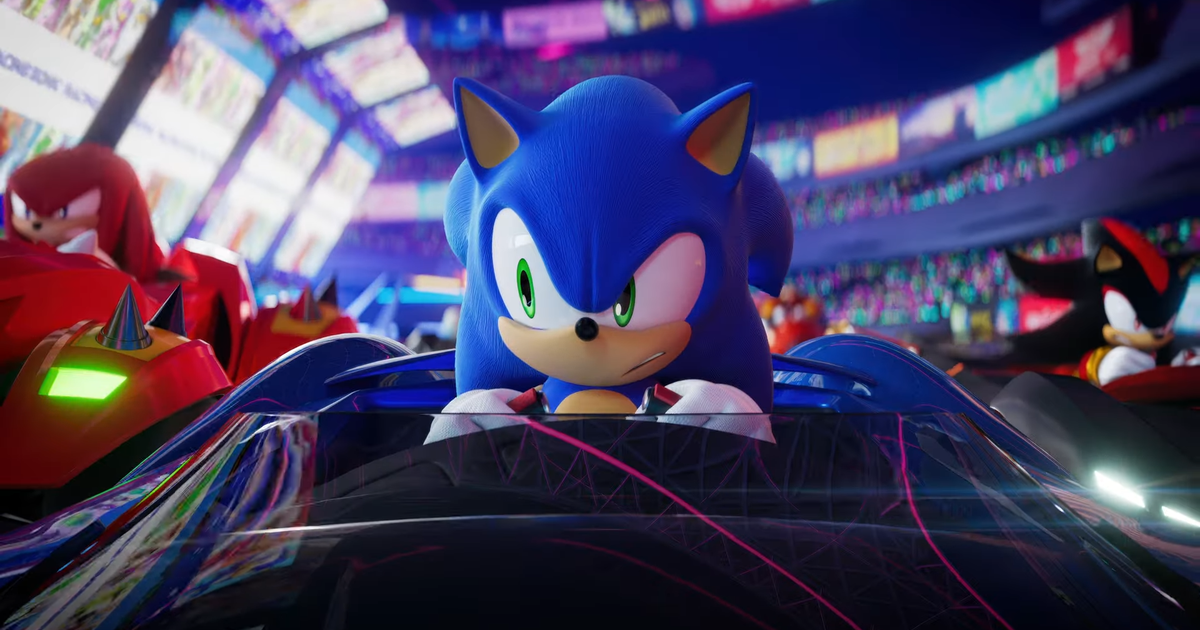
When I realized the playable showing of Sonic Racing: CrossWorlds at Summer Games Fest ran for an entire hour, I was genuinely taken aback. An hour? For a kart racer? At events like this, time is always tight. So, as a rule, you try to squeeze in as much as possible by spending only the minimum time needed to understand the game’s basic premise and where it seems headed.
After only a short stretch into the hands-on session, the reason for that hour became obvious. Sonic’s newest take on racing lives in a rare pocket: although it’s primarily built for kids, it still offers real depth and sophistication—especially if you actually commit to it. There’s that Pokémon-style appeal, too. You can treat it like a simple playground adventure, or you can dig into the competitive layers beneath the surface.
“We have a Sonic development team collaborating with a Sega arcade racing development team,” says Takashi Iizuka, the long-time Sonic producer who has moved from steering a struggling mascot era to serving as the proud guardian of one of Hollywood’s brightest new successes over the last decade.
“They’ve been brought together into a single, bigger team. The arcade racing group has deep experience in building arcade racers—making sure they’re well-balanced, keeping competition fierce, and also ensuring the races stay fair,” he adds.
In other words, it aims to capture the best parts of both worlds. That mirrors the game’s central idea: worlds colliding. You can see that in how Sonic and his allies team up with characters from Minecraft. But it’s also reflected behind the scenes—Sonic creators who’ve sharpened their skills making games for younger audiences teaming up with arcade racing specialists who have worked on series such as Initial D or Daytona.
The end result is honestly pretty wild. The driving feels sharp and smooth, which makes a lot of sense. Iizuka-san explains that the foundational racing mechanics were created first, before layering on extra systems. The logic is that if you want to race with pinpoint accuracy—almost like a simulator—you can. Still, at its core, it remains a kart racer. Then the team started piling on additional ideas. You can almost imagine the conversation: ‘How many mechanics should we bring in, boss?’ and him smiling back: ‘Yes.‘ If you remember a system from an earlier Sonic racing entry, chances are it shows up here too—and then some.
You pick a character, and you choose a kart. Yet the vehicles are far from identical, and you can adjust, refine, and personalize them through the menus to match the driving feel you’re after. These tweaks can be purely cosmetic, or they can directly affect speed and handling. Beyond that, there’s also a distinct perk-style system that lets you slot special bonuses into a card you equip ahead of each race—giving you another way to shape your run.
If you’re the kind of racing player who likes to optimize, you may lean toward perks that strengthen your drifting boost or increase how quickly it charges. On the other hand, if you want maximum chaos, you might select bonuses that raise how many items you grab when you hit an item box—or that make interacting with other racers more helpful.

I can also see why they gave us an hour before anyone even started a race. When you look at the choices available—probably just a portion of what will ship in the finished game—I could easily have spent thirty minutes just moving through the menus to dial in my racer. Younger players may miss a lot of that, but more committed, competitive players should find a lot to enjoy in the extra depth. High-level online matches should be a blast.
The big twist during the races is how the usual idea of “laps” practically dissolves thanks to the headline world-crossing mechanic. At a high level, a grand prix is made up of four races, each with a ‘hero’ track. Your first lap is essentially a walkthrough of that featured track for the race, but when it ends, the frontrunner gets to choose between two portals. Whichever portal they go through determines the track they’ll be transported to for lap two. Then lap three returns you to the starting track for the final showdown.
It’s a smart idea, and it works in harmony with several other systems. If you’re driving a vehicle tuned for water, for instance, you could build an advantage by deliberately picking a portal that leads to a track you know has plenty of water. It also brings variety—because you can enter the same Grand Prix multiple times without always landing on the exact same track layout. I especially like how it’s used in the fourth and final race of a GP: it turns into a kind of showcase of the three signature tracks from that event, with each one getting a single lap as you jump between them.
There’s an element of controlled disorder to the way it all runs, and the classic lap structure gets swallowed by the momentum. During lap two, you need to stay flexible—even if you’re already in the lead and still responsible for the track decision. That creates an interesting and enjoyable contrast with Mario Kart World. It also feels like both teams were aiming to step away from purely traditional, lap-based racing. Nintendo went with a world-tour, road-trip vibe in Mario’s version. Sonic stays focused on tracks, but adds active teleportation between them while the race is still going. Both are compelling alternatives.
That said, while Mario Kart World saves its most chaotic moments for the confusing Knockout Tour mode, Sonic keeps the pace fully turned up at all times. It’s basically the kart-racing equivalent of an incredibly hyper kid right after a sugar rush. Items are constantly being tossed, rings are scattered and collected nonstop, you’re drafting, drifting, and chaining boost tricks, obstacles erupt and scatter, characters trade playful lines, and somehow your vehicle morphs into a plane—then a boat. And, just when you think you’re steady, the second world crossing shows up: it’s bonkers. The screen never stops bursting with motion, and between races there’s a deeper level of customization waiting for anyone who wants to get into it.
It’s a lot to process. In fact, as I played, I understood why during the closed beta some players described it as overwhelmingly intense. Maybe this build has been adjusted, because I found it manageable—though still very much a sensory overload. Even so, that chaos feels like the core of the design, which makes it a striking counterpoint to Mario Kart World’s calmer tone, especially its free-roam elements.
Ultimately, the appeal is that unfiltered racing rush—the carefully built base that then gets layered with plenty of flashy, over-the-top flair. This is a Sega arcade racer, complete with the mechanical nuance and precise controls you’d expect from that lineage. And if you’re able to turn off items and other distractions—a fairly common option in this genre—you might even prefer to experience it that way. Beyond that, it also makes for an impressively chaotic party game.
To wrap up, here’s my comparison. I’m genuinely excited for Sonic Racing: CrossWorlds now. That one-hour hands-on session did a lot for me. And yet, by comparing my hour with CrossWorlds to the four hours I spent with Mario Kart World during my flight to Summer Game Fest, my excitement hasn’t faded—it’s grown. I like World well enough, but even with its fresh ideas, it somehow felt a bit sheltered and subdued, particularly once you’re outside of Knockout Tour. It looks like Sega could be on track to pull off what Nintendon’t—and maybe CrossWorlds will finally satisfy that craving for chaotic, casual multiplayer.