There are plenty of tweaks and refinements, yet this still holds up as a genuinely superb anthology of two classic games.
In Alcatraz, there’s a stretch I truly think is almost perfect. Here’s how it went: I’m juggling two goals at once. One is the hard-to-get tape—easy to spot from afar, but just out of reach. The other is a side task that has me freeing a prisoner from the main cell block. To make it happen, I have to knock over a few wheelie bins to reveal a stash of hidden keys, then sprint back to the central area to open the doors.
The tape keeps slipping away—more accurately, the route to it keeps proving tricky—so I pivot back to the wheelie bins. With about 50 seconds left, I’ve found four of the five bins. I locate the last one when there are roughly 30 seconds remaining. Still, 30 seconds feels like plenty time in a Tony Hawk game. Luckily, the prison block is right behind me. I pop the prisoner free—woo!—and the doors swing wide. I roll in, climb a helix staircase, grind around the upper sections of the block, and with only five seconds left—why not?—I hop out through an open window. Then, to my surprise, I snag on an unruly bend of rebar, using it to carry me along until—bam!—there it is. I’ve retrieved the secret tape I was chasing.
That’s Tony Hawk at its best. There are those wonderful moments that make you feel amazed, capable, and just a bit lucky. It’s a mix of practiced skill and muscle memory, all tied together by those satisfying “connected” moments—the effortless way unrelated parts click into one flow through speed, style, and the occasional happy accident.
Overall, there’s been plenty of chatter about Tony Hawk’s Pro Skater 3 + 4. Some tracks are missing. New levels have been added. Even the pacing of Tony Hawk 4’s campaign has been refined. Still, Alcatraz is here, and it keeps that endlessly looping feeling of momentum. In the end, you’re right back in a noughties Hot Topic cyclotron. And it continues delivering those moments where A rolls into B, then C, and then D-E-F, landing on S-K-A-T-E—honestly, it’s just brilliantly good.
To be fair, I’m finding a lot of it brilliantly good. If you know Tony Hawk’s Pro Skater 1 + 2, this will feel pretty familiar. You’re still looking at two legendary games built around skating and pulling off tricks across clever, slightly surreal, imaginative levels. Everything’s been updated for modern consoles, with redesigned spaces and animations that are wonderfully contorted. It’s the Tony Hawk games you remember—and, in a few ways, the ones you can almost recall they looked like.

That said, as others have already noted, this time considerably fewer of the original soundtracks managed to make the cut—presumably after going through a maze of lawyers who, let’s be honest, don’t seem especially enthusiastic about skateboarding culture. Each game includes far less than half of its original track list, supplemented with a collection of new songs.
At first, I was pretty disappointed. I wasn’t deeply invested in Tony Hawk’s music, but I’m still human—and if someone put Burnout Paradise in front of me while swapping out Avril Lavigne’s Girlfriend—it’s a terrible choice outside of Burnout, yet a classic all the same, one that really earned a place on the Golden Record in that game; the heart wants what it wants—then I’d be pretty upset.
However, with some distance, I’m starting to see why. Finding new music has always been a big part of Tony Hawk, and it still is. The original releases introduced players to tracks they might not have discovered otherwise, and many of those later became favorites. So it makes sense, as Ed explains in this article, that the developers wanted to preserve that tradition in the newer entries.
Even so, there are other changes that could spark more debate—and personally, I’m genuinely looking forward to them. They mainly
—so from here onward I’ll mostly stick to Tony Hawk 4 as my main focus.
(Actually, no. First, it’s important to recognize that Tony Hawk 3 still stands as a classic. Foundry remains a fantastic starting point, and Suburbia is one of my all-time favorite Tony Hawk stages—full of theme, heavy with nostalgia, and tinged with melancholy. Suburbia has always felt like the definitive Tony Hawk level, the one skaters roll through while pretending they’re everywhere in those wilder, more far-fetched worlds. And it’s been handled beautifully here: it’s dressed up for Halloween, and speeding…
across that Queen Anne has never seemed more defiant. Still, the whole game carries that same mood. Tony Hawk 3 is, without question, an outstanding video game.)
Anyway. Tony Hawk 4 dropped the two-minute whirlwind that defined the earlier entries, where you rushed into a stage with a long list of things to do and tried to knock out as many as possible before the timer ran out. In Tony Hawk 4, you start a new area with no countdown at all. Instead, you’re met by a bunch of NPCs who hand you their own quests. It felt like Tony Hawk met Warcraft—who’s up for a mission? A lot of people clearly seemed to love that, at least in my view.
With that removed, Tony Hawk 4’s stages use the two-minute setup. I’m sure some objectives were tweaked to match the format, but these details live in the foggy corner of my memory, so I can’t be perfectly precise. Another reason I’m being a little loose with specifics is that I personally enjoy the two-minute objective loop—so the whole thing lands smoothly for me. It’s harder for me to spot where the seams are, because I’m having a great time.
It’s actually kind of fascinating. Jet Set Radio, another skating game, feels like it works great without a timer, while Tony Hawk, I think, performs better once the timer is back in place. That difference may come down to the kind of game each one is: Jet Set Radio leans more toward platforming and exploration, where skating mainly acts as a stylish way to move through the world. Tony Hawk, on the other hand, concentrates much more on skating itself—what you can achieve inside a level right then and there, and what “Plan B” looks like if your “Plan A” ends with an unfortunate wipeout.
I also like how, once you’ve got two minutes and a handful of objectives spread out, you’re drawn right back into that unmistakable Tony Hawk feeling: the run that beats your own expectations. Here’s what happens. You’re still figuring things out at the start, so you naturally go after the easiest task—usually one or two. In Alcatraz, for example, you may end up dodging around and photobombing three separate groups of tourists. But while you’re on the way there, you catch three of the five letters in SKATE. Just two more after that—interesting. Then, as you land some solid tricks, your score starts climbing. And somehow you also pick up the keys to the prison block. Not to mention that foghorn you’re planning to skate away with.
To me, this captures what Tony Hawk is about: I set out to complete a single target and end up hitting five, thanks to my skill/talent/remarkable luck. Plus, you can open the mods menu and change the time limit for each level, stretching it as far as an hour. You just can’t bring back the full NPC feature. Personally, I’m completely okay with that.
Tony Hawk’s Pro Skater 3 + 4.
On top of that, I’m fully behind the new levels—there are three. From what I understand, two of Tony Hawk 4’s original stages are gone: Carnival and Chicago. In their place, three brand-new locations have been added.
I won’t spoil the final one, other than to say it’s pretty different and still very much in the Tony Hawk spirit. Also, I’m currently having trouble with it. Still, the first two you unlock—Movie Studio and Waterpark—are both excellent. Movie Studio is built around a competition setup, so it may not get a ton of playtime from me. It feels a bit on the compact side, but it’s packed with charm, decorated with fun filmmaking props. You’ve got enormous tentacles, one of those huge LED screens people typically film in front of, and a particularly delightful set of dolly tracks—one that forms a closed loop, which makes it ideal for boosting your score and squeezing out extra time. I’d never think to use that, naturally.
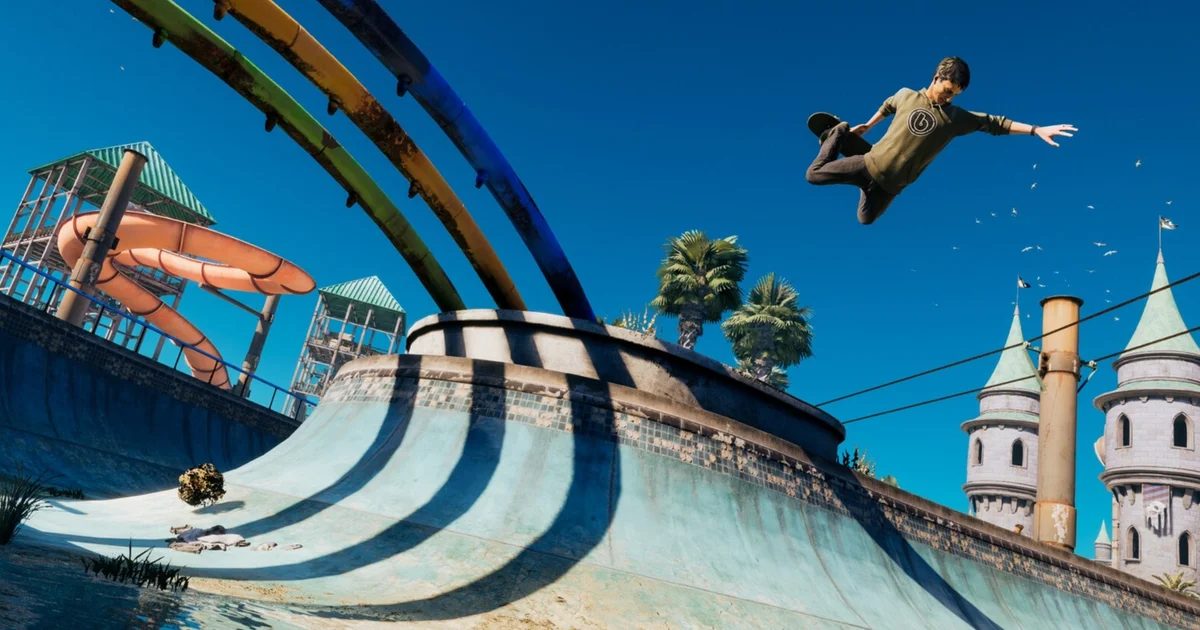
But what about Waterpark? I genuinely think it’s something special—almost a masterpiece. For a few reasons. First, you start high above the action, which recalls many of the best Tony Hawk levels, and then you slide down a run of waterslides into the main area. Second, sure, it’s a waterpark—but in true Tony Hawk fashion, it’s empty, and by the time you arrive it’s already starting to look worn down. Paint peeling. Wires sparking. Plumbing that’s on its last legs. I’ve always felt that part of Tony Hawk’s character belongs in places like Margate, and Waterpark perfectly fits that idea. (No insult intended at all—I genuinely like Margate, and good luck finding a gallery with stronger programming than the Turner Contemporary.)
Thirdly, it’s simply brimming with imagination. Around the edges of the map you’ll find separate slides, each one packed with its own little twist, but the whole thing still feels surprisingly unified—every route eventually steers you back toward the middle. It’s much like following the slices of an orange: no matter how far you wander out, you’ll soon land in a fresh, interesting spot. Somewhere fun!
That, in turn, reinforces the kind of satisfying links this franchise is so good at—one grind rail flowing directly into the next and giving you the feeling that you’ve skipped over a whole stretch of impossible-looking space. It’s not only generous and chaotic; there’s also real depth at its core. Waterpark, I can assure you, is genuinely superb. And it feels completely at home. It’s as if it was written in the same style as the levels standing alongside it.
Beyond that, you get multiplayer, endgame challenges, park-building tools, and a steady supply of unlockables. It’s a substantial package, and I can definitely picture coming back to it now and then for a long time. So! It’s a somewhat unusual collection when you compare it to the straightforward approach of 1 + 2. Throughout, you’ll notice odd gaps and unexpected decisions. Still, there are also fresh additions and choices that—at least for me—end up feeling very reasonable. Remaster? Overhaul? Something even more ambitious? This one happily lets you bounce between all three ideas.
Code for Tony Hawk’s Pro Skater 3 + 4 was supplied for this review by Activision.