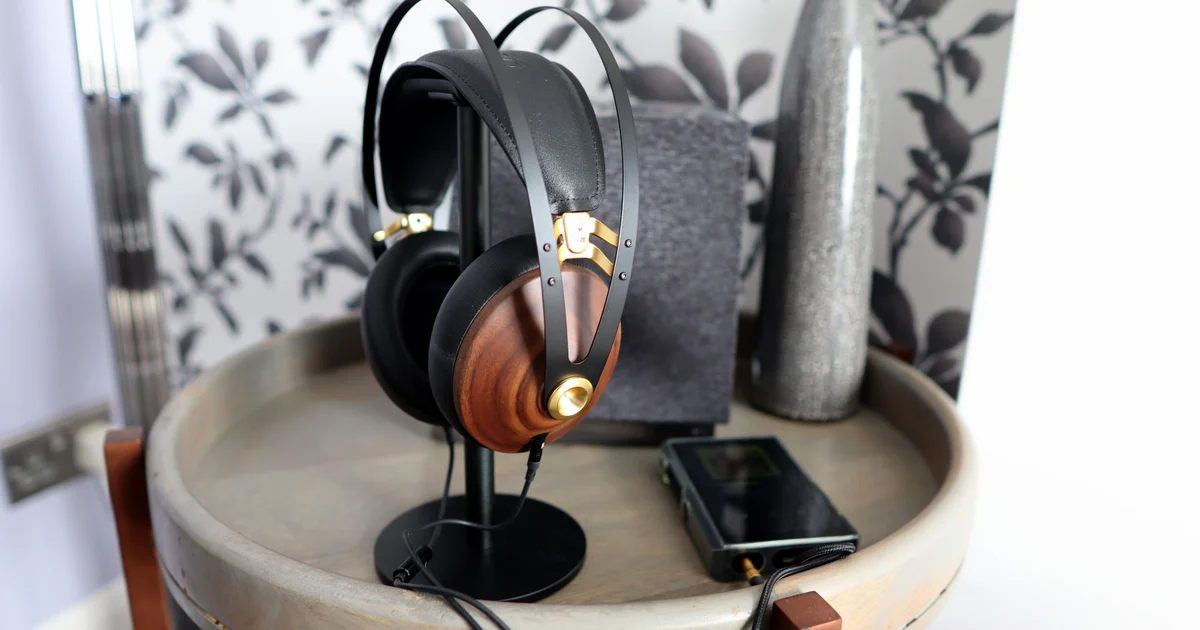
Audiophile headphones don’t have to carry a sky-high price tag, as Meze proved with the 99 Neos we reviewed last year. The 99 Classics are here now, bringing a step up in build materials—walnut earcups and a spring steel frame—plus a gently revised sound character for a higher £269/$309.
The walnut earcups set this version apart from the Neo’s textured black look, and Meze points out that every pair shows its own distinctive wood grain. The process of shaping the walnut and applying its finish takes 45 days, which is especially notable when you consider the asking price. It’s also worth mentioning that the headphones can be dismantled into their individual parts, making them far easier to repair than a typical headset.
The Neos changed my mind about suspension headbands, since I’d never been fully sold on them. Still, once you pair the soft leatherette headband with the lighter metal frame, the result is impressively comfortable. They contour well to my head, with plenty of breathing room thanks to the deep, well-padded earcups. That extra depth also helps the 99 Classics deliver excellent passive noise reduction, which makes them a strong option for travel—particularly if you’re happy to use a wired connection—and for long listening sessions. During my time with them, I rarely felt the need to take them off.

Meze also nails the smaller touches that elevate the 99 Classics, including the impressive case. Inside, it uses a felt lining, while the outer shell is hard-wearing. The headphones are held securely by a small central pouch that keeps all the cables together, including a shorter standard cable for listening on the go and a longer one for connecting to your home amplifier, streamer, or similar gear. You also get a plane adapter, so you can travel with your own headphones with less hassle when you’re heading somewhere enjoyable.
On the audio side, Meze says the Classics match the Neos. If that’s right, you’re in for a wonderfully warm, inviting sound—the audio equivalent of sitting beside a cozy fire on a cold winter evening, or relaxing on the sofa with a captivating book and a heavy blanket. With the wooden earcups, they may even come across warmer and even more satisfying than the Neos, which I loved for their rich, natural character.
The 99 Classics are also simple to drive, with a 32-ohm impedance that helps them perform well whether you’re listening to a Spotify playlist on your MacBook or on a smartphone through an adapter. Of course, pairing them with a solid DAC like the Chord Mojo 2 or iFi Zen Blue 3, plus a music source that includes CD-quality files via my Fiio M11S, is where the 99 Classics really start to shine.
There’s more bass here than you might expect from headphones I just described as “warm and lovely,” yet they still dip into pleasantly low frequencies, adding weight to tracks when it suits the recording. My usual run of hard rock picks—such as “The Invisible Man” by Marillion and the “Meanwhile” section of Steven Wilson’s “Objects Outlive Us”—came through with plenty of mood. Meanwhile, the deep synth bass in Earth, Wind & Fire’s “Let’s Groove” was especially satisfying, with real punch.
Jack Johnson’s “Washing Dishes” is a straight-ahead track that puts his smooth vocals and acoustic guitar front and center. Percussion and drums sit underneath, and the 99 Classics reproduce it with clear, thoughtful detail and the natural charm I mentioned earlier. When the music gets busier with the Bee Gees’ “Nights on Broadway,” the vocals pull back into the mix, framed by the clavichord and strong drumming—yet the overall picture of the Gibb brothers’ excellent harmonies stays full-bodied and engaging.
The Strokes’ “Heart in a Cage” features persistent cymbals across most of the song, and they come across smoothly, avoiding the kind of fatigue that can build during longer sessions. They’re crisp and lively, though they don’t reach the same level of absolute precision—or occasional edge—found in more analytical alternatives. The same idea applies to the competing sounds heard in Steely Dan’s “Do It Again” intro: the 99 Classics remain revealing and upfront without coming off overly forceful.
The 99 Classics also deliver a decent soundstage, with good width for a closed-back set, demonstrated on a live recording of Paul Weller’s “Hung Up,” where you can hear real reverb in the room, along with my usual testing playlist that includes Rush’s “2112.” In particular, you can follow everything from the slower, limited guitar lines and ambient water textures in the track’s “Discovery” section, through to the intermittent vocals and tougher rock moments as it moves into “Presentation” and “Oracle: The Dream.” The result is a strong sense of immersion, even if it isn’t as spacious as similarly priced open-back models such as the Grado SR325x.
Their excellent placement and imaging worked well across different activities, whether I was racing in Forza Horizon 5, Assetto Corsa Competitzione, or playing Counter Strike 2, where I appreciated being able to spot enemies effectively. The bold low-end also boosts explosions, and the rough texture of gunfire adds to a convincing atmosphere, complemented by throaty engine sounds during those driving sessions. Even though gaming isn’t the main goal for these headphones, the 99 Classics still hold their own. Still, some people may prefer purpose-built gaming headsets for that specific functionality—though with the first-party Meze Boom Mic accessory, you can turn these headphones into a genuine gaming setup.
It was probably inevitable that I’d sing the praises of the Meze 99 Classics, largely because their design is so striking. I know the £269/$309 asking price is a serious investment, comparable to pricier reference headphones from Sennheiser and others. Even so, the 99 Classics arguably live up to—and in some ways surpass—expectations, thanks to the craftsmanship and careful attention that went into them, along with a comfortable fit and an engaging, musical sound.
If you’d rather spend less, I’d also point you toward the £189/$199 99 Neos. They’re more budget-friendly, yet they deliver the same essential listening experience as the Classics, with a sound profile that’s nearly indistinguishable and a similarly comfortable fit—just without the walnut housings. Either choice should leave you very satisfied.