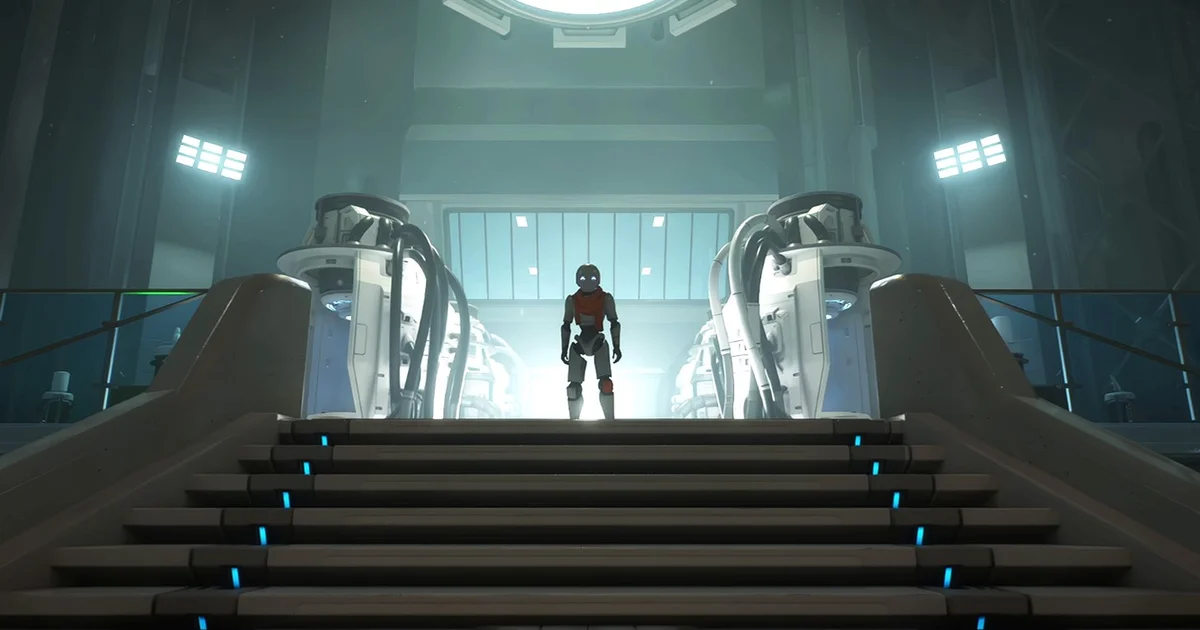
That’s a truly distinctive premise: a survival title set in an ocean-covered world that may still feel Earthlike, where you take control of a robot known as a Caretaker. Your job is to grow humans inside pods, fill them with memories, and then launch them into space—where they’re expected to prosper. Yet something about the storyline remains oddly unclear. As the game’s name implies, you’re the last Caretaker, brought back online at a time when it’s hard to even say what “existence” means, if it exists at all. The aquatic complex you ‘wake up’ in has been thrown into chaos, and while you restore power, repair what you can, and push through the surrounding waters, a broader mystery starts to surface: what’s really going on here?
Channel37, a comparatively fresh seven-person studio, is behind the game, made up of former RedLynx creators. The team includes Antti Ilvessuo, the original mind behind Trials’ motorbike game. If you’ve seen him before, you might remember Ilvessuo from Ubisoft’s E3 2018 conference, where he showed up in a white jumpsuit and sprinted onto the stage to smash the podium as part of a carefully staged moment. He certainly leaves an impression. It was Ilvessuo who introduced me to The Last Caretaker during a video call, with former Rooster Teeth presenter Jack Pattillo demonstrating the game.
What’s exciting is that The Last Caretaker doesn’t really resemble anything I’ve played before. Even though it draws on familiar ideas—so you’ll likely recognize a few touches—it stitches them together in a more interesting way. At first, for example, it comes across like a first-person puzzle experience. You end up deep inside a facility with no power, and you need to work out how to bring it back bit by bit. Unplugged cords show up almost immediately and keep reappearing; they look less like typical cables and more like the hoses firefighters use. Unfortunately, you can’t simply plug them in because they’re too short. So the early objective is straightforward: locate extra cables and connect them to restore electricity.
Once the doors have power, you can access them and keep exploring the facility. As you go deeper, you’ll come across robots that resemble you—damaged, half-abandoned, and scattered through the corridors. The atmosphere becomes genuinely unsettling. You’ll also find additional power outlets that let you recharge your energy-like health by connecting through what seems to be your belly button (at least, that’s how it looks) and save your progress. At the moment, The Last Caretaker is built as a single-player experience. While Ilvessuo has mentioned the possibility of online elements, he frames it as something for a later phase.
After some exploring, you’ll reach a space you’ll return to again and again during the campaign: a hangar that contains a boat. Your boat, in fact. From there, you’ll pilot it across open water while searching for salvage and answers. You’ll also find a computer terminal that dishes out quests and background lore, and below that area sits a warehouse packed with machines designed to manufacture gear for you.

All of that depends on power and connections as well—another recurring idea—so it won’t be long before you open the hangar doors and see what awaits. This is where The Last Caretaker’s open-world component kicks in. Out around you, it looks like an enormous stretch of sea, and you can set sail in any direction to explore. The boat itself moves at a deliberate, unhurried pace, which gives you time to think about what’s happening in the world—or to talk with your viewers if you’re streaming, a point Ilvessuo emphasizes (and one that makes sense). If you want faster travel, though, you can upgrade the boat’s speed.
Still, life out on the open sea isn’t completely safe. You’ll face hazards like mechanical sharks and explosive buoys or mines, meaning that each trip comes with real risk. On the bright side, you have access to a range of weapons, including a standout set of firearms capable of firing bolts, electricity, or flames. These tools are modular, so you can adjust them in a seemingly real-time way—resulting in gameplay that clearly feels like a shooter. There’s also a memorable beat where Pattillo has the character examine the gun, and multiple modular pop-up panels appear. The presentation tends to stay sleek like this: little conventional UI, with much of the information delivered dynamically inside the game.
By the way, combat wasn’t much of a factor in the demo I saw—the small oil rig area we reached was empty and mainly just needed power restored. However, the game’s opening trailer makes it very clear that fighting will be a core part of the experience. In that trailer, flamethrowers blast flames, electro-guns fire bolts, and spherical robots equipped with armed attachments defend certain locations. You can also see a bulbous, plant-like plague spreading across metal surfaces, which underlines the idea that “something has gone terribly wrong.” In fact, during the demo I noticed some hostile black blob-like creatures moving around, reinforcing the sense that things are badly out of order.
As you move forward, you’ll uncover the larger facility built for your work—the place where you cultivate humans in pods, or “spark life,” as the game describes it. We only skim over that in our demo, but finding memory-filled objects to seed these “sparks” with experiences, along with working through their DNA refinement, appears to be central to the gameplay. And once you complete a set—almost like finishing a carton of eggs—you’ll need to locate a launchpad with a rocket to send them off into space. Then… you’ll have to wait and see what happens next.
It’s a fascinating combination, and based on what’s shown in the debut trailer, it’s handled with impressive polish. The world is packed with believable details, and it’s genuinely engaging to watch the sea roll and shift as you travel through it. I haven’t seen water that realistic since Sea of Thieves. I’m also glad to hear Ilvessuo stress how important storytelling is here, weaving together the separate threads of mystery that run throughout it—suggesting a world full of life rather than one that feels abandoned. Add that to the hands-on crafting features, and you start to see a promising overall equation. Most importantly, it feels distinct. I’m looking forward to summer, when I can finally play it properly during early access.