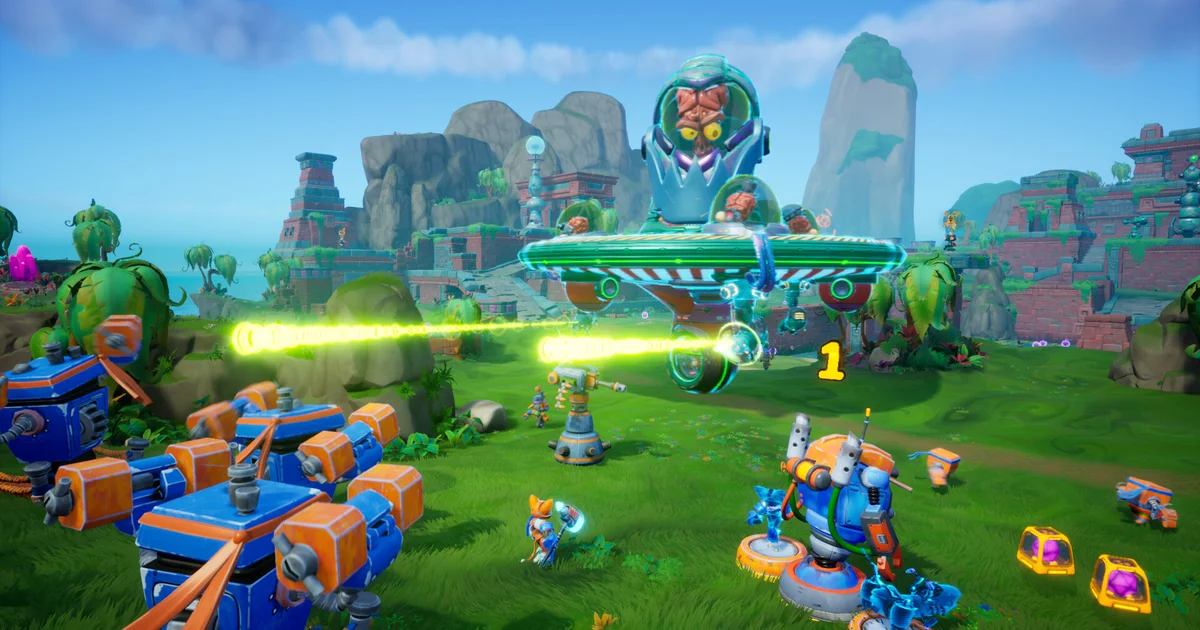
“We still haven’t quite managed to get a proper foothold,” says Jullian Gollop, the creator of the original X-COM (before Firaxis revived it as XCOM (no hyphen) in 2012). He and I are currently holding our ground against waves of disembodied, brain-in-a-jar extraterrestrials in cooperative sessions for his latest project, Chip ‘n Clawz vs. The Brainioids — and this is the second time he’s brought up that foothold idea, which makes me feel the slightest trace of nerves in his delivery.
“One of our structures is under assault!” shouts the unseen voice of Clawz, doing nothing to ease the moment. At this point, I decide not to admit that, despite my claims of real strategic skill, I genuinely can’t recall, exactly, what a foothold means (especially since we’re also crossing a bridge on the move, which throws things off a bit). I set up a few turrets and keep pushing through the fight, counting down the seconds with a growing sense of urgency. After a couple more rounds of zapping and battle cries — during which I can’t help feeling like I’m sharing the battlefield with strategy-and-tactics legends, a seriously sharp mind, while I’m clearly acting the part of a total novice — the panic fades. “We’ve now established a solid foothold,” Gollop tells me, almost as if he’s talking to himself, completely absorbed in the tactics. What a relief!
Chip ‘n Clawz vs. The Brainioids mixes real-time action with strategy in a way that brings Pikmin or Orcs Must Die! to mind. You roam around at ground level and fight, but you’re also building structures and fortifications, collecting resources, and giving orders. Gollop points to these comparisons directly. “Some of the levels lean a bit more Pikmin-like, because you use your minions to handle puzzles and complete objectives — though I’ll admit they’re not quite as sharp as Pikmin.”
Styled like the nostalgic 3D platformers from the early 2000s, Chip ‘n Clawz’s stages — at least the initial ones I played — usually have you moving across a map to grab small items while setting up resource-producing outposts. Those outposts create miner units that gradually chip away at Brainium supplies. You then use that Brainium to construct additional buildings, which in turn produce either melee or ranged troops. Each soldier type unlocks during a level when you locate and hack a small podium somewhere on the map. From there, you command your growing squad to edge forward against waves of enemies that steadily become tougher. There’s also a neat, lightweight rock-paper-scissors logic underpinning the matchups, very much in line with classic RTS play: turrets are strong against airborne targets, artillery does well versus turrets, and flying units have the advantage over artillery. Plus, there’s a practical tactical overlay that’s friendly on controllers, letting you issue commands to coordinated groups.

This feels like a clear departure from Gollop’s usual lane. Instead of turn-based tactical games like Phoenix Point, which map more directly onto the modern XCOM formula (a series he jokingly said he’d gladly revisit if Firaxis ever contacted him), he’s aiming somewhere else. He gives a few reasons for the change. One is to design a game he can actually enjoy with his kids — and the co-op mode is especially important. He also points to Nintendo’s Pikmin, along with Kirby and the Forgotten Lands, as titles that sparked ideas for him in different ways, even if the co-op there can be “a bit dull.” Here, the co-op is handled well: you can jump in with a friend by sharing a code, and there are helpful touches like one-tap resource sharing, letting you pass Brainium over quickly for faster building or repairs.
Still, the second motivation feels much wider in scope and seems to aim at something bigger. As he puts it, he wants to “innovate within the real-time strategy genre.” “I believe there has been a challenge in genuinely innovating in this arena. So you could say Chip ‘n Clawz is my modest attempt to try something a bit different.”
The obstacle, Gollop explains, comes down to how strategy games are competing for attention: “You’re competing with nostalgia, because you may recall how dominant RTS games were in the late 90s and early 2000s — they represented the leading gaming genre globally, particularly on PC. And how they declined in popularity, with MOBAs likely having played a role in their downfall.”
I can point to a few cases where innovation has shown up, even if the results weren’t uniform. Subset Games’ Into the Breach, for instance, or last year’s excellent Tactical Breach Wizards from Suspicious Developments, offer clear examples of turn-based creativity. By contrast, Relic’s attempt to refresh the traditional RTS template with the MOBA-flavored Dawn of War 3 didn’t really click with as many players.
“I appreciate those games,” he tells me, “but they also shifted in another direction. Both Into the Breach and Tactical Breach Wizards operate like puzzle games, where the difficulty comes from the many possible combinations of builds — but they’re still puzzle games, because you have to figure them out in some way.” About DoW 3, he adds, “they attempted to do something unique, but their audience didn’t seem willing to follow them in that direction.”
He admits it’s “challenging — extremely challenging — to innovate in that way. Because, as I mentioned, the long shadow of classic RTS will always hang over everything. The same goes for turn-based games too — I mean, can Civilization ever fully recapture its old brilliance? Maybe not.”
Even so, it’s worth stressing the “humble” character he touched on earlier. I don’t think he’d mind me saying that Chip ‘n Clawz isn’t a blockbuster backed by a massive development team or big marketing resources, designed to reshape a genre all by itself. It’s a more intimate, family-friendly release with a few interesting ideas — the standout being how it combines genuine base-building, a feature many classic RTS fans love, with on-the-ground third-person action.
Of course, the game will face its own difficulties, largely tied to how its style and tone come across as fairly youth-oriented. The familiar buddy-platformer humor and pun-heavy comedy may not line up as smoothly with the deeper strategic elements (Gollop and I actually didn’t make it through a defensive horde mode on Hard difficulty — admittedly, I was the problem, me — but the issue still stands). I also worry that kids might not be drawn to a setup like this unless they already feel comfortable with platform games they enjoy, like Roblox.
Still, the drive to create something new remains, and that’s a commendable ambition. “You could say Chip ‘n Clawz is an endeavor to seamlessly integrate strategy into a more third-person, action-style game that people are used to.” Even if it only achieves that goal in part, it’s another worthwhile effort — and as Gollop notes, strategy needs all the fresh ideas it can get.