The first half of Silent Hill f drags a little and it’s downright frustrating, but a striking, dreamlike second half more than makes up for it—and genuinely redeems that opening grind.
If you take nothing else from what I’m about to say, remember these three words: stick with it.
If you’d asked me to judge Silent Hill f halfway through, I probably would have spoken more softly and urged you to wait for a price drop. The constant whiny, teen-angst energy was wearing me down, and it dragged my thoughts back to Silent Hill’s free teaser, The Short Message. I’m not keen on the combat. Over the last hour alone, I’ve been stuck in what felt like Inventory Management Sim, spent an embarrassing amount of time wandering around and getting turned about in a field, and I still can’t tell what on earth is going on. Even the (rather humiliating) time I’ve spent over the years wandering through Silent Hill’s foggy streets doesn’t really help me make sense of things here. In fact, without Akira Yamaoka’s score—which feels less like the usual Silent Hill style than anything I’ve heard before—I wouldn’t have been convinced Silent Hill f even belonged to the franchise. Which is pretty strange. You know. For a Silent Hill game.
That said, I’m not saying any of this to argue against it. I’m not the kind of fan who only wants Silent Hill 2 over and over again (even if I have to admit the Remake was incredible), and I also don’t automatically dismiss everything a Western studio puts out. But I also can’t pretend that every title wearing the Silent Hill name is automatically great (sorry, Ascension). So I went into Silent Hill f carefully—though still with hope.
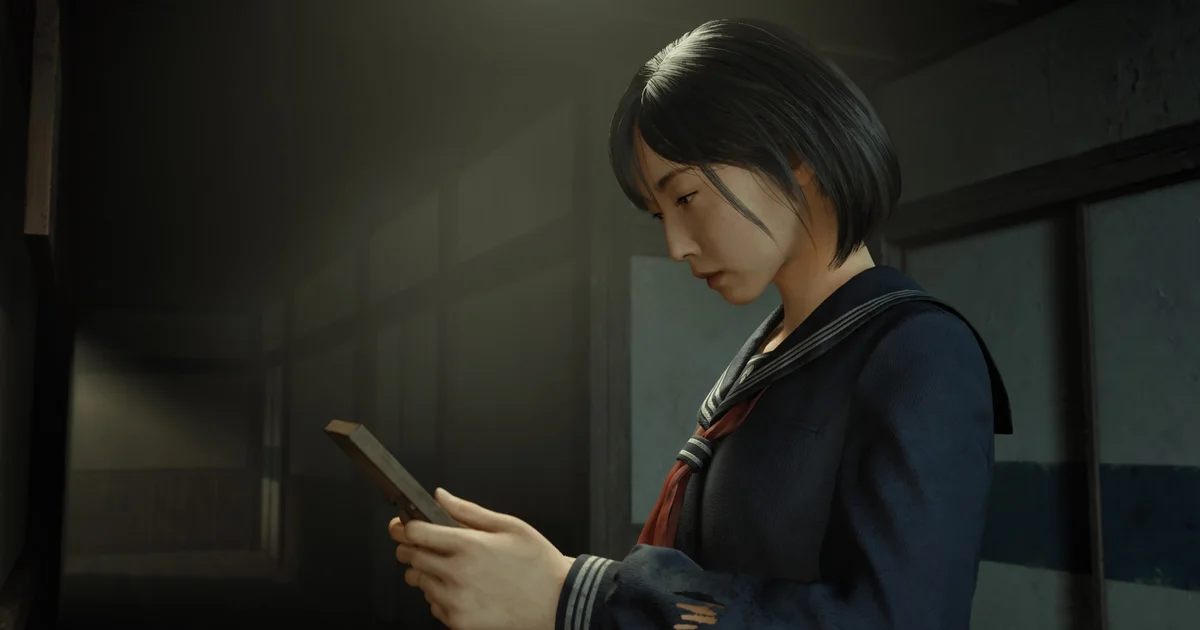
But first, some context! Silent Hill f drops you into the role of teenager Hinako. For reasons that may or may not be explained later, her small town, Ebisugaoka, is suddenly swallowed by an uncanny fog. The walkways swell up and blister with strange crimson plants, while sinewy strands hang from rooftops like grim decorations. Scattered around are unrecognizable, fleshy clumps—messy, bloody, and treated as if they’d been tossed aside carelessly by a careless butcher under a watchful sky. Still, it’s the flowers you really need to watch. One wrong step, and something will catch your ankle, turning you into plant food that triggers trypophobia before you even realize what’s happening.
Even so, none of that is as unsettling as the swollen corpses, twisted puppets, and a whole lot more waiting for you across the village. It’s difficult to tell what’s more dangerous for Hinako: the deadly things living inside the town, or the everyday social pressure of being a teenage girl in Japan in the 1960s.
But those opening hours? Wow. Everyone keeps acting in ways that feel downright bizarre. The dialogue—teenage and awkward—doesn’t land convincingly, and I can’t understand why Hinako and her friends don’t stick close to each other to avoid getting separated in the fog. I somehow managed to go in with no spoilers at all, which may mean I wasn’t prepared—at least not as much as others—for the unexpected directions NeoBards takes from traditional Silent Hill patterns. Even the Otherworld manages to feel different in a way I didn’t anticipate. Again, unusual. Because if it doesn’t look like a Silent Hill game and it doesn’t play like one, and only occasionally sounds like a Silent Hill game, then what makes it one?
And then, without warning, everything clicked.

Not the combat, though. I still find it off-putting. You may have heard people compare it to Soulslike games, and while that comparison comes up, it’s not quite fair. Across the game, you’re swinging a pipe, a bat, or a sledgehammer at a snail’s pace—even if you commit to the faster-looking light strikes. The more you swing, the quicker you’ll drain your disappointingly small stamina meter. And the more you lean into your focus—exactly like the game promises, by powering up a focused hit—the faster everything tips toward madness. It’s pretty familiar, by-the-numbers design, and I did adapt by setting the recommended Story difficulty, but I still didn’t really enjoy it. By the time I finished, I felt the problem might be less about the underlying combat concept and more about how the weapons wear down.
I’ve spent a big chunk of my life playing horror games, so I understand that push-and-pull between being scared and staying calm—something that usually means rationing healing items and weapons, plus relying on frantic “Run away! Run away!” style survival moves. When you’re fighting enemies out in the open, that approach works well enough. Indoors, though—or in tight alleyways—it becomes much more difficult to move with confidence. The more you battle, the faster you burn through your thin supply of weapons (you can carry only three at a time, plus a couple of toolkits to repair them to some extent). That left me staring at a frustrating stretch of about fifteen minutes where I had zero weapons whatsoever, meaning I had absolutely no way to protect myself except dodging and praying I could make it out alive. Hinako wouldn’t even raise her fist.
Your level of frustration might depend on how much time you’ve put into Soulslike titles, but for me, SHf’s fighting felt less like a challenge and more like clumsy motion. Attacks sometimes went straight through enemies without any effect, dodges didn’t respond properly, and my stamina never seemed to last long enough—even late in the game. And when she comes out of a dodge, Hinako just stands there until you remind her she should be sprinting to save herself. In practice, that’s the opposite of helpful, and it often leaves you exposed to a devastating result.
The biggest drawback, though, is this: as someone who has long supported Silent Hill, it’s unusually hard to settle into any truly engaging exploration
across the world. Between clunky fights, weapons that steadily fall apart, and brutal enemies, the task becomes especially tough. Still, about halfway through, you’ll obtain an Otherworldly, well, boost (in a way). Even if I could explain it, I wouldn’t—but I will say it adds an unexpected twist to combat that caught me off guard in the best way. We’ll leave it at that.
As for the enemy you’ll be dealing with more than anything else—one you can never fully outmaneuver? Your inventory.
When you come across a shrine, you’re offered three choices: save, enshrine, and pray. The final two options appear to let you improve your health, stamina, and sanity meters, but they only work if you give up some of the small pile of treasures you’ve collected as “offerings,” or if you manage to find one of the rare “emas” tucked away across the game. At first, I assumed I’d never gather enough items to surrender in order to grow my Faith tally (the closest thing the game has to a currency). Later, even after I had amassed plenty of Faith, I couldn’t upgrade anything—so I must have missed a few emas. That was incredibly frustrating.
You can also pick up passive perks in the form of Omanoris as you play, though I don’t have much more to say there since I barely bothered with them after I found one that only slightly increased Hinako’s stamina.
I don’t think I’d worry as much about Hinako’s limited carry space if we were allowed to decide what to keep versus what to discard. For example, if you trade out a bandage to free room for a first aid kit, the bandage is gone for good. And yes, even though some items stack, many don’t—so it’s even more irritating that you also need to make room in your tight inventory for the offerings mentioned earlier.
I can’t even properly list what all of them do. You’ll find items that restore health, sanity, and stamina in different ways and amounts. Some are straightforward—bandages, first aid kits, and the like—while others are harder to keep track of. Divine Water (which fully restores Max Sanity and temporarily slows Sanity drain), Ramune (which restores Max Sanity by a large amount), and Arare (which slightly revives Health, with the benefit growing the more you use it) are particularly easy to lose track of, especially when you’re in a rush. Since your pop-up inventory only shows a small icon, they can be maddening.
Still, there I was, jaw clenched, smashing a bulbous…. thing—honestly, I can barely define it—until it was dead with a crowbar, fully committed to seeing it through to the finish. I had to keep going. Hinako’s story shifted hard the moment I finally understood what was happening inside her Otherworld, and sometime in the middle of this strange journey, I realized how wrong I’d been to dismiss it as merely a teen melodrama with a Silent Hill logo stuck on top.
In fact, SHf deliberately sidesteps a lot of what typically defines Silent Hill entries—no flashlight, no radio static, and not even a speck of rust—but that doesn’t mean it stumbles. The atmosphere stays tight and immersive. The monsters are every bit as enjoyable as they are repulsive. Even the background sound design is genuinely unsettling. It’s not the same as Silent Hill 2 Remake, of course, and I wouldn’t describe it in exactly those terms—but be assured, it’s just as grim and eerie.
It’s almost as though the back half of the game is the payoff for getting through the first part—twisting into such deeply sinister territory that I couldn’t have predicted it, even with the worst in mind.
Hinako’s Otherworld might not match any Otherworld we’ve seen before, with rusty fences and blood-smeared grates replaced by shadowy temples and shrines, yet it carries the same sense of dread. Step by step and methodically, you’ll uncover what brought Hinako here, and through multiple Otherworldly visits (fortunate enough that they don’t involve weapons breaking down—huzzah!) you’ll learn details about her you probably wouldn’t expect, along with even more about what she’s willing to give up… both in a literal sense and in the symbolic one. While other Silent Hill games often present a Western take on horror, SHf embraces its roots in ways I couldn’t easily foresee. And it’s specifically in Silent Hill f’s hard-to-say—and often hard-to-describe—elements that writer Ryukishi07’s unsettling storytelling really stands out.
So, while it doesn’t fix the awkward combat, it does make that early grind feel worth enduring.
Also, it’s a visually pleasing world when
It won’t give you a scare right away—there’s plenty of detail and plenty of curiosity in every corner. Be prepared for a fair amount of backtracking, which only worsens that fairly tight inventory limitation: more than once I cleared out an area, tossed an item to free up space, fully convinced I’d never need it again, only to be back about two hours later wishing I had it in hand. Still, you’ll get to roam through a range of spots around Ebisugaoka, and while leaving the main route often turns up disappointingly little, exploring can still pay off.
In keeping with its predecessors, Silent Hill f delivers its information in a deliberately subtle way, so you’ll want to spend time hunting down discarded notes and
syncing up with Hinako’s diary while you move through town.
And that brings us back to Hinako’s diary—it’s an essential tool for working through SHf’s puzzles. I played on Hard, the option recommended for people chasing a “classic Silent Hill experience,” and I had almost no truly scary moments early on (except for one puzzling sequence with a crow—if you know, you know). The final mental challenge also proved pretty manageable, largely because the game lays out extensive notes that Hinako writes as you go. That said, the setting-based puzzles demanded more work than the main run—figuring out how to reach a certain area, complete tasks there, and then continue somewhere else—yet they still don’t feel overly punishing. Overall, it’s likely one of the more approachable entries of Silent Hill in this respect.
That said, whether Silent Hill f succeeds or falls apart won’t hinge on its puzzles—it’ll come down to the fighting. I’m saying this as someone with average hand-eye coordination, not much self-control when it comes to impulses, and a strong dislike for boss fights, so if I can handle it, longtime series fans should be able to manage it too, even with the unexpected lack of an easy mode. For a few different reasons, the story—plus several of its strikingly cinematic set pieces—also asks for a fairly tough stomach. Silent Hill has never avoided adult, layered themes, so it’s worth paying attention to the content warning shown at startup. (That warning notes representations of gender discrimination, child abuse, bullying, drug-induced hallucinations, torture, and graphic violence—and yes, it doesn’t hold back on any of it—plus trypophobia, which isn’t mentioned in the content warning but will absolutely be a deal-breaker for some. Take care before going in.)
I still have plenty more I could share with you. Honestly, there’s a lot, though I’m not sure you’d believe half of what I ran into during the twelve-plus hours it took me to get to the ending. I’d like to talk about the enemies, the Otherworld, and the different endings. Even if Konami’s tight embargo didn’t stop me from revealing more, I wouldn’t want to ruin the surprises. You really should see Silent Hill f’s final stretch for yourself.
With that, I’ll wrap things up the same way I started—by leaving you with three final words to think about: Don’t read anymore. If this has sparked your curiosity, close this tab, avoid social media, and steer clear of extra reviews or streams so you can experience Silent Hill f firsthand. You’ll either feel glad you did, or annoyed about it, but no matter what, you’re in for a genuinely unforgettable time.
A copy of Silent Hill f was supplied for this review by Konami.