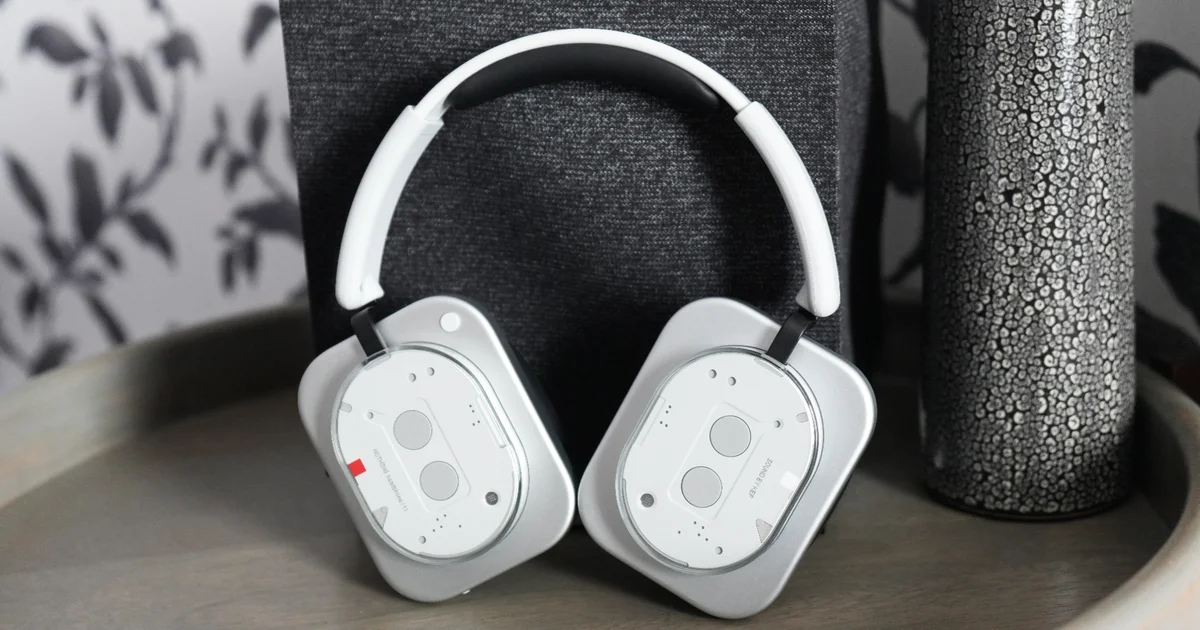
The Nothing Headphone (1) signals the trendy smartphone maker’s first step into the crowded, competitive world of wireless noise-cancelling headphones. With a price tag of £244/$299, it goes straight head-to-head with a category that’s been dominated for years by names like Sony and Bose. It also arrives on the back of other challengers we’ve seen, including the Cambridge Audio Melomania P100, all trying to shake up the established order—with mixed results.
Nothing has built a reputation around its unusual way of doing things, and the Headphone (1) reflects that clearly. I’ve been testing them for a couple of months to see whether they make a lasting impression.
Right from the start, I realize that some people may not love the look of these headphones, but I’ll be honest: I find them great. They feature an appealing design that matches Nothing’s signature blend of contemporary styling and industrial flair.

Build quality is just as solid. The ear cups combine aluminum with large, rounded plastic elements, plus a few rubberized sections that add extra resilience. I’ve never owned a headphone pair that drew this much attention or sparked so many questions from passersby—especially in a tech-heavy setting like Gamescom. If Nothing’s aim was to get people talking, it has absolutely achieved that.
The clamping feel of the Nothing Headphone (1) is also spot on—firm enough to create a secure fit and good seal for the ANC, yet gentle enough that you don’t end up with ear fatigue during longer sessions. The ear cups are deep and well-padded, which helps with comfort.
They lay flat in their relatively slim, minimalist carrying case, though I did wonder about leaving them on your neck for long stretches while stored that way, since the corners of the ear cups appear likely to rub against each other.
One small annoyance is that they sit the wrong way around in their case. After you take them out, the right side of the headphones ends up on the left, and the left side ends up on the right—so you need to flip them every time you want to use them. Maybe I’m being overly picky, but it feels like something that could’ve been caught easily.
Another odd detail is where the pairing button is placed inside the right ear cup. Compared with the otherwise satisfying controls, it feels a bit fiddly. The right ear cup also has a proper volume dial (even if it moves side to side), along with a rocker switch that lets you skip tracks or scrub through content when you press and hold.
The outer face of the right ear cup includes a button you can customize through the Nothing X app for different tasks—such as triggering voice assistants, switching between ANC options, or turning on spatial audio. You can set two different functions for that button, one for a tap and one for a press-and-hold.
Overall, the Nothing X app does a solid job. It offers the usual features for adjusting ANC levels, fine-tuning EQ, and handling spatial audio. EQ includes simple presets such as ‘More Bass’ and ‘Vocals’, and it also includes an 8-band custom EQ for more exact tweaking. You can also boost certain elements like bass on its own, and there’s a low-latency gaming mode for mobile use. Spatial audio uses head tracking, though the effect felt a little forced with the music I tested; I expect it will work better for films and games. It’s still a shame the app doesn’t include the ear-tuning feature found in Nothing’s in-ear models, which is designed to shape a more personal sound profile for your ears.
The Headphone (1) includes active noise cancellation and, for the most part, deals with voices and nearby ambient sound quite effectively. That said, some higher-pitched sounds still find their way through when you’re not playing music. I frequently use my older Bose NC700s as a yardstick, because they create a near-silent bubble—something the Headphone (1) doesn’t quite match. While the ANC is certainly good, it doesn’t quite reach category-leading levels. I also found the transparency mode to come across as slightly artificial when presenting outside audio.
Bluetooth 5.3 handles the connection, and there’s a respectable range of supported codecs. The familiar lineup is here, including SBC and AAC, plus LDAC for wireless hi-res audio on compatible devices. Pairing via Bluetooth worked smoothly whether I was using my Samsung Galaxy S21 Ultra for casual Spotify listening or my FiiO M11S DAP for more careful audio checks. The Headphone (1) can also connect using the included USB-C cable and a 3.5mm jack for wired use.
The Headphone (1) also performs well in terms of battery life. Nothing says you can get up to 35 hours with ANC turned on, and as much as 80 hours without it. In practice, my tests went beyond that: regular listening averaged closer to 40 hours with ANC enabled—so you can typically recharge about once per week, which feels perfectly practical.
Next up is the most important part: sound quality. Seeing the name of British audio specialist KEF printed on the side of the ear cup—crediting them for helping tune the 40mm drivers—raised my expectations, even though KEF is better known for speakers than headphones. It’s been reported elsewhere that KEF’s involvement was limited to tuning, with all hardware and design choices handled by Nothing alone.
Right out of the box, the Headphone (1) leans toward a darker overall sound. The low end feels full, with good depth and extension, along with a touch of added emphasis. This approach works particularly well with my standard
selection of rock testing tracks, such as Steven Wilson’s “Meanwhile.” I noticed a satisfying sense of weight and depth in his rough-edged vocals, while the bassline stayed firmly in place, with plenty of…
an ample amount of drive behind it.
If you want a touch more momentum, you can raise the Bass Enhancement by a few steps in the Nothing X app—I did this while listening to Daryl Hall & John Oates’ One on One. The change added extra presence where it was most useful, yet it never came across as overly forceful.
The Headphone (1) also impresses with its roomy presentation and accurate left-to-right positioning, which I especially appreciated with live material. For example, on a cut from Hotel Hobbies by Fish from a 1999 live release, you can hear plenty of crowd and applause noise in the background, along with the reverb that follows the song’s opening cymbal passage.
Likewise, the bongos in Earth, Wind & Fire’s September came through at just the right distance on the far right, exactly where you’d expect them. For mobile gaming, the strong low-end emphasis and the sense of space helped make the experience feel more immersive while playing COD Mobile on the Honor Magic V5 or streaming Forza Horizon 5 as I sped through Mexico.
I also found the mid-range refreshingly smooth, with enough breathing room for vocals and instruments to ring out above the punchy low end. That balance felt especially nice with September Grass from James Taylor, highlighting his expressive singing and warm acoustic guitar tone. This section of the sound is genuinely effortless to enjoy.
High frequencies are just as easy to hear, though they lean slightly darker than the usual bright, lively drum work that kicks off Steely Dan’s Do It Again. In a similar vein, the cymbal hits in On The Other Side by The Strokes sounded a bit set back in the overall mix when compared with how prominent the low end and mid-range are.
The Nothing Headphone (1) is an interesting product, as you might expect. Its build and look are outstanding, and it offers a clearly different take from other models I’ve tried in the same price range—comfortable, stylish, and genuinely attractive to look at. At this price, I figured noise cancellation might be a little better and the overall sound might land a bit more evenly. Still, if you’re drawn to punchy bass and a generally energetic default tuning, I think you’ll be pleased. I’ve personally been enjoying them for the past few weeks, and if you can grab them at the discounted rate I recently saw, they’re absolutely worth putting on your shortlist.