After a long wait, EA brings back its classic wheelie-focused game, delivering impressive control and a whole world’s worth of slightly unsettling, endearing personality.
Even though it rarely gets said outright, the new Skate game works much like an MMO at its core. That might not be exactly what many players are looking for right now, which could explain why it’s not stated more openly.
There are reasonable grounds for that hesitation! A stable broadband connection can be a hassle, the free-to-play model can feel uncomfortable, and when it comes to EA, there’s always the uneasy chance that a well-loved world could disappear overnight if share prices take a hit.
Still, Skate’s take on the formula is genuinely fascinating, since MMOs are often structured like RPGs—creating an unusual mental puzzle. It feels close to an apocalypse, or something in that direction. The world has shifted, and you can feel it under your feet. Enemies are pushing forward. And you’re positioned as the lone hero for this world. Yet there’s also a queue. Yes, a queue to rescue the world, meaning you eventually fall into the line of people waiting their turn to be world-saving heroes behind a whole roster of other Chosen Ones.
Put simply, in an MMO, almost everything matters, but very little feels truly urgent. That idea feels strange when you’re dealing with an RPG or any kind of story told through cinema. However, when you translate that mindset into a skating game where nothing is urgent and only the smallest actions count, you end up with something that could be surprisingly engaging. It brings to mind a moment from Below Deck: you notice everyone wearing navy epaulets, whispering anxiously through earpieces about ranks—while the real goal is simply to keep mimosas coming. It’s a bit like Star Trek, with almost no chance of the Romulans ruining the evening.
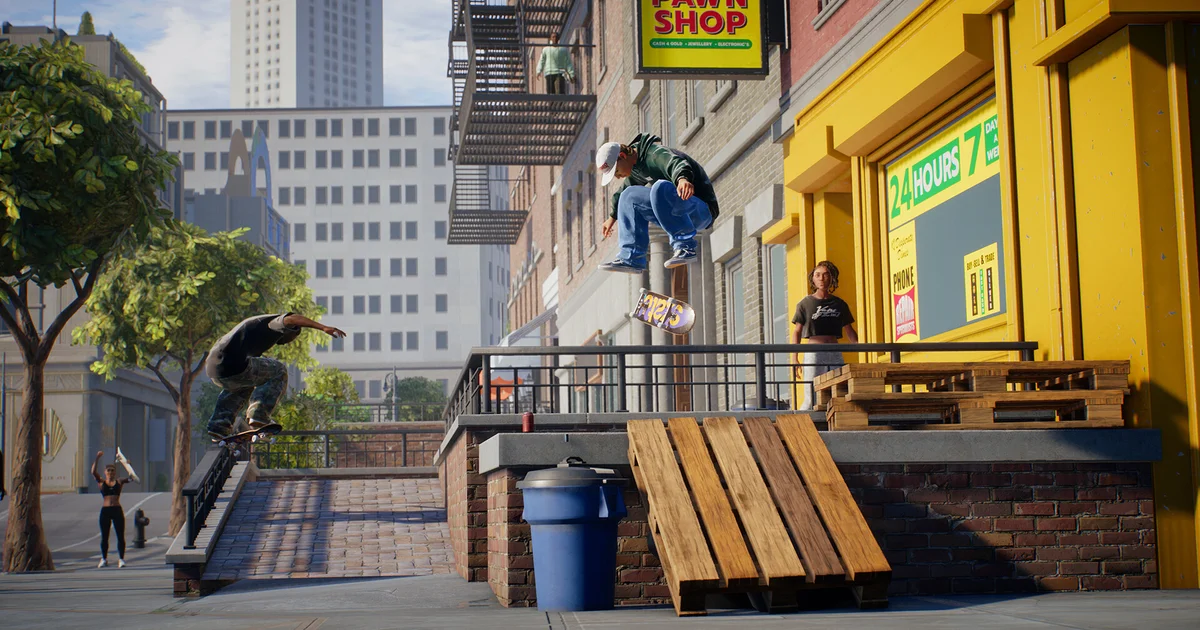
As for what Skate clearly is, it’s the newest chapter in EA’s well-loved skating lineup, and it drops you into a continuously online open world where you’re teamed up with 149 other skaters to explore the city of San Vansterdam, which we’ll get into shortly. San Vansterdam is split into multiple zones, and the Early Access version uses a semi-story framework that guides you through them in order as you uncover what each one holds.
You make progress by taking on missions and joining in with challenges scattered across the map. Many of these tasks roll over through the day, because—and yes, it’s time to say it—this is an MMO. The activities are straightforward, but they still offer multi-step fun. Frequently, you’ll need to gather items in a sequence while landing tricks. Sometimes you’ll jump off a building and perform impressive moves as you come down, only to end up smashing into a dumpster. Other moments call for taking over a spot by chaining tricks, stacking points, and gaining height. Throughout it all, there are strong tools for recording what you do, plus an easy drag-and-drop setup for adding ramps, rails, and more—content other players can also enjoy. You can build your own scene, and possibly entertain those same 149 skaters too. That part is great.

At the heart of it all is the Flick-It system, and I genuinely love it. It comes with a variety of subtleties that shift based on how comfortable you are—or how determined you are to get comfortable—through practice. Essentially, you flick the right joystick to perform tricks. (For context: I’m the kind of person who often needs my hands to be labeled with L and R during swimming lessons, so “right” and “left” can be a little flexible for me.) What stands out is the satisfying responsiveness, plus a hint of physical sensation that makes the on-screen footwork feel truly connected whenever you pull off something impressive. Moves such as grabs and spins blend into Flick-It with impressive smoothness.
It’s a gorgeous feature. To underline just how striking it is—and how well it carries over into this new version—let’s talk about manuals. Manuals—sorry for the loose explanation, since I’m not a real-life skater—are essentially wheelies for a skateboard. You press down on the rear of the board so the front rises. While I’ve never done a manual in person, I always try to land them in skating games, and Skate’s interpretation is outstanding. You just pull back on the right joystick, which is easy enough, but there’s this exact sweet spot you have to hit. Pull it all the way back until the stick clicks against the casing, and you won’t manual. That’s because manualing depends on nuance: it needs quick, delicate input and an awareness of the precise space in the control. For a successful manual, you pull back on the stick and locate the exact gap between its normal resting position and the fully pulled-back point. It reminds me—quietly, in a detail-focused way—of safe-cracking. I really enjoy it. And I’m still a big fan of Flick-It.
Flick-It keeps the game feeling alive and has held my attention even when some challenges don’t offer much variety, and even through a city I like while also admitting it can feel a bit sterile and secure. I’m drawn to San Vansterdam because, at least at the start, it’s clearly inspired by places like Downtown Los Angeles—smooth concrete and stone, a sun-faded horizon, and recognizable nods such as the ARCO Tower. Downtown Los Angeles hits me in a special way because it feels dreamlike when you catch it at the right time: grounded and tangible, yet also fleeting. Of course, it plays very differently from the arenas Tony Hawk would show, and for many people, its distinct vibe may read as a general lack of personality.
Even so, San Vansterdam is a city in name only; in practice, it’s a beautifully designed skating playground packed with lines, ramps, jumps, and grinds that I’m still discovering. I like skating alongside unfamiliar players here—there’s a part of the campaign that encourages teaming up, and it worked wonderfully for me, to the point where I ended up spending hours on it. Still, I also enjoy rolling next to total strangers. I’ll reach one of the custom-built skate parks and watch dozens of people skate, hop, grab, spin, and pull off tricks in patterns I can only imagine. But it leaves me feeling…
I appreciate a lot of things in Skate; honestly, I get the feeling I enjoy it more than many other players do. But
I also get the sense that something is missing. How should I put that? Alright: don’t misunderstand me, but Skate is probably the least fashionable game I’ve played.
And I mean that as a compliment. Skate doesn’t seem to chase trends or force its image. Instead, it tries to feel inviting to a wide range of players. My guess is that it was made by people who’ve lived long enough to recognize how easy it is to miss the important stuff while chasing a shiny idea of “cool.” Still, Skate takes place in a beloved city—almost tailor-made for skating—yet some of the harsher edges are absent, like the fact that it doesn’t really reshape a world that otherwise feels indifferent to you.
From time to time, Skate can feel almost too agreeable. Just make the smallest move on your board, and the voiceover piles on approval, like the sort of upbeat reinforcement you’d expect from a polished, highly “smart” AI. I do appreciate the warmth, but I also know that genuine skating—something I haven’t yet managed to experience—comes with a different feel that isn’t quite captured here.
Or maybe it’s not quite that simple. Skate includes parkour, and it plays out in an awkward, slow-but-still-fun way. You can step off your board and climb up skyscrapers to find stunt spots—or simply track down that ideal place to unwind, such as an abandoned pool drifting in the sky. Since you’re able to dismount, plenty of players have already noticed they can hop, roll, and explore the environment without doing much actual skating.
I’ve run into this a few times, particularly around the game’s early launch period, when getting online could be difficult because of long queues—so I’d spend more time in each session. What I came to see is that players have found a way to work around Skate’s design, much like skaters have always managed to grind rails and turn decorative planters into launch points. That realization, along with the plan to roll out a seasonal update cycle comparable to Fortnite, makes it feel to me like the story of this new Skate is still being written. After all, it’s only in Early Access. For now, I’m going to keep showing up and see how it develops.
A copy of Skate was provided for this early access review by EA.