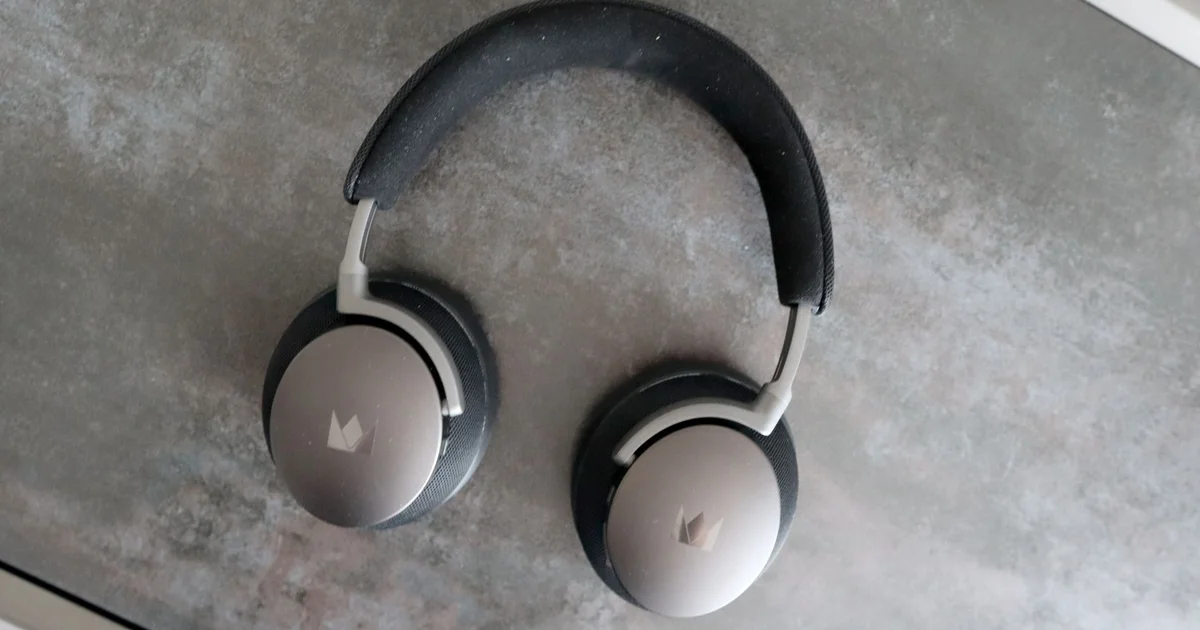
Recently, manufacturers have been rolling out increasingly premium wireless headphones—from established names such as Bowers & Wilkins and Focal (behind the exceptional Bathys) to newer brands like Noble Audio, which sent me the Fokus Apollo model you see here. Priced at £589/$649, these wireless noise-canceling over-ears mark the company’s first step into this category. They also use an unusual hybrid approach, combining classic dynamic drivers with modern planar magnetic ones.
To set the stage, dynamic drivers have been used in headphones and speakers for almost a hundred years. They feature a magnet paired with two wires, mounted inside a paper-cone diaphragm. When an electrical current flows, the paper moves at specific frequencies, producing sound. Planar magnetic headphones work differently: the diaphragm material is suspended between magnetic fields. As a rule of thumb, dynamic drivers shine most with low frequencies, while planar magnetic drivers tend to deliver a more even, accurate sound through the mid-range and treble.
The Fokus Apollo blends both approaches in one pair. It pairs a 14.5mm planar magnetic hybrid driver with a 40mm dynamic driver. The larger dynamic unit handles the bass, while the smaller planar driver is tasked with the mids and highs—aiming to unite the strengths of each design.

With this combination, the results across the whole audio range are genuinely impressive. The treble comes through crisp and lively, with a pleasing sparkle and precise detail in Ralph MacDonald’s Calypso Breakdown, and with sharp cymbal hits in The Strokes’ Heart In A Cage. Even when tracks get busier—like the percussion during the opening of Steely Dan’s Do It Again—the sound stays rich and well resolved, unlike some headphones that tend to struggle there.
The mid-range is lush and handles vocals with an easy, smooth character on songs such as James Taylor’s Caroline I See You and Jack Johnson’s Tape Deck. Even with thicker mixes like Gloria Estefan’s 1-2-3 or Get On Your Feet, vocals remain clearly up front. Acoustic guitar details and the Latin-tinged percussion are presented just as impressively.
If there’s one area where the Fokus Apollo truly stands out, it’s the low end. Using the hybrid setup, it reveals more texture and depth than other models I’ve tested. That includes the punchy synth bass on Earth, Wind & Fire’s Let’s Groove, the gritty breakdown in Rush’s YYZ, and the Meanwhile section in Steven Wilson’s Objects Outlive Us—where the presentation is especially notable. It transitions into lighter acoustic guitar and drum work smoothly, letting the Fokus Apollo stay strong through the mid-range.
The sense of space—width and depth alike—is very good here, though it doesn’t open up as much as the open-back MM500, since these are closed-back models. Still, you can clearly hear placement cues, whether it’s the sweeping drums in Rush’s YYZ or the more distant guitar accents in the Bee Gees’ Subway. I also tested them with a live recording: Fish’s half-hour Plague of Ghosts suite. It suited my usual tastes in progressive rock, moving from heavy guitar riffs to electronic synth loops and sharp keyboard melodies with plenty of flair.
Strong directional performance, combined with a carefully tuned low end, makes these a solid pick for mobile gaming too. I used them alongside my Honor Magic V3 and a couple of mobile controllers while streaming via Xbox Cloud Gaming, and I was impressed by the punch behind the explosions and effects in GTA Online, as well as the convincing engine rumble in Forza Horizon 5. For gaming, a USB-C connection is the most convenient option because it’s built for low-latency use. That said, the Fokus Apollo doesn’t include wireless support for this kind of connection, unlike some more affordable headphones, such as the Cambridge Audio Melomania P100.
Audio excellence is matched by a comfortable fit and robust build. There are plush, soft earpads and a supportive headband designed to stay comfortable over long sessions. I didn’t notice any problems during recent short flights and train trips, and they’re also easy to fine-tune with adjustment options across the headband and earcup swivel for the right fit. You’ll also get physical controls for volume, ANC, power, and a microphone mute slider. The included hard case is sturdy, with a fabric exterior and a handy carry handle; inside, the Fokus Apollo lies flat, with the cables placed in a dedicated slot.
On top of that, you can use these headphones over Bluetooth or through a wired connection via 3.5mm or USB-C. The wired route also works in the standard way, without needing active power, which is a nice convenience. Bluetooth 5.3 stays steady in day-to-day use, whether I’m riding alone on a train or moving through crowds around St Pancras, where other models—like my Bathys—can sometimes feel less reliable.
They also support a wide range of wireless codecs for high-quality listening, including AAC, SBC, aptX, aptX HD, and the less common LDAC. Control comes through the dedicated Noble Fokus app, though it’s fairly straightforward. From there, you can switch noise cancellation on or off, enable transparency mode, and tweak a 10-band EQ to shape the sound to your liking.
In terms of active noise cancellation, the Fokus Apollo arguably does even better than the Focal Bathys, cutting down a lot of unwanted background noise during busy, noisy flights and train rides over the past few weeks. Some higher-pitched sounds—like children’s voices—weren’t fully removed, but overall the effect is strong. Transparency mode also feels more natural than what the Bathys provide, so when you want to hear your surroundings, it doesn’t come across as fake.
Battery life is another standout. The Fokus can last up to 60 hours with noise cancellation enabled and up to 80 hours with it disabled, putting it among the top contenders for endurance. By comparison, both the Bathys and the Bowers & Wilkins Px8 offer only up to 30 hours.
All things considered, I’m genuinely impressed by the Noble Audio Fokus Apollo. It’s a premium headphone set that seems to excel in every key area: effective noise cancellation, excellent battery life, a comfortable fit, and outstanding sound quality thanks to the blend of dynamic and planar magnetic drivers. You may or may not love the look, but if the style works for you and you’re ready to spend on new noise-canceling headphones, these should be near the top of your shortlist.