Last week, Rich leaned on that DF Direct session as a jumping-off point to explore how Intel’s forward-looking benchmarking tools might reshape the way we assess and cover PC games—so this week, I’m very pleased to share that a promotion is now live in the Digital Foundry store.
There’s a small difference in scale and importance, but I wanted to take a moment to outline how the DF Store is moving along and explain why we’re cutting prices across a large share of our catalog. Put simply, we’re actively working on new designs, and that means we need to make space by moving through some of the older ones.
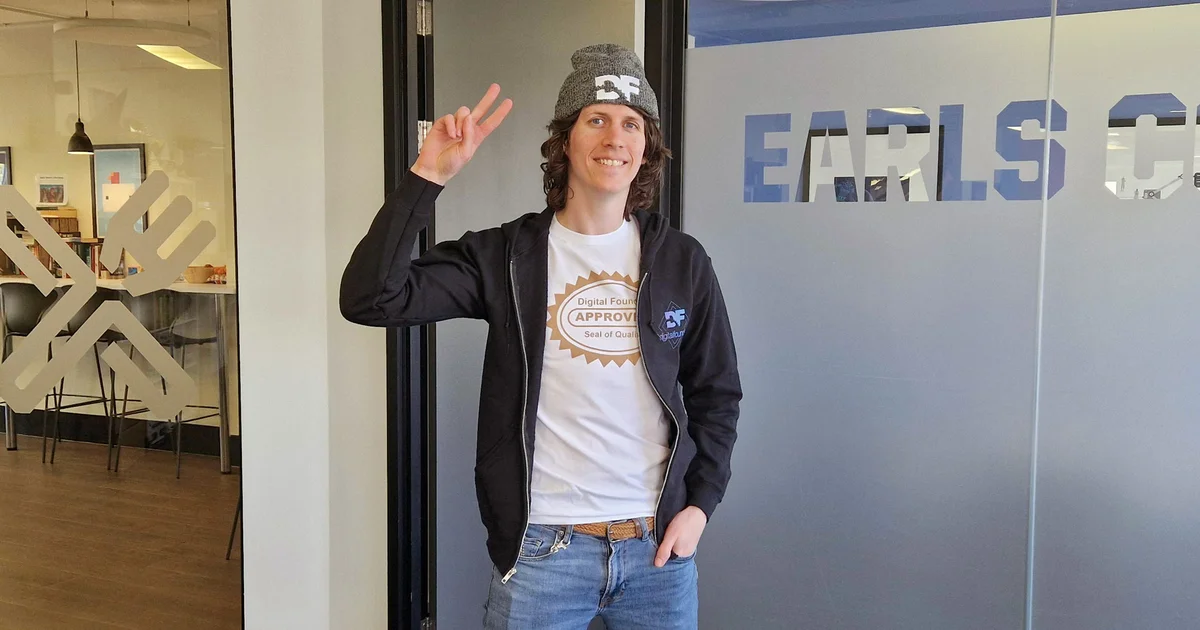
With that in mind, we’ve marked down our original Digital Foundry Logo t-shirts in black and white by 30 percent. These styles aren’t being retired permanently, but they could be out of stock for a stretch—so if you like the look, now’s the moment to pick them up at a lower price. You’ll be glad you did, just like Tom (Morgan, pictured above).
I’ve also selected a few extra items for the event, including the now-less-seasonal Beanie—one I still reach for during the UK’s ‘spring’—as well as two lovely pieces of artwork: the DF Fighters A2 poster and the Motherboard sticker. Each of the three is discounted by 30 percent and makes a cheerful addition to your headwear, your living space, and your laptop, respectively.
Since the store first opened, we’ve revised shipping costs on a number of occasions, and things should now be fairly competitive for sending items both within the UK and overseas—so take a look and let us know what you think.
Of course, the show was about far more than this sale. The remaining two hours, one minute, and 39 seconds (!) covered a wide range of subjects, including the creation of the Xbox game preservation team—kicking off conversation around what’s next for Xbox consoles, upcoming Fallout 4 improvements, reactions to the Star Wars Outlaws story trailer, and the initial rollout of FSR 3 on consoles running Immortals of Aveum.
- 0:00:00 Introduction and DF Merchandise
- 0:01:39 News 01: Xbox creates game preservation team
- 0:20:26 News 02: Fallout 4 to get current-gen upgrade
- 0:30:03 News 03: Star Wars Outlaws story trailer released
- 0:46:10 News 04: Dead Space is no more!
- 0:53:56 News 05: Immortals of Aveum gets FSR 3 upgrade on consoles
- 1:08:29 Supporter Q1: Can you get console-level ease on PC?
- 1:16:12 Supporter Q2: Is the PS5 Pro’s CPU boost enough to move a 30fps game to 40fps?
- 1:20:23 Supporter Q3: Are modern games too ‘artificial’, leaning too heavily on upsampling and frame generation?
- 1:26:40 Supporter Q4: Could ray tracing be losing momentum with future games?
- 1:34:38 Supporter Q5: Might Microsoft release a Series S-friendly handheld this holiday season?
- 1:42:06 Supporter Q6: What does Microsoft mean when it says the next Xbox will deliver the biggest technological leap in generations?
- 1:52:06 Supporter Q7: Should we be happy that more games are targeting 30fps on consoles?
- 1:57:57 Supporter Q8: How strong will Switch 2 be compared with Steam Deck and Series S?
The conversation about Immortals of Aveum really caught my attention. Even though it didn’t break sales records in a major way, it has still acted as an interesting proving ground for a broad range of newer technologies—most notably as the first AAA release to arrive with all of Unreal Engine 5’s key features, aside from Epic’s own Fortnite. This time around, it should make use of the newest FSR 3 version, which is expected to deliver the improvements AMD’s frame generation technology needs.
We previously noted that while FSR 3 can be very efficient, it can struggle in some situations—like keeping frame pacing consistent or performing well with variable refresh rates. The upcoming FSR 3.1 update should help with several of these issues, but bringing it to consoles adds complications that we don’t see on PCs—above all, consoles usually offer fewer ways to reduce input lag. Latency is still the main downside of frame generation at the moment, and Nvidia’s PC approach depends heavily on integrating its Reflex feature to lessen the impact as much as possible. On consoles, there’s nothing comparable, so it will be fascinating to see how FSR 3 holds up—even when using a controller setup that may be more sensitive to lag.
I was also intrigued by how the team answered a handful of interesting supporter questions this week, particularly the consistent response given to a viewer who asked whether today’s games feel too ‘artificial’, considering how much they rely on upsampling and frame generation.
Taking cues from Rich, Alex, and Oliver’s thoughts during the Direct, it’s tempting—and in some ways reasonable—to connect the sudden surge of PS5 and Series X games with unusually gentle resolutions and weaker image quality to these technologies. Still, the truth is that none of the frames you see in a game are truly real. It’s all part of an illusion, as we learned from Cyberpunk 2077 developer Jakub Knapik. Nearly every rendering approach used in games is designed to approximate reality in a way that works, rather than pursuing perfect, absolute authenticity.
You can absolutely prefer a game that looks sharper, and that view is completely fair. But there will always be developers willing to skip ‘raw’ pixel counts in favor of more realistic (or stylised!) visuals made possible by these same technologies. Becoming fixated on ‘real’ versus ‘artificial’ frames is, in the end, a bit of an oversimplification. As Oliver points out, it’s often more useful to ask whether you’re satisfied with what ends up on screen—and what leads you to that satisfaction.
Ultimately, frame generation and upsampling sit within a broader push for performance and optimisation that’s been part of video games for decades—particularly on consoles, where it’s long been common to use resolutions below native, especially for visual effects. They’re tools that help developers deliver the look they want while still staying inside a defined frame target. While it is fascinating to understand what goes on behind the scenes, that knowledge shouldn’t be allowed to reduce the enjoyment of the final product.
And since we’re talking about the end result, let’s come back to our starting point and encourage you to check out the DF Store Warehouse Sale while the 30 percent price cut is still available. After all, this range of merchandise is certified to be free of artificial frames and Digital Foundry approved.