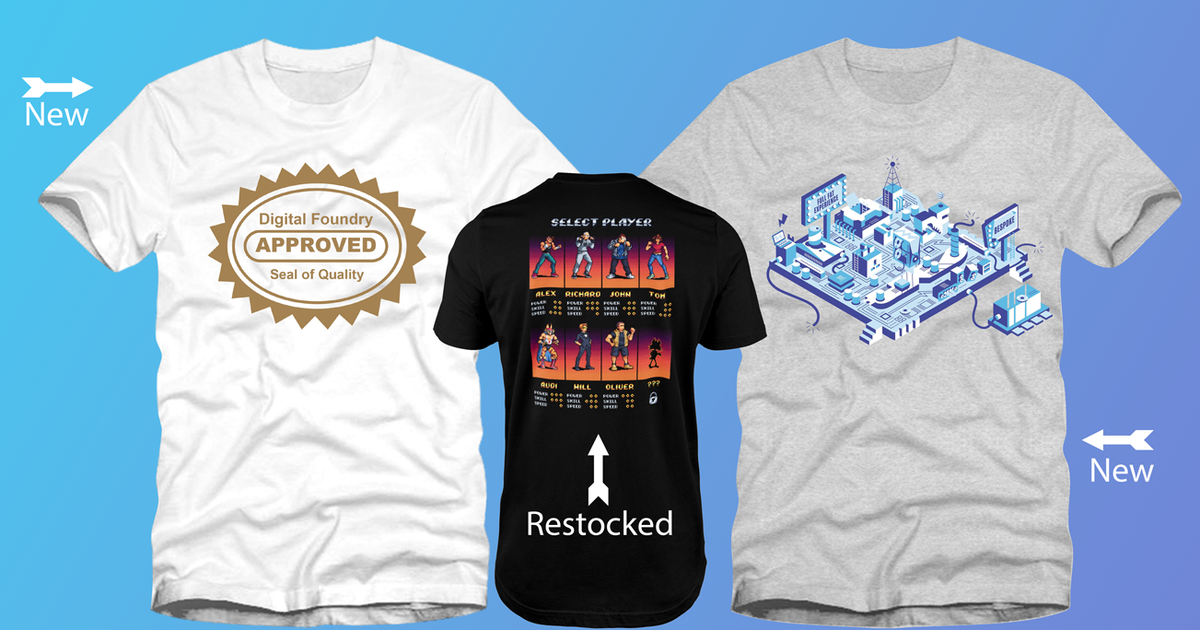
You may remember that we brought back the Digital Foundry merchandise store last year for Black Friday, with a selection of DF-inspired items including t-shirts, mugs, hoodies, posters, and stickers. Today, we’re delighted to introduce our first set of fresh designs for 2024—presented by Rich and Alex in this week’s DF Direct episode—along with the return of a much-loved classic.
In the header image for this blog, you can see our two new releases side by side: to the left is the DF Approved t-shirt in white, and to the right is the Motherboard t-shirt in grey. Both shirts are screen printed using 100 percent cotton Gildan softstyle midweight material, so they feel as comfortable as they look. The DF Approved artwork communicates that you, the wearer, are someone with a polished, on-trend style. By contrast, the Motherboard design offers a detailed visual interpretation of a circuit board, finished with distinctive, wide-ranging nerdy details.
Also returning is the DF Fighters t-shirt at the center, featuring eye-catching artwork by community contributor Rachel Hams. It portrays every member of the team in the spirit of a classic beat ’em up. After it sold out fairly quickly when it first launched, the DF Fighters shirt is now back in stock and available in sizes ranging from S to 3XL. If you’d like to pick one up—along with a matching poster, if you prefer—now’s the time while supplies last.
We’ve also reduced many shipping costs compared with the store’s initial launch. If you order a single shirt, untracked delivery to the UK is now £3, while tracked shipping is £5. International tracked postage has been cut too—for example, it’s roughly $14 to the US and €12 for deliveries to Germany.
As always, these products are a fantastic way to back Digital Foundry and the projects we support, while also giving you practical clothing and/or accessories you can actually wear and use. We genuinely appreciate your support—so please do take a look at the DF merchandise store!
Finally, these new March additions won’t be the only merchandise drops in 2024. We’ve got an exciting schedule lined up, including several new product categories arriving in April and May—something I’m especially looking forward to—but we’ll share more information as those releases get closer!
- 0:00:00 Introduction and DF merchandise
- 0:02:26 News 01: Rise of the Ronin preview
- 0:11:40 News 02: Nvidia announces forthcoming game enhancements
- 0:35:55 News 03: Intel reveals PresentMon 2.0
- 0:51:08 News 04: Stellar Blade demo released, then quickly retracted
- 0:56:48 News 05: Peter Moore discusses the future of consoles
- 1:12:11 Supporter Q1: Should console platforms allow users to set frame-rate caps themselves?
- 1:19:39 Supporter Q2: What rendering technology will follow path tracing?
- 1:27:22 Supporter Q3: Should more developers include debug menus in their games?
- 1:31:43 Supporter Q4: What storage technology do you utilize?
- 1:39:38 Supporter Q5: What would Digital Foundry have looked like in the 1990s?
While DF Direct kicked off with a brief merchandise mention, there were plenty of other stories this week that deserved attention. One in particular that grabbed me was Oliver’s early look at Rise of the Ronin, Team Ninja’s highly anticipated PS5 mega title. The review embargo for the game hasn’t lifted yet, but the preview embargo has now expired—giving us the freedom to talk about parts of the game and how it was developed.
From a technical angle, there’s a clear visual leap compared with Wo Long Fallen Dynasty, the studio’s previous project from 2023. Oliver pointed out the apparent use of Virtual Shadow Maps (VSM), delivering extremely detailed shadows with adjustable penumbra across all three graphics modes. These modes include performance, graphics, and RT, with the RT option also bringing reflections on smaller stretches of water—think ponds and brooks.
Both of these changes are particularly noticeable outdoors. That said, Oliver also found that indoor areas and urban scenes don’t stand out to the same degree, showing a comparatively straightforward approach to indirect lighting and ambient occlusion that doesn’t quite match the strongest examples we’ve seen on PS5. There are also some potential image-quality worries, including what seems to be a checkerboard-style rendering approach and visible image imperfections, though we’ll need to wait for the full review to dig into those points properly.
On the whole, it looks like a solid release that goes beyond what Team Ninja has made so far, and it should still be an enjoyable ride—even if it may not represent a graphics benchmark, and some performance areas could be improved. Tom is handling the review for this title, so be sure to check back for more!
In addition, the rest of the episode covers discussions about upcoming Nvidia improvements for a range of games (including various RT features and DLSS), genuinely interesting enhancements to Intel’s open-source PresentMon performance analysis tools, the accidental release of the Stellar Blade PS5 demo, and more besides.
We also received a great batch of supporter questions this week, covering ideas around console-level frame-rate limits similar to those on the Steam Deck and RTSS on PC, updates related to the Spider-Man debug menu, and perspectives on our own PC storage solutions—plus, what Digital Foundry might have looked like if it had launched in the 90s.
We’re nearly always treated to an exciting set of questions, and if you’d like to submit some of your own for us to address in DF Direct or DF InDirect, please consider joining us!