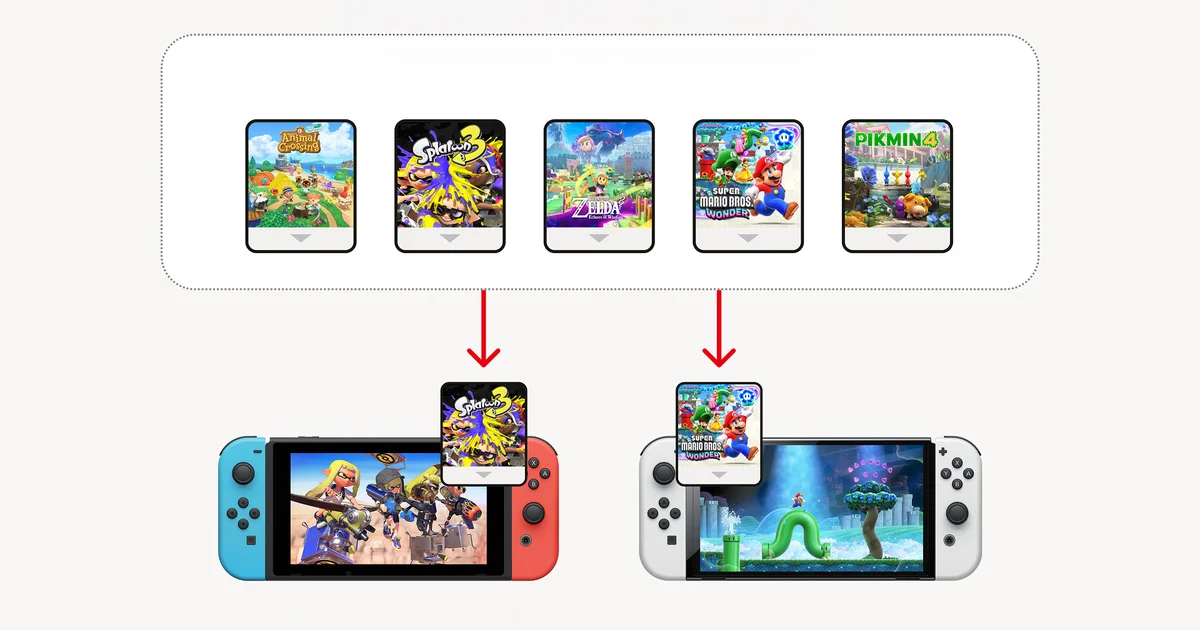
Before Wednesday’s Switch 2 reveal event, Nintendo unveiled a fresh feature for its Switch systems: virtual game card. In practical terms, you can now link several Switch consoles to trade digital games—so a title that you remove from one device can be accessed on another. That means you no longer have to sort your consoles into “primary” and “non-primary” roles. It could point to Nintendo inching closer to the “charmingly all-digital” direction mentioned in Microsoft’s leaked documents, but does this really signal that shift?
To look at this development along with other notable tech stories from the week, Digital Foundry’s John, Alex, and Oliver joined together for DF Weekly #207. The discussion kicks off about 40 minutes in, where our hosts wrap things up by saying this doesn’t represent a move toward the digital-first approach seen in the strategies of Microsoft and Sony. Instead, it reads as a practical quality-of-life improvement arriving right as Switch console owners start thinking about Switch 2.
So, what issue is Nintendo trying to tackle with this update? At the moment, you can designate a single Switch as your “primary” console, while all others are marked as “non-primary.” The primary console can run your games offline, but the non-primary consoles need an internet connection to play—an annoyance if you want to enjoy a digital title during a flight, or anywhere your connectivity is unreliable.
- 0:00:00 Introduction
- 0:01:17 News 1: Nintendo Direct – Metroid Prime 4
- 0:11:02 Pokémon Legends: Z-A
- 0:22:08 Patapon, Everybody’s Golf, Tomodachi, Dragon Quest, Witchbrook, Shadow Labyrinth, Gradius, Marvel Cosmic Invasion
- 0:33:02 Switch 2 C button leak and Nintendo Today app
- 0:40:01 News 2: Nintendo unveils Virtual Game Cards
- 0:54:01 News 3: Has Switch 2 game rollout been revealed?
- 1:00:33 News 4: Witcher 4, Intergalactic to launch after 2026
- 1:09:51 News 5: Alex’s issues with Nvidia drivers
- 1:19:36 News 6: John’s reflections on GDC
- 1:32:44 Supporter Q1: What is your all-time favorite GPU?
- 1:39:07 Supporter Q2: Will Valve soon release a Steam Deck 2?
- 1:44:31 Supporter Q3: Should PC settings undergo changes for enhanced branding?
- 1:52:02 Supporter Q4: Could Xbox One have thrived with a better introduction?
- 2:00:12 Supporter Q5: Is disc degradation a concern with Blu-ray media?
When you compare it to what we have today, the new approach looks especially attractive. Much like you’d remove a physical Switch cartridge from your console and let a friend or family member use it—or even move it to another Switch you own, such as a Switch Lite—you’ll be able to “eject” a virtual cartridge from one device and “load” it onto another using a dedicated menu. Even though internet access is needed for both loading and ejecting, once a game is loaded, you can play without worrying about your connection status.
It also appears that family sharing has improved under this new system. There’s now a simpler interface for lending a game to a member of your Nintendo family group (up to eight people). That said, family sharing still comes with tighter rules: a 14-day usage period, after which the transfer must be authorized again, and it also requires both Switch consoles to be near each other physically for the move to work. Even so, you can still choose the older family sharing option if you prefer.
The key point is that the virtual game card framework could set the stage for a future where many Switch 2 customers already own a previous-generation Switch system, keeping it useful even after the new hardware launches. Nintendo seems likely to follow a strategy along the lines of what Xbox and Microsoft have done with their ninth-generation consoles. With this model, digital game transfers between the two generations become possible—making it straightforward to hand your old Switch to someone else when you’re ready to commit to Switch 2.
It’s also worth thinking about the current landscape for physical retail. Nintendo is clearly strong here, particularly in its home market of Japan, while Microsoft has almost fully retreated from the space and Sony is steadily shifting toward a more digital-first outlook.
That suggests Nintendo may feel the biggest impact from a transition to digital games, since the company targets a wide audience that may be less at ease with digital buying—especially when parents or grandparents are purchasing games for children. In those cases, physical releases often offer a major advantage. The new virtual game card uses a familiar metaphor that initially feels easier to grasp than Nintendo’s rivals’ approaches, yet it’s difficult to imagine Nintendo abandoning its established habits around physical media any time soon.
The rest of the Direct is absolutely worth your time, too, covering a range of additional details from Nintendo’s announcements—such as the Switch 2’s C Button and possible game rollout plans. Alex also voices frustration with the state of Nvidia drivers, John shares his hands-on impressions from GDC, and we’re treated to a set of lively supporter questions, starting with what the best graphics card (and GPU generation) of all time is. While the RTX 5090 is noted for its raw performance, our hosts lean toward slightly more classic, older options.
As always, we’re grateful to our supporters for submitting great questions. And if you’d like to join in yourself—along with access to high-quality video downloads for everything we publish, plus exclusive weekly production notes and more—take a look at the DF Supporter programme on Patreon!