My relationship with video games has shifted a lot since I became a parent. I’m now constantly tuned in to the wellbeing of any young ones—whether they’re right in front of me or living on a screen. That awareness makes me quickly fixated on protecting them and keeping them safe. In many ways, I’ve stepped into the role of guardian, and it’s not something I treat casually.
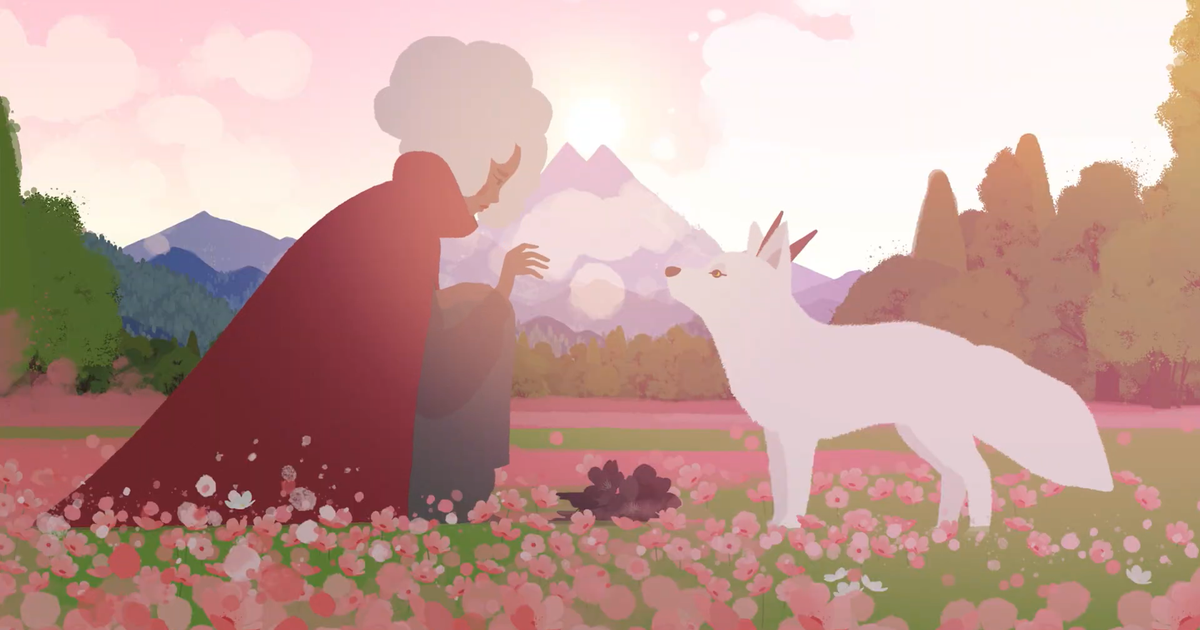
This protective instinct is exactly what Nomada Studio, based in Barcelona, is leaning on with its next release, Neva, a visually striking 2D puzzle-platformer. Where the studio’s earlier game, Gris, offered a quiet, solo journey through the stages of grief, Neva follows a different bond: Alba, the player-controlled character, travels with a young wolf.
That wolf is Neva—“snow” in Spanish—an identity that nods both to the whiteness of its fur and to the clean, fresh symbolism often linked with snow. Neva is Alba’s “child,” and as her mother (Alba means “dawn”), she will do everything she can to protect and raise the pup. The studio is hoping players will connect with that same feeling.
I got to preview Neva at an event in Barcelona last week. Early on, I met Alba and Neva, along with another wolf companion that had already fully grown. As they move through a vivid environment, they start to see the landscape fall under a creeping blight. A bird lies motionless on the ground, and dark flowers spread over what remains. Before long, more birds drop from the sky, and a shadowy presence made of vicious creatures closes in on the two wolves and Alba. Alba and the older wolf do their best to hold them back, but Alba is knocked out. When the darkness retreats, the other adult wolf is discovered dead. Now Alba and Neva have only each other, and they must team up to face the darkness endangering their world. The emotional stakes are set from the start.
Nomada Studio sees this parent-and-child relationship as a natural step forward for the studio. Creative director Conrad Roset also pointed out that games like The Last Guardian and Ico helped shape their thinking. Roset became a father while work on Gris was nearing completion, and that personal milestone changed the studio’s direction in a meaningful way. “If I hadn’t become a father, I wouldn’t have created [Neva],” he said. “The narrative is closely tied to my recent experience of fatherhood. I wanted to tell a story that illustrates this evolving role.”
As you play as Alba, the life changes Roset mentions also carry over to Neva—especially her growth from a young wolf into someone more capable. In the first chapter, Neva struggles with bigger jumps and hesitates when it comes to enemies. But as the story moves forward, she becomes more coordinated and bolder. Over time, Neva will show more independence: she’ll start taking the fight to foes on her own and become increasingly confident in what she can do. Eventually, Alba can rely on her “child” to help her move through the world.
“I find myself navigating two generations,” Roset explained, and expanded on how his own experience informed Neva. “I have my children, and I have my parents. Now, I am caring for my parents, who once looked after me.”
Lead producer Roger Mendoza—who’s also a parent—shared a similar perspective. “The goal was to create a game that could convey the emotions involved in raising someone,” Mendoza told me. “That’s why it was so important for us to add a companion. We wanted to capture the full cycle of ‘you begin by caring for someone, you develop alongside them, and in the end they end up supporting you.’”

Even though players steer the “parent” character the whole way through, Nomada still considers Neva the lead focus. “You don’t unlock any new abilities as Alba,” Mendoza clarified. “It’s actually Neva, through her growth, who brings new gameplay mechanics into play.”
The team also felt it mattered that these added skills—and the game’s evolving platforming—should come from Alba’s wolf companion, not from the parental figure. “Right now, my child is young, and he doesn’t always pay attention to what I say; he does his own thing,” Mendoza joked. “That’s what we’re trying to show early in Neva. It’s ‘look, here’s a character that does its own thing, and you need to teach them something.’”
“The story’s core message is your bond with your companion, and how that bond changes over time,” Nomada’s technical director Adrián Cuevas added. “It’s about the process of looking after Neva—keeping her safe, worrying about her wellbeing—and then, as she matures, how she can end up backing you… this is essential for telling a game about any kind of parent-child relationship.”
Alongside moving through several story segments tied to seasonal changes—along with platforming and puzzles—players will also have to confront the nightmarish beings that are poisoning the world with cruelty and violence. Still, if Alba’s sword swings, jumps, and evasive moves aren’t timed properly, she can—and will—be killed. That’s a notable shift from Gris, which didn’t include violence or fail states.
Alba can restore lost health at rugged, shrine-like locations scattered throughout the landscape, usually found shortly after an encounter. She can also recover health by striking enemies with her sword while keeping herself out of harm’s way. Even with these chances for fairly regular healing, the developers admitted they were uneasy about adding combat to Neva. Their concern was that they didn’t want to push away players who appreciated Gris’s more relaxed, low-stakes approach.
“It
was one of the main worries we had to tackle during the game’s development,” Cuevas told me. “That said, we viewed Neva as a modest step forward in a player’s journey—from first meeting Gris to diving into this new release. It isn’t an easy game, but it also isn’t unreasonably hard. All things considered, it doesn’t feel overly punishing.”
“In Gris’s narrative, there was no space for death, because of the message we wanted to convey,” Roset added. Then he explained: “With Neva, the characters are directly standing up to evil— or to the people and forces facing them. So, in terms of storytelling, combat fits naturally. And on top of that, as a studio, we wanted to try something new.”
To give this added combat a bit more range, the team built a Story mode for Neva that features simpler puzzles. In this option, Alba deals more damage to her enemies, and she also receives help with actions like jumping. Alba is not vulnerable in Story mode; however, she can still be pushed back by enemy attacks and obstacles in the environment. Players can move between Story mode and the standard Adventure mode whenever they like, which improves Neva’s accessibility. “We don’t like the idea of players getting frustrated when they’d rather have a calmer experience,” Cuevas said with a smile.
On the other hand, Mendoza hopes that adding more action alongside the game’s platforming elements will encourage fresh players to check out Neva. “Some people say, ‘Well, there’s no gameplay in Gris; it’s a boring game.’ And that’s totally fine— it’s a fair opinion,” he remarked.
“But Neva has a lot more to offer.”
So, exactly who—or what—are the foes that Alba and Neva face? There’s no denying they’re unsettling in their presentation, with narrow limbs, deep dark tones, and faces that, even when they seem simple, still manage to stick in your mind. The developers of Neva say these figures are meant to be whatever you, the player, decide they are. They stand for the “embodiment of anything considered evil,” or “a reflection of everything that might go wrong in the world.” They personify war, climate change, corruption, and anything else you feel you want to protect the people you love from.
“When I was a child, I read The Neverending Story, which talks about something called ‘The Nothing,’” Roset told me. “It’s shown as a void—if you stare into it, it feels like you lose your eyesight. You see nothing. And in Neva, [the enemies] can be understood as The Nothing from The Neverending Story, spreading out and wiping the world away.
“You can read [the adversary] as a metaphor for whatever you want. I don’t want to be too specific about what it could mean, but it’s the closest way to describe this void from The Neverending Story, the force that’s swallowing up the space our characters live in.”
“We’d rather not be super precise about what the monsters represent,” Mendoza added. “We want people to connect the symbolism to their own ideas.”
“If you’re a parent, your fear only grows stronger when there’s someone you have to protect—because if you don’t, you might just run away and hide,” Cuevas said. “But when you have a child, you may feel more compelled to face these difficulties and help make the world better for them.”
I asked Roset how he came up with the designs for Neva’s monsters, especially since their meaning can be interpreted by the players. He explained that he wanted to create “characters whose only job is to spread evil,” and he achieved that with impressive skill. According to Roset, the monsters in Neva draw nourishment from the decaying parts of the forest, which “puts across the notion that they need darkness to survive.” “There are also quieter metaphors woven throughout,” he said, “where the enemies can bring to mind different aspects of society.”
My time with Neva wrapped up far too quickly. This game is shaping up to be another emotionally driven work—let’s be honest—of art from Nomada, and I already feel it will move me to tears. Between Neva’s art direction, music, careful storytelling, and smooth gameplay, it comes together as an inviting mix, delivered with impressive craft. Even though my practical time with the title was relatively short, I’m sure that fans of Gris will feel just as captivated—if not even more so—when Neva launches next month.
And speaking of what’s next: with Neva’s release on the horizon, what does the respected studio have planned? Even before Neva officially arrives, the team has already outlined their next undertaking. Studio Nomada is keeping the details under wraps for now. “We have a concept… development is going to start very soon,” Cuevas shared, smiling as he said it. “It takes a long time, so even though we’ll begin shortly, it may still be years before it comes to life.”
Before they dive into that mysterious next chapter, the team wants to take a proper break. “I’d like to rest and spend some meaningful time with my family. I just became a father for the second time,” Roset said proudly.
“I already have ideas for another project, but for now, I’m going to take it easy.”
This article is based on a press event in Barcelona, for which Devolver Digital provided travel and accommodation.