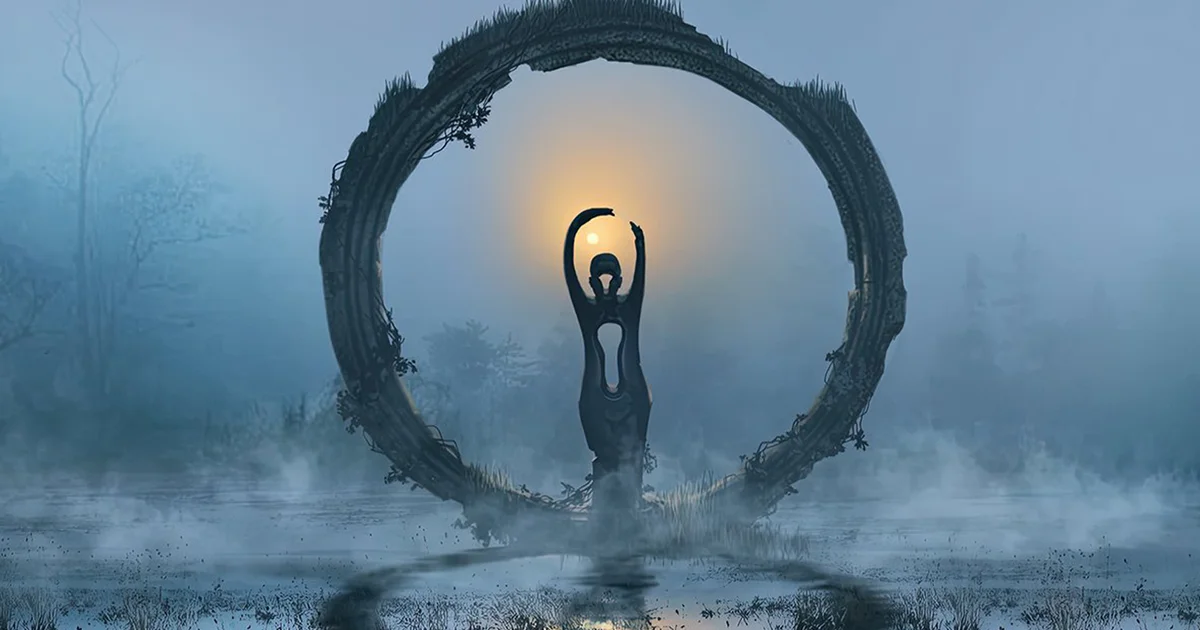
Set in the early nineties, Hell is Us—the upcoming action-adventure project from developer Rogue Factor—follows Rémi’s attempt to find his parents in the fictional country of Hadea. The problem is that Hadea is tightly sealed off. The only reason Rémi lives beyond those borders is his mother: she smuggled him out when he was just five. Sadly, Hadea’s border authorities caught her, forcing him to survive on his own and ultimately end up in the Canadian foster care system. What little he truly remembers from his short time in Hadea boils down to her arrest and the fact that his father worked as a blacksmith in a village called Jova. With that in mind, Rémi understands why his parents made their choices—but he still longs to reunite with them and learn exactly why they decided to bring him away.
That longing becomes even more urgent once Hadea slips into civil war. Because the nation keeps itself closed off, details about the conflict are scarce during the two years it rages; still, Rémi eventually hears about a United Nations Peacekeepers operation planned to enter. With his Hadea visa requests denied, Rémi chooses to sign up for the mission, believing it may be his only chance to track down his family. Unfortunately, when they reach the mountain range that rings the country, the Peacekeepers are turned away. After getting so near—and being stopped again—Rémi gives up on the assignment and sprints down the mountainside into Hadea.
This is where my Gamescom preview of Hell is Us begins: in the Hadea foothills, with Rémi standing beside his discarded Peacekeepers uniform. In the forest, Hadea looks calm. Water moves quietly along the riverbank, and the breeze stirs the leaves. Yet there’s a constant sense of pressure beneath the surface, since the only real clue about what comes next is the war still unfolding in the background.
It didn’t take long before the civil war’s effects were impossible to ignore. Not far into my time, Rémi found a ruined farmhouse. In its basement, an elderly man waited in isolation, clinging to the belief that at least one of his sons might still be alive. Later in the preview, the conflict’s reach became impossible to sidestep when the next stretch of land turned into a marshland Rémi had to cross to reach a village left in ruins. Still, the first real shock for me in that area was a mass grave—innocent civilians caught up in a struggle they couldn’t control, piled together beneath the excavator that had carved out the pit where they now lay. The contrast with the peaceful forest I’d been walking through could not have been sharper, making it clear that the quiet I’d seen at first was only an illusion, and showing what Hadea has become. For the time being, though, I only had what the elderly man could share: a rough sense of where Jova was, a few additional notes about the fighting, and—most importantly—the presence of soldiers operating in the forest. To find them, all I needed to do was follow the sound of wind chimes.

And I truly mean it. Hell is Us removes both maps and quest markers. There isn’t even a compass to steer you. Instead, you make your way through Hadea by collecting hints and directions from the people you meet. Sometimes that means using a visible landmark; other times, like here, it means tracking down a sound you have to chase. This approach also fits Rémi’s story of slipping into Hadea with very little knowledge to rely on—it also brings a real nervous edge to exploration. You can’t easily tell what’s ahead, because nothing clearly shows where cliffs, craters, or other dangers might be waiting.
At one point, I walked straight into a body of water, assuming that if Rémi survived the previous one, he’d manage this time too. He didn’t. Even so, being taken out like that felt strangely refreshing. I was constantly paying attention to what surrounded me, rather than staring at a mini-map—or, even worse, following some loud orange arrow pointing the way. (I’ve always found this kind of guidance distracting: GPS is for the cautious! And in real life, there aren’t huge arrows floating in the sky telling you where to go. We’re not living inside a Philip K. Dick novel. Not yet.)
With this navigation approach in mind, the closest thing Hell is Us offers to a quest log is an “Investigation” hub. It displays some—though not all—of the information you’ve gathered using a mind-map-style layout. What if something’s missing? Then you’d better remember it. The hub isn’t meant to capture every detail of your trip; it mainly exists to keep enough puzzle pieces on hand to guide Rémi’s next moves through Hadea. Because the information it holds is limited, it never becomes an obstacle to exploring the world itself. Instead, you’ll check it quickly to confirm a point before continuing, relying on the geographic clues you’ve picked up—whether that’s following a chain of landmarks or hunting for a particular building.
One major benefit of Hell is Us is that it doesn’t flood players with the absence of maps or with scant recorded details. The first forest area I explored seems built specifically to get you used to this navigation system. The forest is fairly compact, with the wind chimes—and later, paint markings—kept close together, yet it still rewards players who decide to look around. It also gives you a good feel for how movement across bigger spaces might work, especially if the game offers more than one line of directions to follow. That said, in these woods there’s only a single place you need to reach.
Deep within the woods, I came across an injured soldier sprawled outside what was unmistakably an ancient ruin. I’ve spent enough time with fantasy stories to recognize the vibe right away, and enough time with horror to understand that something inherently bad is rarely waiting in places like that. (Even the soldier’s gouged eyes functioned as a blunt, effective warning.) I decided to go in
Inside, I found a setting that shifted between a forgotten stronghold—complete with grand, ornate columns—and a subterranean dungeon where people were left to deteriorate in cramped cells. Still, it wasn’t humans I ran into below. With every step Rémi took, it became clearer that this isn’t only a civil war crushing Hadea. There’s more going on—something stranger, something darker—something that has been present since before humanity ever wandered these grounds.
I’ll admit, the first reaction I had when I witnessed the supernatural creatures in Hell is Us was: “That’s interesting. They bring Control to mind.” But if Control’s Hiss is a warped version of humanity caught inside brutalist architecture, then the figures in Hell is Us feel like a frightening kind of minimalism.
At first glance, their clean white bodies and uncanny stillness might make you mistake them for stone statues. Not for long, though—once you notice the dark, empty hollows where a human face and chest should be. Some appear to have nearly shed every trace of humanity, with arms shaped like pressed-down wings, yet those faces-without-faces remain. There’s a simple, unsettling elegance to their design; however, that impression evaporates as soon as you spot Rémi. Their arms begin to jerk in an unnatural way, or an eruption of energy launches from their midsection before surging toward you like a demonic claw machine. When that moment hits, you need to counter with a quick, slicing strike.
The excitement of combat in Hell is Us comes from its ability to challenge you without feeling like it’s delivering harsh, punishing brutality. Even though I picked up the basics during the preview, I still needed to adapt whenever a fresh opponent appeared. I also had a chance to try out the different options the system provides—because even though Rémi starts with a sword, I soon discovered a pair of axes. That shift let me experiment with a faster, more aggressive style: close in quickly, stay in the thick of it, and then dodge incoming attacks on the fly.
Rémi is further supported by a drone, which during the preview could be used to draw enemies away. It adds another layer to your planning, too, because its cooldown means you have to choose the right timing and positioning. You can use it to divide the battlefield right at the start of an encounter, or, if things start to spiral, to distract an enemy while you pull another target aside to buy yourself some breathing room. When you combine the hack-and-slash combat with the drone’s tactical utility, you get skirmishes where accuracy and control can translate into victory. Still, no matter how carefully you set things up, there’s always the risk of being overwhelmed—followed quickly by a sudden end.
From my short time at Gamescom, the result was that perfect kind of moment—when a game clicks immediately and you want to stay wrapped up in it. The story has kept my attention: the human struggle of a country caught in conflict, where ordinary people can barely endure, woven together with a supernatural puzzle about horrifying threats creeping in from the dark. Meanwhile, the combat system shows real promise for when Hell is Us arrives next year. But it’s the unique take on movement and navigation that truly creates the lingering magic of its unsettling atmosphere.