Monster Hunter is back, arriving with a stack of fresh changes and new franchise ideas that set Monster Hunter Wilds apart from its previous outings—possibly making it the most approachable, crowd-pleasing, and beginner-friendly chapter in the series to date.
That said, Capcom has to strike a careful balance. On one side, it wants to pull in players whose sense of comfort comes from the polished MonHun Lite style found in games like Horizon Zero Whatever—people for whom the original Monster Hunter has often felt a little tangled. The upside of this approach is obvious: more newcomers, a wider audience, and Capcom can keep the momentum going.
On the other hand, there’s a fiercely loyal and vocal community that genuinely values that very intricacy, for real. Monster Hunter stands out with an energy and personality that you won’t find in anything else. But chasing a fresh crowd could end up distancing the existing one, so Monster Hunter routinely positions itself to experiment with new systems and borrow concepts from contemporary games—while still preserving every painstaking element of the core loop. Otherwise, it risks the harshest charge of all: “dumbing down.”
That core loop is something Wilds appears far more eager to use to immerse you than Monster Hunter World did. Ahead of the recent six-hour preview session at Capcom’s London headquarters, I returned to World, hoping to avoid looking like an absolute beginner in front of industry colleagues. One of the first things that stood out was how long it takes before you’re truly thrown into monster hunting. Despite having minimal narrative, Monster Hunter World is surprisingly talkative during its early hours. Its extended tutorial feels endless—more like the onboarding process for a temp agency than the start of a life devoted to tracking wilderness animals.
I’m happy to say Wilds’ first major shift is the kind you notice immediately. From the very beginning, it drops you into a jaw-dropping set piece: a high-energy arcade-style sprint through dry terrain while you ride an ostrich-like beast, chased by small sandworms—like a strange mash-up of Frank Herbert’s Dune and Road Rash, scaled for the Sega Mega Drive. As an opening gambit, it absolutely works. It flips the switch and gets you moving. The tutorial steps then roll out bit by bit during the initial string of story missions, as your expedition supplies start appearing back at base camp.

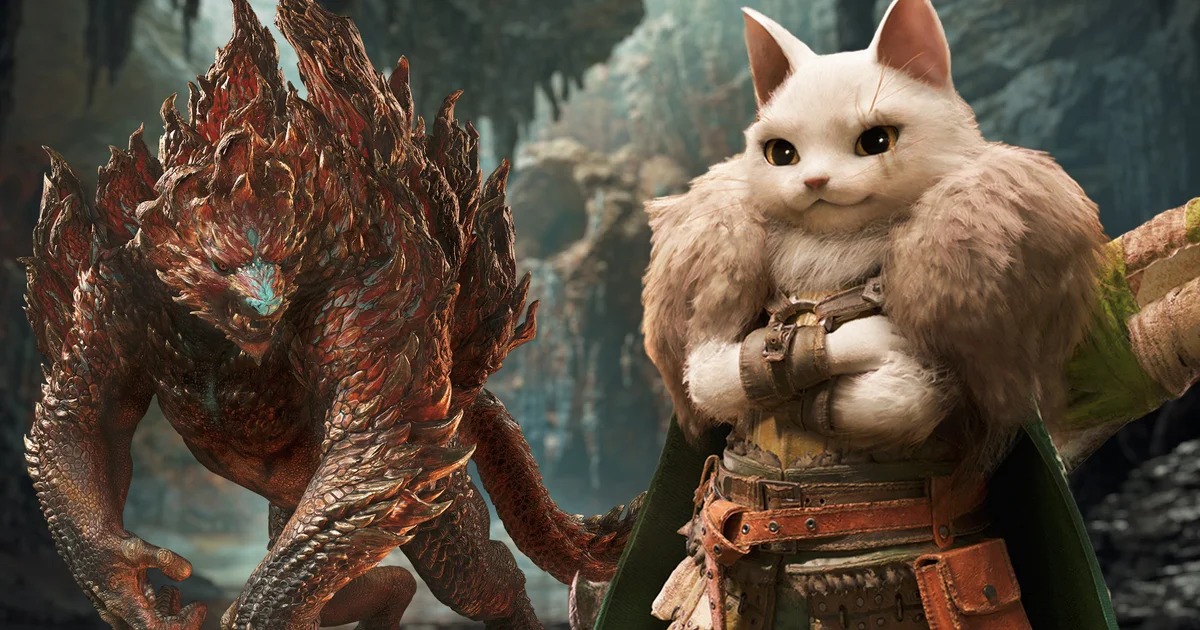
Because this is largely a game about upgrading your gear, the blacksmith gets a suitably dazzling introduction. Gemma—the attractive blacksmith (with Capcom’s usual exposed midriff)—works at the forge in a flashy routine that feels less like traditional craft and more like the opening number of a Broadway musical built around shoeing horses. It’s ridiculous, sure, but it’s also the kind of game where your cat assistant is a tidy, well-mannered helper that improves your output without turning your rug into a disaster. It lives in its own warped logic, and you just have to go with it.
Traversal, meanwhile, gets a major overhaul in Wilds thanks to Raptor-like Wyvern mounts called Seikrets. That label can be a little misleading: if you walk around telling people you enjoy riding an animal but it’s a secret, you’re probably going to invite a visit from law enforcement. These mounts matter for traveling across Wilds’ massive biomes, but they also highlight the vertical side of the map—marked routes along steep cliffs and through foliage that can cut down travel time and lead to spots you wouldn’t otherwise discover, much like Palamute mounts did in Monster Hunter Rise. They’re also useful during fights, letting you build momentum and launch yourself at a monster to land meaningful damage from above.
Combat (and yes, we should bring it up since it makes up about 90 percent of the gameplay) feels strongly tied to World, using the familiar set of 14 weapons. The standout changes are “Focus Mode” and “Wounds.” Focus Mode lets you execute bigger flourishes by zeroing in your attacks on specific body parts. Wounds, on the other hand, show up in red when they’re ready to be struck—and they close back up after you trigger the right animation, meaning you can’t just keep farming them on repeat. In general, fighting now asks you to create openings for focus attacks while slowly draining a large health bar. It’s a bit more satisfying with friends—or even random players—just like in the previous entry. This time, though, your SOS option can call in a reliable group of AI-controlled hunters, which makes Wilds noticeably more enjoyable when playing solo than World was. As a result, your runs are also less dependent on that fleeting factor: whether other players happen to be around.
In fact, you can get through Wilds’ hunts without needing other real-life players at all. In a number of ways, Wilds looks like a friendlier experience than its predecessors: its systems feel more streamlined and less likely to overwhelm someone who’s used to more conventional third-person action games. Honestly, it’s also easier. Straight to the point: I’m not great with Monster Hunter titles, and I usually fumble my way through them with about as much smoothness as a Great Jagras fresh off an Aptonoth. Still, in Wilds, I barely felt any pressure. If anything, I often found it so laid-back that I started wondering whether the preview build had an invincibility option enabled for players who wear plaid shirts and look lost. My guess, though, is that Capcom is simply trying to address two different audiences with this release.
Even if it’s gentler, the hunts stay genuinely engaging and fun. Wilds uses a living, constantly simulated ecosystem, so during quests and boss fights, other creatures can wander in and join the action on their own. Plus, the varied terrain now plays a much bigger role in set-piece battles. Each arena includes risky, ACME-style traps that can deal big, comedic damage—if you can coax your slow-moving opponent into the right spot.
Just from the opening six hours, it’s clear that Wilds is packed with memorable moments—and, given where the earlier entries have gone, I’m fairly certain this isn’t simply a “put the best bits up front” situation. We’re only starting to uncover its story, which now plays a bigger role than in the past, complete with dialogue trees and a fully voiced lead character. Early encounters also introduce a lively indigenous culture, so unfamiliar to our Old World protagonists that their understanding of weapons is limited, pointing toward a wider idea of colonialism and its human consequences. Monster Hunter doesn’t need to tackle themes, yet it’s still interesting to see Wilds leaning into narrative substance even when it isn’t required. It feels a bit like a prelude (or a nod) to fans of Red Dead and The Witcher—players who are more likely than most to give MonHun a chance if they haven’t already. Still, I’d argue that Capcom has already delivered a Monster Hunter experience tailored to that audience. It’s called Dragon’s Dogma 2, and you may have simply missed it.
That said, this is exactly the group this preview is ultimately for. Longtime Monster Hunter fans have had an extended waiting period for Wilds, filled with many previews and sneak peeks, including two public betas—the second of which is still underway—along with a continuous stream of details from a publisher that’s generally known for greater openness about upcoming releases. I can’t offer those fans much they haven’t already picked up, aside from one possible reassurance: the worrying performance problems noticed during the public beta don’t appear to carry over into the finished game, at least based on what we saw in this preview build. We tested both fidelity and performance options on a standard debug PS5 (not the Pro model), and both ran with consistently solid frame rates, with no meaningful trade-offs. So if the beta made you nervous, you likely don’t need to stay that way.
If you’re curious about MonHun, I’d recommend going in with caution. The pressure to keep up is real: Monster Hunter is the kind of phenomenon that sparks a competitive, jealous energy within its fanbase. Its supporters talk about their love for the series with an energy that’s hard to find anywhere else. Still, even though Wilds is eager to wow you and pull you in, it remains a Monster Hunter game—and, like any marmite-style title, it’s bound to split opinions. If you’ve struggled to click with the series before, there doesn’t seem to be anything in Wilds that’s dramatically different enough to flip your view this time around.