When Microsoft and Compulsion Games first teased South of Midnight back in 2023, it immediately sparked my interest. I was drawn in by the game’s stop-motion look, the varied cast of characters, and its Gothic “Deep South” storytelling that leans into a folklorish tone. The instant Shakin’ Bones started playing guitar, I knew I wanted to dig deeper.
So, what’s it actually like to play? I got to try South of Midnight for myself last week, and I can confidently say it’s strikingly beautiful. It’s clear the developers at Compulsion have poured real care into the details, along with a genuine admiration for the Deep South. The visuals, audio, music, and art are simply gorgeous. Life in South of Midnight feels charged and alive—flies buzz, birds call out, rabbits dart across the ground, and alligators lounge along the water. That lively mood is matched by heartfelt guitar lines and rich choral harmonies, pulling you right into the center of the Deep South.
That said, for all its great atmosphere and solid foundation, I do have a few concerns.
My preview session took place in the third chapter of South of Midnight, called A Big Fish. Early in this chapter, the protagonist Hazel sets out to find both her home and her mother Lacey, who has been swept away by a hurricane. Yet the storm doesn’t just disrupt Hazel’s everyday life—it also creates something unsettling in the world around her. As she explores, oddities start stacking up: giant peaches appear everywhere, Mahalia—an eerie presence—shows up as a ghostly guide, and another unfamiliar voice keeps calling for help.
As the landscape opens up, you also come across nightmarish beings called Haints. These Haints appear when grief and trauma tear at the very fabric of the universe. The result is a phenomenon known as Stigma—the source of the Haints—which only Weavers can notice. Weavers are magical fixers who mend broken bonds and spirits, the kind of magic Hazel can use. In other words, the supernatural element is very much in motion.
Within minutes, I met a few Haints and got my first real taste of South of Midnight’s combat. Much of it depends on Hazel’s newly learned abilities, all tied to weaving. Hazel can use a move called Strand Pull to tug enemies toward her, and Strand Push to—yes—send them right back. In my preview, this back-and-forth approach worked especially well against Haint nests, which periodically spawn explosive flying threats called Larva Haints. When Hazel’s Weaver magic comes into play, I pulled those creatures closer and then hurled them back toward the nest, where they detonated.
I used the same pull-and-push rhythm against other Haint variants I ran into. I caught foes at a distance, dragged them in, and then followed up with strong strikes using Hazel’s Hooks—two blades with a spinning-wheel-like textile pattern. Each hit chipped away at the enemy’s health. At the same time, another Weaver ability called Weave let me momentarily halt opponents by trapping them in an ethereal, woven hold. All of these spells can be boosted by collecting items known as Floofs, which you earn by fighting Haints or spot around the environment as glowing, threadlike objects.

Still, there’s a catch. In the early encounters I had with the Haints, I felt good about how I navigated and dodged around the terrain (and yes, that wording is intentional). Before long, though, using these tools in sequence started to feel a little repetitive and easy to predict. Even though I ran into several kinds of Haints during the preview—including the Hurler Haint that throws projectiles and the more familiar Ravager that swipes—the fights began to blur together. I never felt like I was making truly game-changing decisions, and by the time the chapter ended, I was stepping into combat spaces almost without thinking.
I asked the South of Midnight team whether later chapters would add more variety to combat, and I was told I’ll face additional Haint types as the story progresses. Similarly, while chapter three finishes with a surprisingly steady landing (more on that soon), later chapters will end with larger boss-style showdowns. We got a peek at one of those in a previous South of Midnight trailer—the imposing gator Two Toed Tom.
Later on, you’ll also pick up another spell: Crouton, a small patchwork puppet companion. Because he’s so tiny, Crouton can reach spots Hazel can’t, including areas inside fox dens. In fights, he can also act like a “puppet master” spell, steering one Haint to attack another. Even so, despite how much I liked the idea of Crouton’s kit, he wasn’t included in the specific build I played.
Even though I felt the chapter-three combat leaned a bit toward a set pattern, the story and the environment do a lot to offset that. After picking up the ability to double jump and glide with Mahalia’s help, I quickly met Catfish, a mystical talking fish whose voice had been calling for help earlier in the chapter.
Following
That devastating
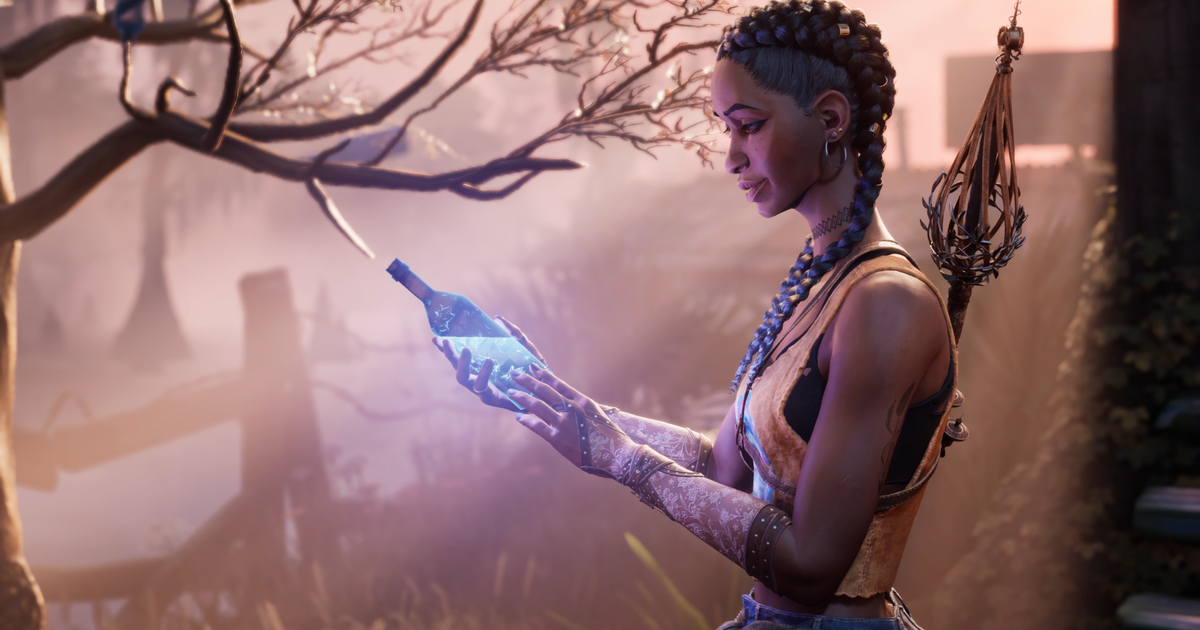
The hurricane left unfortunate Catfish wedged beneath a massive tree that simply wouldn’t let him go. To free Catfish from that grip, Hazel had to support the formidable tree as it dealt with its own emotional turmoil. That meant heading to a nearby bottle tree, taking a magical bottle from its branches, and facing the Stigma and Haints lurking in the area.
On the surface, it sounds like a simple errand, but it highlights the careful attention Compulsion has built into South of Midnight’s storytelling—and its connections to the Deep South. If you’re not already familiar, bottle trees have roots in Southern folklore. The belief is that hanging a glass bottle from a tree can draw in and trap evil spirits overnight. Once those spirits are lured by the bottles’ glow, they stay caught until the morning sun erases them.
The bottle trees in South of Midnight follow a closely related idea. In my preview, Hazel used a bottle to capture the painful recollections tied to the location, and as she collected them, a narrative started to unfold. With every new fragment she pulled free, Hazel learned the history of Benjy and Rhubarb—two brothers who endured cruelty from their community because of Benjy’s unusual nature. I found the memories deeply affecting, and at one point, I had to pause my controller just to steady myself. Even though these ghostly glimpses were only a short window into Benjy and Rhubarb’s lives, they carried real weight. Through the brothers’ story, we began to understand the grief embedded in this place—grief Hazel could begin to mend with her Weaver abilities.
After Hazel stored those memories inside her bottle, she could draw on them to help Benjy face what haunts him. In fact, Benjy is the towering tree that’s holding Catfish—and he’s also one of South of Midnight’s mythical, folklore-inspired beings.
Still, mending Benjy wasn’t as easy as pushing a button and watching everything unfold like a scripted cinematic. I had to climb Benjy’s trunk to reach the heart of his pain, navigating with glides, double-jumps, and wall-runs along the route. The climb was, without exaggeration, one of the most memorable experiences I’ve had in a video game. The platforming itself was fairly straightforward—watch for ledges, avoid thorny plants, glide across wider gaps, and so forth—but everything played out alongside one of the catchiest and most heartfelt original songs I’ve heard in a game, neatly summarizing the chapter in musical form. “He was my brother, Benjy his name,” it started, and I still catch myself humming it.
Climbing him left me energized and confident. Benjy’s story is tragic, of course, but I began to see sparks of optimism once I realized I could lessen some of that suffering and make the world a little better.
That said, I can’t help wondering whether this approach to gathering and healing painful memories—much like the game’s combat—might start to feel familiar over time. South of Midnight is structured as a linear experience, and so far, it seems that Hazel heads into a fresh area each chapter, uncovering a mythical creature’s story by fighting Haints and collecting memories at specific moments, then addressing their suffering before moving on to the next chapter. Will that repeated flow start to feel a touch predictable? Only time will tell.
As my session with the game wrapped up, I was just as struck by how committed the team is to making South of Midnight approachable for a wide range of players. While I personally can’t get enough of the game’s stop-motion look, I know it won’t land with everyone, and players can turn it off during play (though it still shows up during cutscenes). There’s also the ability to tweak difficulty settings in real time, adjust camera shake and text size, skip chase sequences if you prefer, and access a range of additional options.
Like I said earlier, I do have a few small reservations about South of Midnight, but I also know I’ve only spent time with a limited slice of it. With those worries set aside for the moment, I still see a thoughtfully developed depth in the rest of the game. The world Compulsion has created feels magical—packed with real potential. I’m already looking forward to South of Midnight’s April release, so I can return to the bewitching Deep South with Hazel, uncover more of this wonderful game’s secrets, and hear the stories it still hasn’t shared.
This article is based on a preview opportunity for South of Midnight in New York, for which Microsoft covered travel and accommodation.