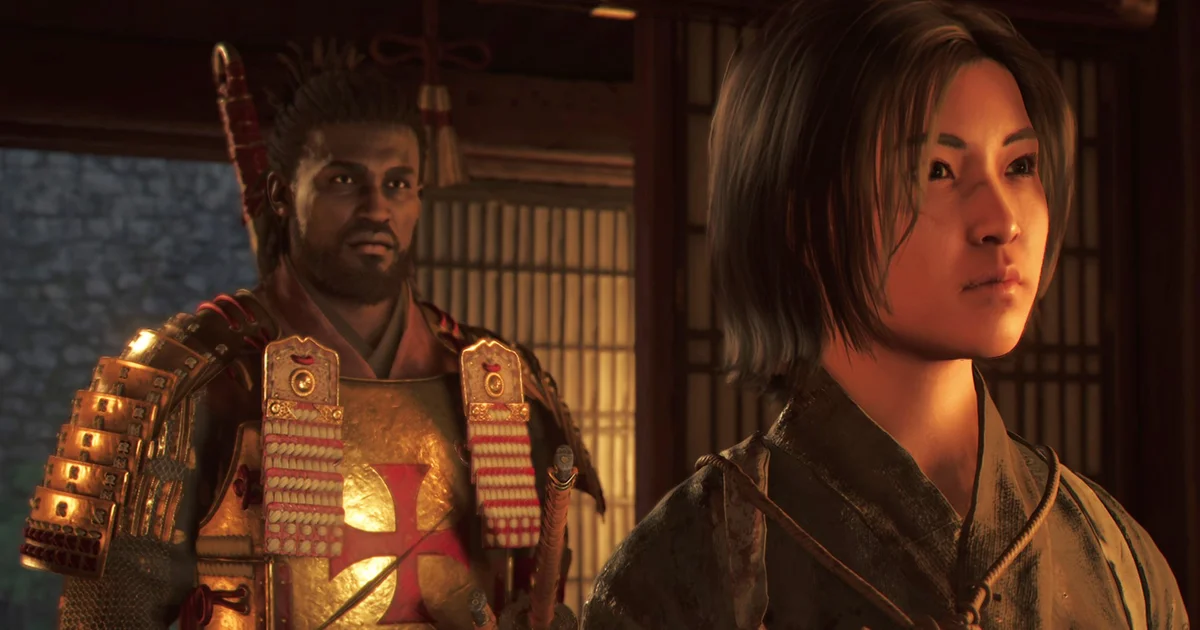
While it has only been pushed back by another month, I’m really happy to report that Assassin’s Creed Shadows is shaping up to be one of the strongest games in the series so far. After roughly six hours with it at Ubisoft Quebec’s headquarters last week, it’s easy to see that Shadows doesn’t simply meet the look and feel you’d expect from a next-gen Assassin’s Creed. It combines upgrades like tougher, more engaging combat, customizable base-building, and the thoughtful inclusion of two separate protagonists in a way that genuinely builds on what earlier entries tried to do. And if you’ve been following the franchise for years, you can breathe easy—this still feels like the Assassin’s Creed you know, just with a handful of fun surprises coming from unexpected places.
First up is a new Immersive Mode option you can choose before starting the game. When enabled, it automatically switches to the Japanese voice track, paired with Portuguese that fits the period—excellent for anyone hoping to experience a Shogun-style setting ahead of the second season, since Shadows covers much of the same historical window. It’s the kind of adjustment that, in many ways, should have been included in Assassin’s Creed from the start, and I was glad to experience it firsthand. Game director Charles Benoit said the idea was partly sparked by his own experience watching Shogun. “It’s more immersive. So why not implement it and make it more [at the] forefront [of the game]?” he explained, adding that it would be “a positive development” if future releases kept moving in this direction.
The biggest addition I ran into during my preview came partway through, when I realized I hadn’t yet taken the chance to climb one of the series’ well-known observation spots. After spending the opening hour with the game’s thrilling prologue—exciting, but still fairly linear—that section introduces the backgrounds of both Yasuke and Naoe with a flair that feels close to what Origins used to deliver. From there, I was placed in the castle town of Himeji, fully prepared and upgraded to level 25. I began my playthrough as the samurai Yasuke, but a quick stop in the menu let me swap over to the quicker shinobi Naoe whenever I wanted. The story also offers multiple moments where you can choose between the two, giving you the ability to decide who you want to take forward through the main missions.

In fact, getting to the shrine while playing as Yasuke proved a bit more demanding—at least compared with how quickly and smoothly you can reach it using Naoe’s grappling hook, which latches onto the right surfaces with a tap of the left shoulder button. Once I finally got into place, the familiar Assassin’s Creed panorama spin kicked in right away, unveiling a striking view below.
The surrounding detail and realism of Himeji’s waterlogged rice fields already struck me as a noticeable step up from Valhalla’s ground-level areas. Paper lanterns swung and bounced in the breeze, while spring trees were alive with pink cherry blossoms that swayed as the wind moved through them, thanks to Shadows’ updated physics system. Still, when you look down from this vantage point, the sheer scale of the scene really hits you. Fields stretch outward into rolling forests and distant mountains, and the outlines of other camps, castles, and shrine locations—often several kilometers away—keep pulling your attention further across the map.
Pretty soon, thanks to Shadows’ new seasons system, those pink blossoms and fresh spring growth in the trees and fields will give way to vivid greens and thick shrubs when summer arrives (and then to mud and bare branches once winter rolls in). For me, though, that first shift is still a few hours away—at least for the moment—because each seasonal change is controlled by a dial in the menu. You can trigger it manually after everything is ready, or let it happen automatically when you switch characters or hit an important plot moment during a cutscene. For now, I can’t bring myself to look away from Himeji Castle itself—one of more than 30 distinctive castles in Shadows—rising in the foreground above me. It’s not so high that I can’t still sneak a glance at its many detailed levels and the lived-in spaces tucked behind those imposing, unreachable walls that rise from its watery moat.
In my preview session, the main story objective soon pulls me into the center of Himeji Castle, but once the camera slips back under my control, question marks begin dotting the horizon. Like Valhalla, you won’t know what they represent until you go and check for yourself. They may point to sidequests or combat arenas packed with worthwhile loot, additional shrines where you can ask the deities for key mastery points to strengthen your growing skill set, or new faces who can teach Yasuke and Naoe extra moves for fighting.
If you hover over them for a moment, they’ll be added to Shadows’ full map. That map stretches from Himeji’s Harima Province in the west across Japan’s central area—including Kyoto and Osaka—before reaching Lake Biwa and the major religious sites of Nara and Mount Koya in the east.
You might expect everything up to this point to feel pretty standard for Assassin’s Creed. Then something unexpected occurred. After collecting everything I needed from Saifukuji’s viewpoint, I switched back to Yasuke—and spotted one of the franchise’s signature hay bales directly under me. Without really thinking, I started the familiar routine of dropping Yasuke into the ground using the well-known Eagle Dive. But Yasuke isn’t a lifelong Assassin. He’s a former slave turned samurai, brought from his previous Portuguese Jesuit mentors into the service of the famed historical Japanese daimyo Oda Nobunaga. Yasuke doesn’t know how to Eagle Dive, and when I drove him into the leap, he cried out and waved his arms in mild panic, smashing into the hay with a heavy thud. He then rolled away from it, grumbling and groaning. When he finally stood up—still carrying the same heaviness of middle age that Indy showed in last year’s Indiana Jones and the Great Circle—he commented that he’s getting too old for all of this as he brushed himself off.
In a few ways, I probably should have expected this, because Yasuke feels markedly unlike Naoe in nearly every respect. Naoe carries the kind of instinctive Assassin’s Creed muscle memory you’d expect, while Yasuke needs more effort. For example, his run is slower and clunkier (likely a result of the samurai armor he wears). Even tightropes don’t behave the same way—he can knock them loose, cutting off routes that Naoe could pass through without trouble. His moves through the treetops also come off awkward and unsteady, and he has difficulty finding his footing when he hauls himself up over scaffolding and rooftops. When he hides in hedges and tall grass, he likewise takes up more space in the scene—though that doesn’t seem to make him dramatically easier to spot by nearby enemies. As with Naoe, it looks like Yasuke can crouch or go prone with little drawback.
Because he’s built sturdier, he makes things a bit more difficult to…
Find ways to hide in deeper darkness, because the push-pull between brightness and shadow is crucial for staying out of sight. While you’re on the move, lanterns can be snuffed out and candles can be blown away, and a refreshed open-and-closed eye interface—an echo of Skyrim—helps you gauge more clearly how well you’re blending in when you creep. Keep an eye on that eye staying open often in winter too, especially once trees lose their leaves and bushes have little foliage left to provide natural cover. You may also get a boost from fog, which can conceal an opponent’s view just as effectively as a thick summer patch of grass.
Yasuke doesn’t have Naoe’s natural poise, and it’s harder for him to move through trees or climb buildings as quickly and quietly as she does. That contrast comes through clearly in his strained motions and in his character animation.
Audio is also more prominent in Assassin’s Creed Shadows. Even when you move with care, Yasuke tends to make more noise than Naoe. Conditions in the environment will further shape what you hear on your end: heavy rainfall, for example, can help mask louder steps. Still, that won’t do much when you enter the castles and have to deal with their painstakingly made nightingale floors—historically constructed to creak underfoot so residents would be alerted to intruders. Yasuke’s assassinations don’t exactly help either, since ‘Brutal’ runs before every so-called stealth takedown, drawing the notice of nearby guards and ronin warriors if you perform it too close. While the eye icon responds well to line-of-sight warnings, there’s no dedicated noise meter to tell you how loud you’re really being. That feels like a missed opportunity, and it’s hard not to think Shadows has space to grow here—taking cues from older stealth favorites like Thief and even Ubisoft’s own Splinter Cell: Chaos Theory.
That said, it’s not always a setback if Yasuke gets spotted. With a larger health bar and heavier-hitting attacks, he effectively outweighs Eivor—pushing Valhalla’s Viking thirst for blood and revenge to a whole new pitch. Even though I kept defaulting to his traditional long katana during my playthrough, his naginata spear also proved reliable when it came to dismemberment, and his bow along with his teppo rifle made him dangerous at range. My personal go-to ended up being his kanabo club, which includes a special move that can crush spines the way dried pasta breaks. Like in Valhalla, these attacks are mapped to your right bumper, but because mastery points are tied to building out both Yasuke and Naoe’s weapon trees, it will take a while before you can unleash them at their most destructive.
Yasuke’s teppo rifle (top left) is particularly handy for explosive barrels, and his sprint is also forceful enough to bring down enemies—and even certain doors—(top right) when you need to close the distance fast. If you line up his Stance actions correctly (below center), Yasuke can unleash devastating damage.
Naoe, on the other hand, uses a smaller lineup of weapons: a standard katana, a shorter tanto knife, and a chain-mounted spinning scythe called a kusarigama. Her real advantages, though, are rooted in stealth—drawing from the more traditional Assassin’s approach seen in earlier entries. That toolkit includes specialized bells to draw attention and route enemies to targeted spots on the map, smoke bombs, throwing knives, and other tools designed to remove threats quietly. She’s also the only character who can perform double assassinations and use a close-range version of Eagle Vision to spot enemies hiding behind doors and walls. Yasuke doesn’t have the same options; he has to depend on improvisation and a whistle, hoping enemies appear from concealed panels even though you can’t be certain whether it’s safe to continue.
To be fair, Naoe’s attacks don’t hit nearly as hard as Yasuke’s, and I ended up falling in far more often when I was up against groups while playing her. The urge to pull back for cover (or use her grappling hook to climb higher) was much stronger in those situations, but that doesn’t mean Shadows’ combat system as a whole is weaker than earlier games. If anything, it’s shaping up as the series’ most compelling combat yet, and fighting with Yasuke in particular often felt like a genuinely fun surprise. Much of that comes from each character’s new ‘stance’ moves—though they’re closer to charged attacks in practice than to true sword stances like those seen in Sekiro and Ghost of Tsushima.
By pressing and holding the right shoulder or trigger buttons, both Yasuke and Naoe enter a special attack stance. If you time it right, you can break through opponents’ guard and finish them with a satisfying, gory end. The payoff is a quick monochrome burst, then a savage red cut of blood as heads are separated and stomachs are pierced—a flourish that, as Benoit explains to me, feels more like the team’s affection for anime and manga than something drawn from Akira Kurosawa’s films. Even so, it still adds a striking look to every fight.
For Naoe, perfect dodges and, for Yasuke, perfect parries now leave enemies dazed and open to follow-up. This brings a new layer of timing, rhythm, and subtlety to the familiar light-and-heavy attack flow. It also highlights—and rewards—each character’s strengths: Naoe’s ability to evade, and Yasuke’s more aggressive, full-bodied pressure. As a result, the differences between them feel even sharper depending on who you’re controlling. Enemies also seem more clearly defined than before, which makes it necessary to keep switching between the two primary weapons regularly
you will…
have been equipped to take on smaller, quicker foes that can easily slip out of Yasuke’s kanabo strikes—such as alongside the more heavily armored samurai wearing daisho guards.
Regrettably, the one feature both of them were missing this time was a trusty eagle companion. Even if it’s impractical for either character to share one bird or keep two eagles hovering nearby all the time, the upside is that you can still tag enemies and point out nearby treasures and objectives thanks to their new Observe ability. It functions much like having a bird, just from ground level rather than above. Benoit adds that this change was intentional because, “sometimes, I feel we don’t observe the world [enough] as a player.” He cites the game’s 30-plus castles as an example. “If you have the eagle and you can just scan and unveil everything, everything may appear somewhat similar. But if you look from your viewpoint, with Observe, you feel much more immersed in the game. You examine the walls, you discover things with your own eyes and alongside the character, so I feel it’s a bit more engaging.”
He’s right, and I caught myself valuing the game world’s finer details more than I ever did in Valhalla or Odyssey. That said, I’d argue that those earlier games had several of their most memorable moments come from the chance side paths I stumbled into while moving through their settings. For instance, Valhalla’s nod to Alice in Wonderland, or its riff on the viral Fenton the Dog meme. In my own preview, though, this kind of quest variety and offbeat storytelling showed up far less often. To be fair, I only had access to a limited stretch of the Harima province during last week’s session, and Animus walls blocked any further travel—but I do wonder whether Shadows will end up feeling as lively between its major story beats.
There were multiple side activities to mess around with, though the two main ones I tried were both tied to Yasuke: a somewhat underwhelming horse archery challenge, and a kata exercise with a rhythmic, QTE-like feel. That kata relies on fixed movement patterns drawn from traditional kendo practice, and—admittedly—it also seems to fit the QTE mini-game format surprisingly well. Naoe gets her own parallel set of activities too, designed to strengthen her particular skills. This includes kuji kiri meditation points, where you memorize sequences of rhythmic button presses, which brings Final Fantasy 7 Rebirth’s summon shrines to mind.
Plenty of activities are available to both Yasuke and Naoe, but my personal favorite was sumi-e painting. In it, each character can pull out a scroll and an ink brush to quietly capture a small moment from nature—like boars locking horns or birds trying to split clam shells—once you creep in for a closer look. In the moment, it can feel a little goofy (and possibly more mundane than Valhalla’s quirky Fenton antics), but there’s a genuinely thoughtful touch: later on, those scrolls can be hung on the walls of your custom hideout. Beyond that, other paintings and animal encounters can unlock pets you can place—then pet—in the freeform building mode. And yes, I filled mine with cats and tanuki pups—naturally, I did.
The building features are straightforward yet easy to grasp—you can dig into more details in my fuller hands-on breakdown—and overall, it’s a welcome step forward from what Valhalla introduced with its Ravensthorpe homestead. Just like that base hub, you can go directly to your Shadows hideout from the map or fast travel there to rest, recover, and spend time with your recruitable allies.
Allies are a big focus for me in the full game, because every one of them comes with their own questlines that you can either succeed or fail in, with the goal of bringing them back to your hideout. You can also set up to two of them to support you during battles. In my preview build, they functioned like standout special abilities, complete with a noticeable cooldown after each use. The good news is that Shadows has adapted the safehouses from Mirage—called kakurega here—so you can manage these allies more smoothly while you’re out in the world, and also pick up additional quests and contracts around you. Oddly enough, unlocking them takes only a small amount of in-game currency. They’re also handy fast-travel stops when there isn’t a nearby viewpoint to warp to.
In a lot of ways, Shadows feels like a point where Assassin’s Creed’s earlier and more modern directions come together. It moves the series forward with deeper combat systems and a more refined exploration structure (even if it’s still heavily guided), while also staying true to its stealth foundation. Sure, you can still mow through everything if you prefer a more action-heavy approach, but I liked how much flexibility each mission gave me in my preview build. Even when the layouts of the different locations I had to infiltrate seemed tailored to specific characters, the broad selection of tools available to both Yasuke and Naoe pushed me to try far more approaches than I ever did in Odyssey or Valhalla. It’s refreshing to see an Assassin’s Creed that feels inventive again, rather than just another familiar rehash of what came before (sorry, Mirage). Beyond a few technical hiccups and a couple of system crashes I ran into, Shadows looks poised to deliver the feudal Japanese fantasy we’ve been waiting for. If Ubisoft can pull this off the right way, it should justify the long wait.
This article is based on a press event in Quebec, for which Ubisoft covered travel and accommodation.