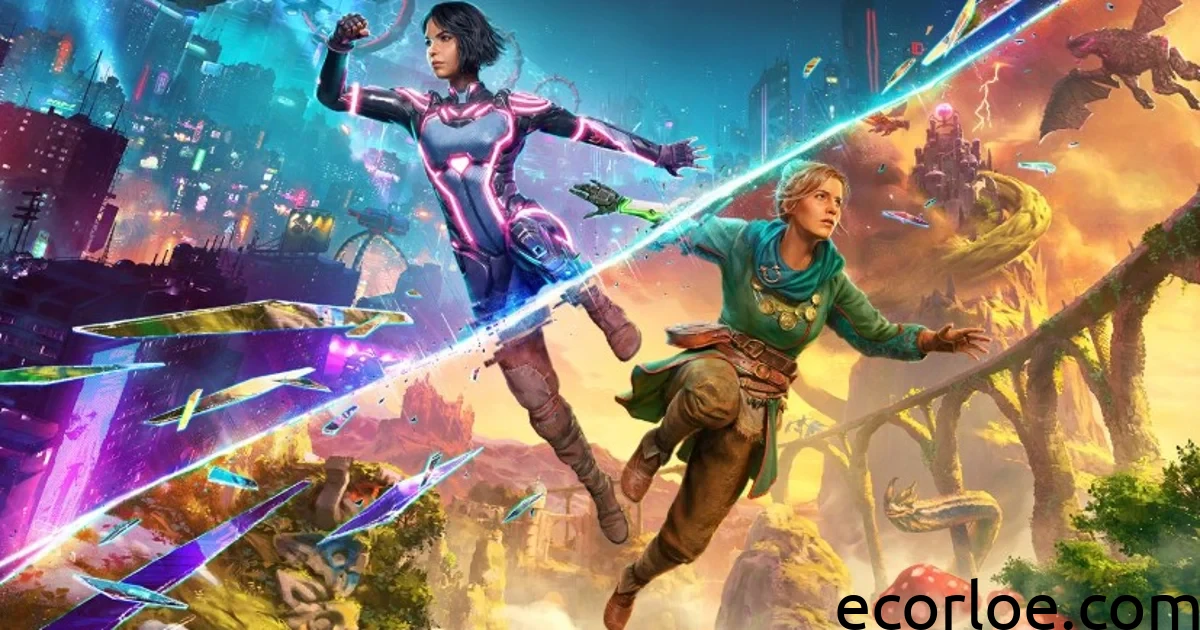
If variety truly sits at the core of life, then Split Fiction ought to feel like a bottle of punchy tabasco—packed with plenty of cayenne pepper and finished with a hearty spoonful of scotch bonnet chili flakes. Goodness, this game is a remarkably fiery mix of different experiences, spanning its locations, mechanics, abilities, and even its camera angles. Honestly, while I try to jog my memory of every separate moment from my Split Fiction preview, I’m struck by how hard it is to name them all. There was so much packed into the three hours I played, and it translated into an absolute delight that kept pulling me back in for the entire session.
What Hazelight has managed to deliver here is a natural step forward from their outstanding co-op efforts, A Way Out and It Takes Two—pushing their ambition even further. Still, before I get carried away, let’s return to the start, since that’s exactly where my preview began. Split Fiction kicks off by following Zoe and Mio, two hopeful authors trying to land their work with a publisher, and their aspirations appear close to becoming real thanks to a company called Rader Publishing. Yet there’s more going on at Rader than you’d expect from a typical publishing outlet. First, both writers are encouraged to feed their own stories into a simulation through a device known as, um, The Machine.
Zoe, an upbeat fantasy writer hailing from the countryside, is raring to go, while the more guarded and leather-clad Mio isn’t quite as convinced. It soon feels as though Rader’s intentions may not be as clear-cut as they claim, and when Mio refuses to take part in her own simulation, Rader’s boss (also named Rader) won’t let that stand. From there, everything spirals into chaos: Mio gets shoved into Zoe’s simulation bubble and lands inside Zoe’s creative world.
Unsurprisingly, Zoe is thrown for a loop when Mio—who seems to be a total sci-fi fan—suddenly appears inside her narrative, and the shock only grows when a strange purple, glitch-filled void tears through her once-comfortable surroundings. But before they can really process it, the pair are swept into a dusty sci-fi setting packed with metallic framework and hostile spacecraft—an abrupt break from the rural wooden beams and crackling hearth that define Zoe’s story. That’s how their adventure to untangle the mess begins—and it’s where the enjoyment really kicks in.
During this opening stretch, Split Fiction walks you through its platforming basics: double jumps, wall running, ducking incoming projectiles, climbing poles, grappling across deep gaps, and—just like It Takes Two and A Way Out—how crucial it is to pull these moves off together (and yes, a big thank-you to David Jenkins from Metro for being the Mio to my Zoe).
For example, after Mio used a switch to shut down a particularly ominous laser shield, Zoe could grapple to a safe ledge and then return the favor on the other side. A few moments later, we coordinated key inputs on a control pad to take over a ship; then, in another vehicle, Zoe had to bring down incoming enemy crafts while Mio steered both of us toward (relative) safety, along with yet another glitch portal. All of that happened within the first 15 minutes, and even though it functions as a tutorial, it does an excellent job of pulling me into the action and keeping my focus locked in.
And that immersion is exactly what comes next for Mio and Zoe. As soon as they make contact with the glitch inside Mio’s sci-fi version of events, they’re pulled right back into Zoe’s fantasy world… though it’s not quite the same story she originally shared with Rader Publishing. Hmm, yes—something feels off here for sure…

I’m not going to get into too many plot details here, since I don’t want to spoil more than necessary. But I can say this: every main story segment I played felt refreshingly original. Whether it was the more action-heavy sci-fi portions or the puzzle-focused fantasy sections, it all seemed new and distinct—bringing ideas I hadn’t come across before. Rather than leaning on well-worn fantasy and sci-fi tropes, it felt like Hazelight kept serving up surprises at every turn.
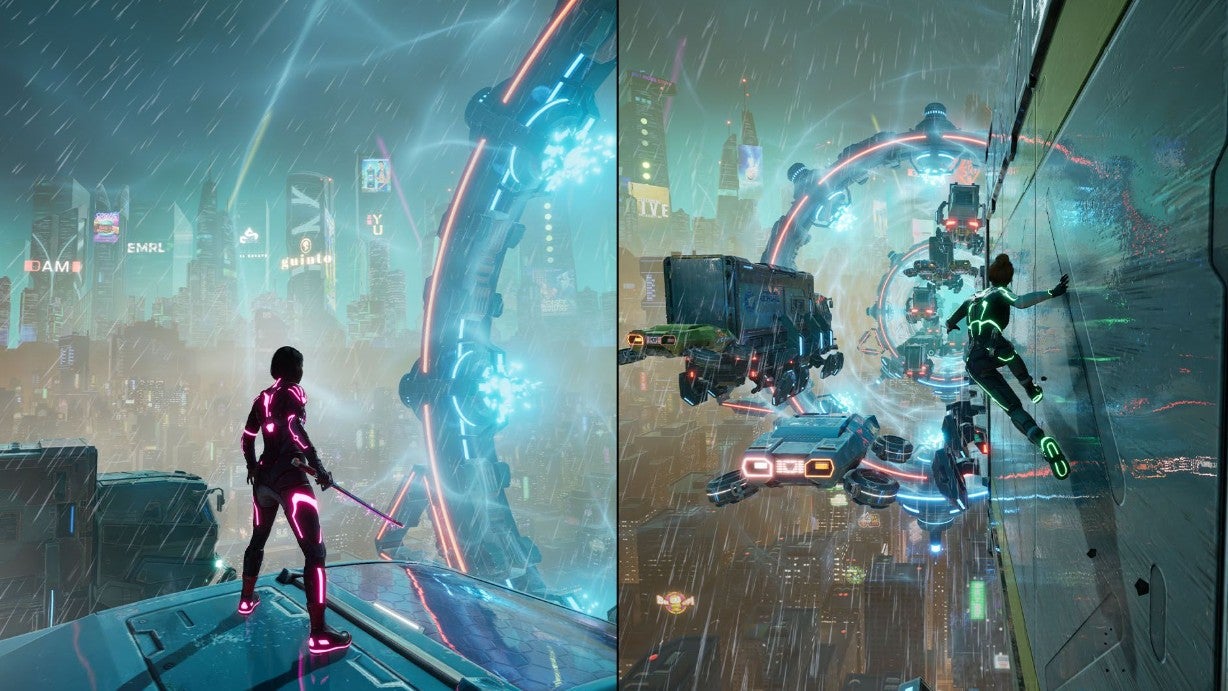
For instance, across those three hours, I took on the role of a Cyber Ninja using a gravity whip (which was especially handy for yanking enemies off ledges, like a futuristic Indiana Jones), ran from a huge, orb-like “parking attendant” boss who apparently believed dumping cars and firing lasers at me was a fitting response to unpaid parking tickets, and then morphed into a metallic zorb-like sphere that could project a magnetic aura—helping me roll up walls. I also encountered gravity pads that let Mio sprint along the ceiling. At one point, I felt like I’d been dropped into Tron, tossing pool toys (yes, pool toys) at flying vehicles while riding on the back of a motorcycle. Another moment saw me become a ball inside a pinball-inspired space, while my co-op partner pulled multiple levers to send me up ramps and, at times, straight into the void.
Still, the highlight of the main sci-fi stretches for me came from a section in a level called Final Level. In this phase, both Mio and Zoe are armed with blasters and grenades designed for breaking shields, but their gear is color-coded to damage particular enemies and objects only. Zoe handles the blue threats, while Mio focuses on the red ones—though there are also additional targets that either of them can shoot. What results is basically one long futuristic side-scrolling experience, with clear echoes of both Portal and Metroid. I kept thinking of Samus Aran stepping through portals to reach different areas within the level, right up until we finally faced a massive mechanical boss called the Overseer, who tried to wipe us out using lasers in a range of forms. He was a serious threat—trust me.
On the fantasy side, I had a blast running around on a dragon that could curl up into a tight ball to heave heavy objects—something of a nod to a Goron from The Legend of Zelda. I also got to switch into a tiny fairy, capable of chaining jumps through a lively stretch of forest scenery, and I even saw myself become a massive, Ent-like tree being that could extend its limbs to reach far-off spots. Overall, it was genuinely delightful.
As I mentioned earlier, the fantasy sections I played leaned more heavily into puzzles, especially when compared with the swift, high-pressure action moments shown in the sci-fi preview. Still, I’m happy to say they were just as engaging—mainly because the goals felt more considered and the spaces were built for exploration. In a level called Rise of the Dragon Realm, the pair needed to open enchanted gates by combining raw power with a dragon’s corrosive breath to rouse spirits hiding in a temple. That required a lot of coordination with my co-op partner: we had to guide our dragons up the grassy cliff faces, form glowing platforms for each other to traverse, and work our way through a line of golden orbs using temporary, slightly unsteady ramps.
Coming off the sci-fi stretches, this change in pace felt refreshing—though I’ll admit the earlier sequences left me with a mild cramped hand from clenching the controller as the tension kept building. I’m only half kidding (and yes, I’m making a joke), but I really did appreciate having a breather here. And as always, the sheer variety kept pushing me to see what came next. After each scene ended, I found myself eager to find out where I’d go next and what challenges would be waiting when I arrived.
Beyond Split Fiction’s main storyline—which is already packed—there are also optional side chapters tucked into the experience, delivered through small portals that pull you away from the core game. These are a notable step up from the mini-games in It Takes Two: rather than serving as quick diversions placed inside a level (like the fan-favorite “Whack-a-Cody”), these side narratives feel more like self-contained mini-games of their own.
During the preview, I tried out two of these side narratives. The first drew from a story Zoe wrote when she was younger, set on a farm. What really caught my attention was how it turned each author into a “Super Pig” inside the tale, instead of keeping their usual human looks. The game’s official line—“Hold Y to wallow”—has officially become my go-to prompt.
As these new pig-like versions of Zoe and Mio, the two had to move around the farm gathering apples to satisfy a series of hungry doors. Cooperative platforming was, once again, essential. Zoe’s pig could stretch into a huge spring, letting her jump much higher, while Mio’s pig could release a burst of gas to launch her through the air like a set of extra-breezy bellows—endlessly funny in the moment. At one point, I (playing as Zoe) jumped onto one end of a shovel, which sent Mio—standing at the other end—soaring upward. Then Mio released gas to lift herself onto a ledge that would’ve been unreachable, where she could grab an apple for that particular door.
Aside from the sheer silliness of our ridiculous pigs, this segment also squeezed in plenty of extra laughs. We ran into a giant pig, and jumping into its belly made it break wind, complete with an obnoxious green cloud. We also found the homes of the Three Little Pigs from the nursery rhyme and were able to knock them down. “I didn’t anticipate that farting force,” complained the brick house pig as Mio and Zoe strutted around the wreckage. This side story wrapped up in a darkly comic Hazelight style, echoing that elephant moment from It Takes Two, though I won’t spoil everything—because I’d rather you experience the same kind of joyful shock I had. Just know this: it probably isn’t a great fit for vegetarians.
The second side narrative was created by Mio, called Slopes of War. In it, the two competed for the highest score by pulling off jumps and tricks while
And, just as a small additional note, there was also the minor problem of conflict breaking out around them. A futuristic SSX—armed, essentially—with firearms; then I shot off, spun, and—on more than one occasion—stumbled my way down the slope as explosions flared all around me. Honestly, I loved it. (For the record, I also pulled off the highest score.)
With so much to watch and jump into, Split Fiction hardly felt dull or repetitive at any point during my time with it, and I’m really hoping the rest of the game can match this fast, constantly shifting stream of ideas. Even so, while each level takes place in its own distinct science-fiction and fantasy setting, every new portal dropped me into a space that felt genuinely different, largely thanks to the variety of environments and the fun blend of skills on offer. I already find myself wanting to return to the preview sections—this time, playing as Mio.
I’m also eager to find out whether, and how, the game expands on the compelling backstories of each character. During the preview, Zoe kept bringing up her sister, while Mio talked about her father (though I do hope we won’t run into another “daddy issue” storyline that echoes Lara Croft or even Chloe Frazer in Uncharted: The Lost Legacy). Either way, I’m interested to see how Hazelight keeps shaping its characters beyond what’s already on the page. Although the two leads begin as strangers, it’s clear that their relationship is headed toward friendship as the narrative unfolds—and I can’t wait to see how that develops.
One more point to mention—less of a criticism and more of a heads-up—is that Split Fiction comes across as notably tougher than It Takes Two. There were plenty of moments where timing and teamwork mattered a great deal, and at times it was genuinely hard to track everything that was unfolding, as well as who was handling what. I ended up falling a number of times than I would’ve liked to admit. Still, Split Fiction seems to be fairly thoughtful about checkpoints, so even though my character stumbled more often than when I played It Takes Two, it never turned into an exhausting loop of having to start over. On top of that, the steeper rise in difficulty made finally landing on the right moves feel that much better. Once everything clicked and we managed to keep progressing, my co-op partner and I felt exhilarated as we congratulated ourselves for pulling it off. It’s the sort of feeling I imagine is similar to a runner’s high.
Ultimately, even after such a short stretch with it, it’s clear that Split Fiction is starting to take shape as something special. When it’s often hard to find a title that truly separates itself from the pack—particularly when it’s doing something new and unfamiliar—I’m confident this one will deliver. Split Fiction is inventive, playful, smart—it’s simply… fantastic. I really can’t wait to get more of it.
This article is based on a preview opportunity for Split Fiction located in Los Angeles, for which EA covered travel and accommodation.