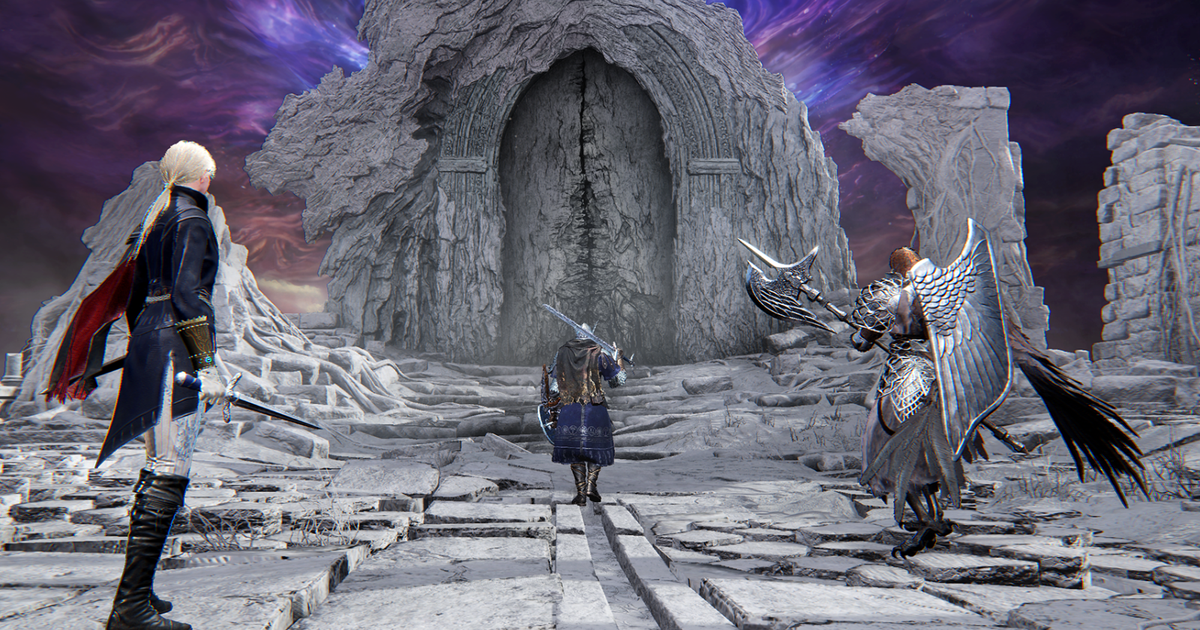
In the end, I gave up. After pouring more than a hundred hours into Elden Ring, I just wanted to reach the finish line. So, I brought in help for the final boss following a long, grinding session. After a quick bow, I stepped aside and let other players take over the toughest parts, while I stayed at a distance and threw spells. Even with that relief, I still felt drained, and when the credits finally began, the win felt oddly flat.
I ran into the same problem with Bloodborne. The DLC boss, Orphan of Kos, had me smashing my head against a wall for what felt like forever, until I finally dragged myself back to the closest lamp and asked for assistance. I expected a drawn-out, difficult fight—something we’d push through together in a big, celebratory team effort. Instead, they rushed in with a broken-looking weapon and ended the fight in a single blow. I felt misled, and completely deflated.
I’m not bringing this up as some sort of brag, pretending I’d rather play Souls games entirely solo. It’s more of a personal preference shaped by my own experiences. And yes—I’m the same person who plays Final Fantasy 14 with NPCs. I like moving through content at my own pace, with fewer distractions, while other people value the presence of teammates. Neither approach is wrong.
That’s why, when FromSoftware announced the co-op Elden Ring spin-off Nightreign, I was curious, but also a little uneasy. Would this fresh take on the Souls formula actually click with me? I’m happy to say that Nightreign really is a great fit. My mindset changed, and I’ve genuinely found the fun in playing alongside others. Honestly, who saw that coming?!
So what’s the deal with Nightreign? Basically, it feels like Elden Ring reshaped into a roguelike, mixed with the energy of Fortnite—or, if you prefer the analogy, like cranking the game’s soundtrack to double speed and turning on shuffle. It sounds strange, but somehow it works.
In squads of three, players work through two rounds of day-to-night progression before facing one of eight Nightlords—in this preview, that’s the cerberus Gladius Beast of Night. The map plays like an instanced dungeon, yet each run reshuffles loot and enemy positions. On top of that, the Nightlord you choose determines which bosses show up at the end of the day. Those boss encounters come from across various Souls games, though they’ve been modified with different movesets and mechanics (and no, you shouldn’t try to cut off the Centipede Demon’s tail this time—trust me).
(For clarity: publisher Bandai Namco told Eurogamer that although three characters are always required to play online, you can queue by yourself, with a partner, or as a full trio, and be matched with others as needed. Also, solo players can play fully offline with no AI companions.)
You launch into the level riding a hawk (much like Fortnite’s battle bus), and from there each day runs for roughly 15 minutes. During that window you have to gear up for combat: clear out enemies for runes; track down strong weapons; collect healing flasks at churches; take on minibosses for rewards; and upgrade weapon effectiveness. As the day wears on, an oncoming azure firestorm closes in and starts draining your health—again, very Fortnite-like—pushing you toward a boss encounter when night falls. Beat that boss and you move into day two in the same area, ready to explore and prepare for the next night’s fight. If you make it to the third day, it’s devoted entirely to a boss battle in a separate location.

That brings us to the biggest challenge: managing your time, since Nightreign strongly rewards fast, decisive choices. Do you focus on defeating smaller enemies for runes, or risk exploring underground dungeons where the loot is better but the storm makes it harder to move? Should you head straight to churches to strengthen your healing, or spend that time taking down minibosses to secure your set of three weapons and attribute boosts? And you’ll want to collect as much loot as you can along the way: your carry limits have been increased, and while weapon slots are capped, secondary effects still always come into play. So even if a greatsword ends up feeling too heavy for your build, grabbing it can still be worthwhile because it may end up improving your overall setup.
The most noticeable change compared to Elden Ring, though, is how much faster everything feels. Sites of Grace automatically restore health when you’re nearby, leveling has been simplified down to HP, FP, and Stamina, and characters can sprint. More importantly, fall damage has been taken out, and parkour tools let players vault over obstacles. Want to see a boss far off—or escape the storm pressing in? Just jump from a cliff, climb up on the other side, and run hard to put distance between you and danger. In Elden Ring this sort of thing wasn’t really an option, but in Nightreign, free movement gives you that thrilling, open feeling of Souls-like freedom. You’re not slowly sneaking through every dungeon or castle while memorizing enemy layouts—there’s no time for that. This is Elden Ring speedrunning, and the storm only makes the pressure sharper. Even random surprises, like bosses invading your session, can throw you off. If you aren’t quick, you won’t survive.
Playing again and again sharpens your strategy, since teammates coordinate their actions and decide priorities together. You can also mark locations on the map in real time, though that’s the only communication option besides voice chat. In the end, success in Nightreign comes down to trusting your instincts—without having to dig through menus or spend ages analyzing character builds. You need to instantly recognize whether a two-handed sword truly beats the dagger you’re holding; whether raising your Arcane stat will actually improve your damage; or whether you specifically need a bleed-focused weapon—so if you stumble across one, could you please drop it for me? Long-time Elden Ring players will likely feel instantly comfortable with this rapid, high-pressure style, while newcomers will need to adjust quickly.
Players are encircled by a purple meter, and the more damage you take, the higher the number of strikes needed before you can be brought back to life | Image credit: FromSoftware / Bandai Namco
While the completed game will let you pick from eight Nightfarers, this preview (plus the upcoming network test) limits you to four options.
You’re no longer assembling characters from scratch; instead, you choose a particular hero, each with its own set of skills and a distinct way of dodging. They loosely line up with familiar archetypes—Wylder is your flexible sword-and-shield brawler, while the bird-man Guardian functions as a sturdier, greatshield-focused fighter—but that’s only the starting point for how you’ll play. Learning to make the most of each kit is essential, and using them is genuinely a blast. I naturally leaned toward Wylder thanks to his claw shot, which lets you snatch bats out of the air and slide into bosses, then finish with his explosive Onslaught Stake for a decisive hit. Guardian’s Wings of Salvation divebomb also turned out to be especially handy for dealing with groups.
The Recluse, meanwhile, is the team’s sorceress, built around a more intricate mechanic: she draws magic from enemies (and even allies) to restore FP. Once you’ve collected three spells of the same element, you can unleash a stronger casting. She plays like a glass cannon, so she’ll likely take longer to get comfortable with than this preview implies, though I’m fairly sure the payoff will be worth it. Anyone who suggested magic is the “straightforward” path clearly wasn’t telling the truth.
There’s also the option to choose the same character as another player. In this case, coordination matters less for matching power levels and more for making the most of what each person brings to the team. For our latest run, for instance, we committed to The Duchess: a slightly mischievous character who can make the whole party invisible to keep enemy attention off you, and who can also rewind the last few moments of combat by replaying them through a ghostly enemy manifestation—extra damage included. With all three of us using bleed-focused weapons, we made excellent use of that Restage ability to pile on the status effect while swapping invisibility to erase bosses. It was a great time.
Cooperation plays a key role for resurrection, too. Bringing teammates back is as simple as striking them, but once the fight is underway, is it smarter to revive someone else—or focus on the boss yourself? If you die while exploring, you lose a level and the chance to revive yourself, though the dropped runes are still there to pick up, just like in the base game—even if that means risking a sprint back into danger. So, do you stick together to share runes and lift each other during exploration, or break off on your own to cover more ground across the map? Still, if all three players fall to a boss, that’s the end—you restart from the beginning in true roguelike fashion. With Nightreign, Elden Ring remains just as unforgiving as ever.
Relics provide a kind of built-in safety net. You earn them after each run, and they grant a range of stat or attribute boosts—like adding Scarlet Rot to your attacks or improving your effectiveness with certain weapon types. Relics are color-coded to correspond with the slots on each character. Some also come with effects tied specifically to that character, while a new currency named Murk will be used to increase the number and range of slots. The result is that you’re never truly stuck with a dead run, and as you accumulate more Relics over time, future runs become noticeably smoother—while also encouraging you to experiment with different Relics on different characters.
The only part of Nightreign I’m unsure about is how things will look at the end. It’s not yet clear whether the map will change depending on which Nightlord you choose to face. And once all eight have been defeated, what reason will you have to keep playing? At minimum, I’m curious about the giants that seem to be the source of the firestorm. Ultimately, this is a spin-off built for shorter sessions rather than a long, sprawling epic—but the core idea is strong. It gives FromSoftware room to explore a full live-service approach, complete with more maps, bosses, Nightfarers, and loot. To be clear, that’s something I’d happily get behind: add a handful of new assets and see what the system can produce—the options feel endless. Still, I don’t think that’s the goal of this project.
For now, though, Nightreign delivers an inviting slice of Elden Ring in a format you can return to again and again. It keeps the friction, progression, boss showdowns, and the feeling of exploration—but compresses everything into a fast, new kind of test. Meanwhile, its grim lineup of foes feels like a best-of Souls playlist I’ll gladly revisit. Most importantly, it pushed a solo player to swallow their pride and team up. Souls games have always been about defying the odds, hands shaking and hearts pounding. Turns out, sharing the win can be just as exhilarating.