In my view, the most rewarding games are the ones that give you plenty of moments worth sharing. Our previous editor-in-chief, Tom Bramwell, came up with the phrase “anecdote factory” when he reviewed Far Cry 3, and it sums up my experience with Atomfall very well. I spent 90 minutes with Rebellion’s upcoming radioactive RPG at a recent hands-on session, and I’m pretty sure I walked away with close to 90 stories—each one more unexpected and fun than the last.
This point (and one that’s highlighted in the longer video included below) hit roughly ten minutes into my time with the game. After avoiding a couple of furious Protocol soldiers, I decided to sneak up on them and take them out—only to round a corner and find one of them, completely unexpectedly, urinating against a wall. I couldn’t stop laughing when I sprinted over, dropped him with a few hits from my unmistakably British melee tool: a cricket bat.
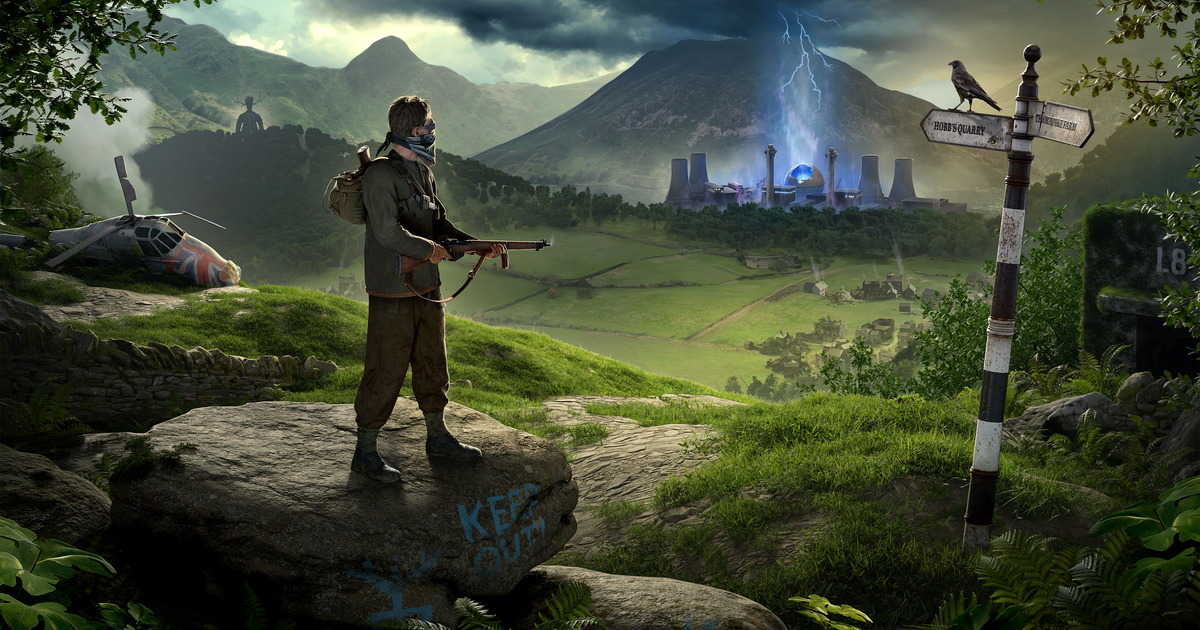
That said, I’m jumping ahead—Atomfall is an action RPG set in the picturesque English county of Cumbria, where all the gameplay takes place inside a quarantine zone created after a nuclear disaster. It draws loosely from the real Windscale fire of 1957, and that historical framing makes the apocalypse feel different. You don’t get the dusty, often lifeless ochre-yellow-brown look that shows up in many post-apocalyptic stories.
Instead, Rebellion places its story among the forests, hills, and lake edges of the English countryside. Bright colors are everywhere, from the deep, rich greens of Casterfell Woods and the bold reds of the instantly recognizable British telephone box, to the vivid blues and purples seen across mutated plants and animals. Even the Windscale power plant feels more like something from Alex Garland’s Annihilation than a typical Fallout setting, largely thanks to a subtle pinkish-purple haze that seems to pour directly from its smoldering reactors.
That doesn’t mean Atomfall is entirely unlike Fallout, though. It definitely shares a number of obvious touchpoints with Bethesda’s series—particularly because it’s set after a nuclear disaster. You’ll run into creatures that bring ghouls to mind, along with multiple NPC factions that range from fervent cult devotees to heavily armed troops, plus plenty of oddball personalities to cross paths with. Still, the combination of those gorgeous landscapes and the distinctive architecture of historic England makes Atomfall feel less like a direct copy and more like its own distinct world.

One of the defining ingredients of a strong RPG is player choice, and in my hands-on session I was dropped into a save file a few hours into the game. I was also told I could go anywhere and do whatever I wanted. The region itself—Casterfell Woods—seems to be one of several small sandbox areas, stitched together through loading screens. Even without a sprawling open world, though, the presentation still impressed me. The backwoods scenery, complete with uneven steps and collapsing walls, was genuinely striking, and the shallow river moving under my feet while I emerged from a tunnel into daylight was equally memorable. In fact, while I was busy taking in the view, I ended up walking straight into the line of sight of a group of angry Druids, who immediately turned hostile.
It’s important to mention that Atomfall runs on the same custom Asura engine used in Rebellion’s Sniper Elite games. So the moment I was spotted, my muscle memory from playing as Karl Fairburn kicked in and I threw myself into nearby tall grass. Unfortunately, it also revealed what could be the game’s biggest weak point: the enemy AI. Much like in Sniper Elite, enemies who detect you often march past your hiding spot again and again until they either lose interest or drift away. It’s a pattern I’ve seen in nearly every Sniper Elite title I’ve played, suggesting there may be some older systems working behind the scenes beneath the impressive visuals.
In the end, I did get the hang of the stealth approach, and that’s when I tried Atomfall’s melee fighting for the first time. It initially felt a little sluggish and awkward, though it was still a step up from Fallout’s close-quarters combat. The rusty guns I used later on also packed plenty of punch—especially the shotgun—but they take a long time to reload. The bolt-action rifle is particularly slow, so don’t rush into firefights, or you could quickly find yourself overwhelmed while trying to chamber a new round.
As I mentioned earlier, I was told I could explore wherever I liked during my preview, and there were a few notable points of interest north of the Casterfell Woods map that were said to point me toward some exciting parts of Atomfall’s action. Still, being me, I went in the total opposite direction—and I’m really glad I did. From that moment, I felt like I was living through my own personal adventure. Not long after, I encountered something that completely changed how I approached the game: a crashed helicopter carrying a distress message from Dr. Garrow, who had been seeking shelter in a nearby village.
Whether this came from a quirk of the demo, I can’t say for certain, but I soon learned that Atomfall doesn’t exactly hold your hand when it comes to tracking down clues like Dr. Garrow’s whereabouts. I worked out that I had to find the doctor in a village called Wyndham because of the note attached to the recording, yet aside from that, there were no visible map markers to indicate where they were exactly—or even where to start looking.
At first, I found the lack of directions unsettling. But once the moment passed, the absence of a map marker felt surprisingly refreshing compared to the usual waypoint-based routine that you get in Fallout and many other modern open-world games. Rather than simply following a string of objective breadcrumbs, I felt like I was setting out on something more natural—doing some real investigative work—which genuinely deepened the sense of immersion in Atomfall’s world.
While I was looking for the village, I came across hidden comic books, uncovered concealed treasures with my dependable metal detector, and got an unpleasant jolt from a massive, looming tower that set off a blaring alarm the moment I got close. I even had to defend myself from some vicious leeches using my cricket bat when they swarmed me while I was splashing around in a nearby lake. Overall, it felt like a real expedition through the English countryside—one that reminded me of my wonderful childhood in the Oxfordshire village of Garsington, where my friends and I would wander the fields acting like soldiers or duck into old barns to “hide” from imaginary zombies.
And that was only the first quarter-hour of my playtime. I haven’t even covered the mishap I triggered in Wyndham Village’s bakery, or what happened when I peered into the bunker-like Interchange, or how you can treat yourself to a pleasant cup of tea whenever you spot a charming teapot left lying around. I go into all of that in my video, though—so if you want to hear more about the game and see me interact with its memorable characters, from the serious Captain Sims to the eccentric Prudence Rook, Datlow Hall’s oddball owner whose butler Jenks has disappeared—then make sure you watch the video above.
I only spent about an hour and a half in Atomfall’s world, but it felt like I got more out of those ninety minutes than I have from many other games. There’s no shortage of wit, substance, and distinctive personality, plus a painstakingly built setting that captures the oddities and subtle details of everyday English village life—stitched together with a fascinating sci-fi storyline that keeps catching me off guard and pulling me in. Of course, the AI isn’t perfect, and the combat can feel a little stiff, but those are genuinely the only issues I’d flag. Given everything else the game showed me, I’m prepared to look past that. And if, like me, you felt Avowed was a bit too formal and restrictive, Atomfall might be just the cure: it has humor, plenty of chaos, investigative moments, and satisfying exploration. I’m honestly eager to play the full version of Atomfall after my first hands-on session, and I have a strong hunch you’ll feel the same.