I tried to approach Blades of Fire like it was another game I already knew, and I immediately paid for that mistake. In MercurySteam’s newest action-adventure—also the studio behind Metroid Dread and Castlevania: Lords of Shadow—I kept getting knocked down again and again. Only after I fully accepted what makes Blades of Fire so singular, stubbornly original, and hard to categorize did I start to see just how exciting it can be.
Blades of Fire was only announced last week, so it’s completely reasonable if you haven’t heard much about it. Still, it’s scheduled to arrive soon, on May 22nd. Remarkably, MercurySteam managed to keep the project quiet for four years. I honestly can’t figure out how they pulled that off with a team of 200 people—it’s an impressive accomplishment. From what I experienced at a preview event, the finished product feels close to complete and makes a strong first impression.
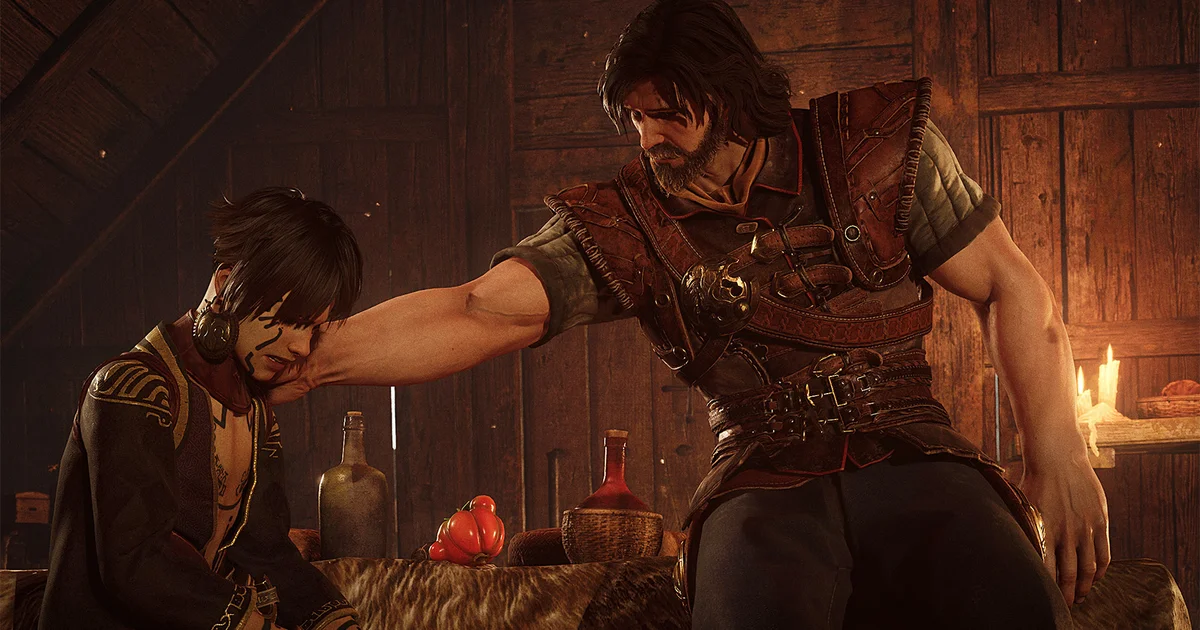
We’re deep in a fantasy world—luxurious, overflowing, and at times, brutal and twisted. Magic courses through a landscape packed with plants and alive with wildlife, while creatures like trolls and elementals roam around. Soldiers that resemble the Locust from Gears of War—same heavy build and pale look—hang back, waiting. The whole game has a chunky, weighty feel, similar to what you notice in Blizzard productions. Hands and forearms are notably large, and buildings and barriers look solidly built, which not only boosts the visual impact but also adds to the sense of sturdiness. You know that feeling from gunning down Locust with a chainsaw in Gears of War? You’ll get a comparable thrill here—smashing heads like watermelons with oversized hammers or cutting through limbs with broad sword swings.
In short: Blades of Fire—nothing like the ice-skating movie Blades of Glory—is an action-adventure that puts heavy focus on fighting, anchored by a distinctive forging mechanic. You play as Aran, a tough character who wakes up one day in some kind of pit and hauls himself out only to find himself in fights with soldiers, while a mystical forge hammer is thrust into his hands—something he seems to recognize, yet also fears. Once he swings it, he’s whisked away to an enchanted forge world where he’ll return again and again to shape his weapons.
This forging mechanic isn’t just a small feature—it’s the most thorough system I’ve come across. It turns weapon creation into multiple stages, each packed with decisions that shape the stats of your final weapon. You can, for example, choose the metals for different parts of the build, then refine the blade profile, cross-guard style, and pommel design. When it comes to hammers, you can even select the kind of wood used for the handle. Are you aiming for something huge and heavy, or compact and quick? Do you want strong blocking and parrying, or something a bit more responsive and precise? There’s plenty to weigh and consider.

That’s the troll I took down! The game delivers a darker spin on fantasy, which leads to some genuinely twisted creations.
To start, you pick the weapon you want to make from the scrolls you’ve collected, then you map out a design using the choices mentioned above. After that, you take a chunk of red-hot metal and work it into shape through a mini-game. The aim is to press a pattern into a specific form—somewhat like a graphic equalizer—except that when you hit one end, the other end shoots up, making it harder than it sounds. And to top it off, you’re limited to a set number of hammer strikes to finish the task. When you’re done, you’ll be graded with a star rating based on your performance. It’s unexpectedly detailed, and surprisingly engaging.
After you’re back in the game world, the value of the weapons you forged starts to become clear. The enemies you run into each have weaknesses that show up once you lock on. If they glow green, your current build is working well and you’ll hit for maximum damage. If they shift to orange, your setup likely needs improvement, since their armor will absorb part of what you land. And if they display red, that’s a bad sign—your weapon won’t deal any damage at all. In practice, it works like a traffic-light guide: lock onto an enemy, swap weapons and fighting approaches until you find the one that’s actually ready to work.
I’m aware of the idea that some weapons work better against certain enemies, but I’m not used to a system that can fully shut down your attacks when you’re mismatched. I’m also not familiar with this specific way of switching between options. Here, changing weapons means holding the right trigger and pressing the right stick, while swapping fighting styles is just a quick press of the right trigger (at least that’s how it worked with the PS5 controller I used that was connected to a PC). Fighting styles, meanwhile, change how you handle a sword—either emphasizing the blade’s tip for thrusting or using the sides for slashing. Hammers appear to be far more straightforward, mainly used for crushing. None of this has to sound complicated on paper, I realize, but once the fight starts, it can get difficult—especially when multiple enemies in a single group are calling for different approaches.
Blades of Fire’s
The combat system feels awkward almost immediately. Honestly, why put the dodge-roll on the left bumper? For heaven’s sake. It’s a clear example of how this game chooses to operate on its own terms, ignoring more familiar conventions
… the approach you’re taking. The face-button assaults are just as distinct. Rather than telling you whether a hit is light or heavy, they show the direction of your strikes. Different face buttons line up with attacks coming from the left or the right, or with blows aimed at either the head or the upper body. As long as you keep the button held, you unleash a brutal finisher—exactly as it sounds: a potentially lethal, intensely gruesome power attack. Remember those “watermelon head” takedowns I brought up earlier? Press and hold triangle to pull them off.
There are plenty of thrilling—and sometimes sharply punishing—moments waiting for you.
It’s an odd setup, but Blades of Fire uses it to connect with the earlier traffic-light system. Enemies can have separate weak spots—green-marked zones, if you like—so when their torso is vulnerable, that’s where you should focus. And if they’re not wearing a helmet, you’ll want to target the head. In the beginning, it can feel like a lot to take in.
Adding to that awkwardness is the game’s difficulty. For me, Blades of Fire sits somewhere between the Soulslike genre and the more recent God of War entries. In fact, there are plenty of similarities to God of War in how you play: you control a tough, older fighter accompanied by a spirited young companion named Adso. You’re soon tasked with cutting down an evil queen, and Adso pledges to stand by you—helping as a sidekick by highlighting enemy weak points and assisting with puzzle-solving. Combat delivers the punchy feel associated with God of War, but it also punishes you in the Soulslike style—not by taking away experience, but by forcing you to drop the weapons you crafted when you die. You’ll still have a basic sword, but to retrieve your equipment, you’ll need to fight through respawned enemies to reclaim it, which gets difficult if you don’t have the specialized tools you’d hoped to use against them.
Back you go to the forge then—and during my fourth or fifth visit, within the 90 minutes I’d played, the forging process started to feel a bit tiresome. The good news is that you can instantly rebuild weapons you’ve already made to cut down on time, but overall it began to lose some of its spark. I started to feel like I was pushing through the activity rather than genuinely enjoying it.
After that, things began to change. It started when I slowed down enough to comb through the game’s menus and built-in hints, which helped me spot what I’d been doing wrong. That’s where I noticed the small details I’d missed. With that clarity—and better weapons—plus a stamina recovery trick (holding block, which is surprisingly uncommon), I returned to the world and started winning fights again, including bringing down a huge troll that had been wrecking my progress for the previous thirty minutes. That troll, in my view, summed up the game’s stance toward me: a stubborn trial you have to overcome. Once I made that adjustment, I was finally ready to properly throw myself into the experience.
It might not sound like it, but I genuinely liked my time with Blades of Fire. I have a lot of admiration for teams that stick to their design principles no matter what’s popular, and that’s the impression I got here. Blades of Fire is distinctive. It shares a loose connection with a game developed years ago by some of the MercurySteam founders, Severance: Blades of Darkness, but mostly it’s a new project—and you can feel that. Since MercurySteam is co-funding, it gives the studio a chance to finally build something that truly belongs to them after years of collecting acclaim for other companies’ franchises.
“For an independent developer, the industry landscape is challenging to navigate,” CEO Enric Álvarez tells me. “We believe that if we lift off on our own wings it will open up bigger opportunities. It gives us autonomy. It gives us complete responsibility; we’re taking on part of the risk. Still, for us this isn’t just a risk—it’s a chance to create something that’s ours, without needing anyone else to make it happen. In that sense, Blades of Fire is an opportunity for us, both as a business and creatively. Of course there are risks involved. But what in life doesn’t include risk?”
Whether it will ultimately come together into a unified, polished product, I can’t say for sure yet, but what I’ve seen so far is genuinely exciting. Roll on May!
This coverage is based on a press event, for which food and travel expenses were covered by 505 Games.