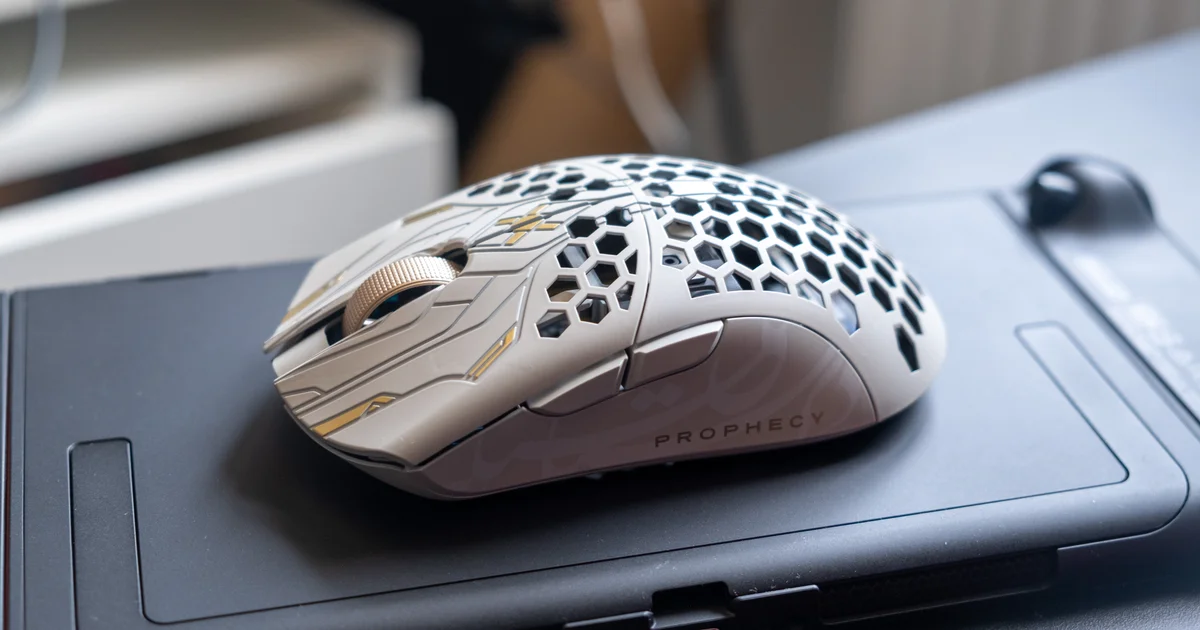
What’s the most you’ve ever paid for a computer mouse? For the vast majority of people, it likely won’t top £20—and even for PC gamers, many of the most sought-after models usually land somewhere between £20 and £40, like the £38 Logitech G502 or the £18 Razer DeathAdder. If you want wireless support or higher-end parts, though, you may end up paying double that figure. That brings us to today’s focus: the Finalmouse ULX Prophecy, which retails for a hefty £150.
At that premium price, you get a mouse that reflects many of the latest trends. It includes an ultralight 38-gram build, an 8000Hz polling rate, and strong wireless performance, plus an eye-catching look drawn from successful esports players. The question is whether any mouse can genuinely justify a recommendation at £150.
Practically speaking, probably not—you can choose an excellent ultralight gaming mouse that feels similar to the Finalmouse ULX Prophecy for far less, especially if you’re willing to look beyond major names like Logitech, Razer, and SteelSeries and instead consider lesser-known Chinese brands such as Lamzu, Fantech, Zaopin, or Epomaker. Features like 8000Hz polling and replaceable switch designs only stay “novel” for so long before most manufacturers copy them, usually alongside falling prices. That’s great for shoppers, even if it’s less inspiring for the early movers.
Still, the Prophecy has a certain magnetism. Part of it comes from the extravagant “hypebeast” style of marketing Finalmouse is known for—going as far as claiming that each Ultralight 2 mouse sold back in 2019 was flown to Cape Town and sealed with a five-day ceremony. But there’s also real attention to detail here, along with impressive performance in actual play.

The Prophecy is packed with thoughtful touches that reflect the decade of experience Finalmouse has built in lightweight gaming mice. Every area your fingers rest on is solid and subtly textured to improve grip, while hexagonal cutouts in other sections help reduce weight. Inside, reinforcing structures prevent the shell from flexing when you grip the mouse firmly—helping avoid accidental clicks.
It’s also offered in three sizes, all with the same overall look, so the experience stays consistent across different hand sizes. Finalmouse also uses this structure to support a 31g weight figure—though that weight applies only to the smallest variant. The craftsmanship is equally impressive, with detailed cutouts on each mouse button and refined gold-toned accents. Even the battery and PCB are designed to look attractive through the clear chassis.
That care carries over to the software, too. Instead of requiring an installation, you can tweak settings through a web interface—an especially useful option if you prefer a tidy PC setup or want to adjust configuration at a LAN café or tournament. There’s even a “tournament scroll” option that I haven’t seen copied elsewhere. It’s made to prevent rare, unintended single scrolls caused by a hardware quirk that can affect all mice. This is most helpful for competitive FPS players who map the scroll wheel to jump, which targets a specific audience—but it’s still an impressive inclusion, reinforcing that the mouse market in 2025 hasn’t become completely saturated with unnecessary extras.
Finalmouse has frequently faced criticism for quality control that hasn’t matched its pricing, but that concern appears to have improved—if not fully disappeared—with the Prophecy. Complaints online for this release seem very limited. Most buyers report no problems across multiple units, and the few who ran into issues were given replacements that addressed their concerns.
The review sample provided by exclusive UK distributor CCL has been working flawlessly since it arrived a few weeks ago. That holds true even for details like the scroll wheel and mouse clicks, which sometimes felt slightly off on earlier Finalmouse models. With CCL handling sales, you can also buy a Finalmouse as a straightforward product, which is a big step forward compared with the earlier, extremely limited “drops” that came with previous releases.
One thing Finalmouse has rarely fallen short on is in-game performance—and this continues to be the case. As you’d expect at this price point, it feels incredibly responsive during use. The combination of remarkably low weight and an unusually high polling rate results in performance that only a handful of the many ultralight mice I’ve tested over the years manage to beat.
I can’t say it’s the absolute best option, especially since ultralights have become so impressive in 2025, but the Prophecy definitely ranks among the leading models for shape, weight, balance, and grip. The mouse clicks feel light and responsive, even though there are some audible differences between the buttons. Wireless operation also stayed dependable throughout my testing. I never felt the need to swap out the PTFE skates or apply the included side-grip tape.
In many ways, this mouse almost single-handedly brought me back to Counter-Strike 2. It was so satisfying to reposition quickly and secure headshots during deathmatch. With the standard 1000Hz mode enabled, it’s also free of any major compromises that would limit it to high-level play. It works well for everyday use and slower-paced games, unlike some competition-oriented ultralights that trade away battery life, long-term comfort, or side-button usefulness. The real downsides are a rigid charging cable and the inability to remap the buttons, but neither issue affected day-to-day usability—plus third-party solutions can help with both.
Testing the Finalmouse ULX Prophecy over the last week and a half has been genuinely fascinating. It offers a look at the high end of the gaming mouse market. There’s nothing here that’s impossible to find in a cheaper alternative, but the combination of build quality, performance, and design is extremely difficult to match. That may go some way toward explaining the £150 price for the well-heeled enthusiasts this mouse is aimed at.
A Finalmouse ULX Prophecy review unit was provided by CCL.