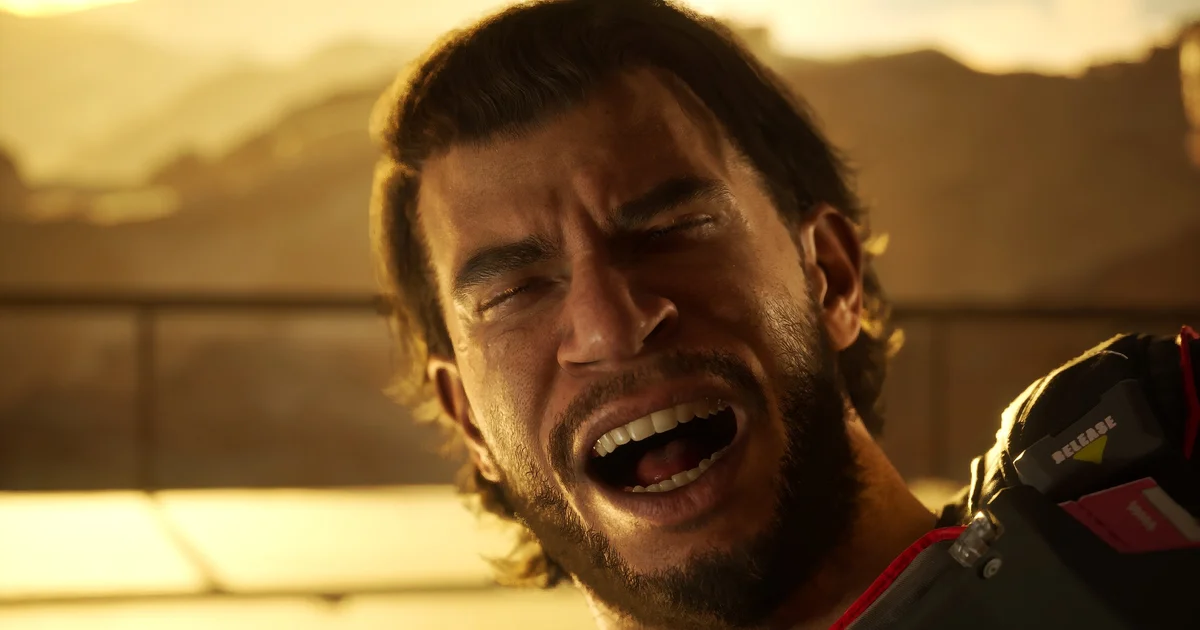
Even with a promising start, MindsEye ultimately stumbles under a ridiculous story, inconsistent prose, clumsily designed mission setups, and shockingly bad combat.
Given the score, it’s understandable if you doubt me, but I went into MindsEye feeling genuinely hopeful before launch. Back when cover shooters and huge driving games were everywhere, they were starting to feel exhausting. Now, though, when nearly every action release is either a soulslike, a roguelite, a live-service multiplayer shooter, or borrows heavily from Doom, the classic GTA-style clone really does stand out as a rare treat.
I know I’m asking a lot of your patience, but I genuinely believe there’s room in my life for fast, high-energy vehicular mayhem—and I was hoping Build A Rocket Boy’s first outing would win over the doubters ahead of release, turning into a thrilling nod to an earlier era. Instead, the reviewers might have been a bit too forgiving. MindsEye is, without exaggeration, a disaster. Its flaws run much deeper than the technical issues and oddly rendered visuals people have shared online; you’d need a pressure-proof submarine to dig through them properly.
Before the inevitable backlash arrives, I want to highlight a few things I genuinely liked about MindsEye. Even with all its problems, there are moments of imagination and craft here—glimpses of the game it might have become if it had simply had more time.
One standout is the opening. MindsEye follows Jacob Diaz, a military drone pilot, and we meet him in the desert as he tries to investigate an ancient underground complex (the game keeps returning to a running gag about whether it’s a pyramid or a ziggurat, which isn’t particularly funny, and is the sort of detail most characters wouldn’t realistically care about—though I’ll be polite for now and move on). Diaz uses the ‘MindsEye’ implant in his neck to mentally guide his drone as it drops into the structure, where it uncovers a set of strange glowing symbols on a door. Then the drone is hit by an unknown force, Diaz collapses and blacks out.
It’s a short, intriguing prologue that subtly challenges what you expect to see—dusty military types on screen—while delivering the kind of cinematic polish you’d associate with a studio tied to Rockstar North. That cinematic energy doesn’t just stop there; it extends through the prologue and into a large portion of the game. After being released from the military and losing connection to his MindsEye drone, Diaz winds up in Redrock City, a futuristic version of Las Vegas. He moves in with a friend who has lined up work for him as a security guard at Silva Industries. Still, Diaz has his own plan. Silva Industries, led by tech magnate Marco Silva, built Diaz’s MindsEye chip, and Diaz wants to recover the major pieces of memory that vanished during the operation that separated him from his drone.
It might sound like faint praise to call out the cutscenes as one of the strongest aspects, but I kept finding myself enjoying MindsEye’s presentation, even when it veered into its strangest and most confusing stretches. They aren’t the highlight, though. That distinction belongs to the vehicles. The game’s lineup—electric sports cars, SUVs, and off-road 4x4s—is beautifully formed, fits naturally in the near-future setting, and is usually a pleasure to drive. The handling leans slightly more arcade-like than modern Grand Theft Auto, but there’s still enough physical weight simulated that you feel like you’re steering around two tons of metal through every turn.

1. Offer us a kiss or the girl pays the price. 2. There are some intriguing mission ideas in MindsEye, but few are executed effectively. 3. Forget bungee jumping; it’s all about Humvee jumping. 4. The symbolism of a mini-game in which you dig your own grave feels a bit too obvious.
MindsEye doesn’t always waste its vehicles, either. Early on, you’re pulled into a car chase during a sandstorm, which brings to mind the key sequence from Mission Impossible: Ghost Protocol. The route through the city is drawn out and full of turns, letting you blast through side streets and construction zones to close the gap to your target. Maybe it’s just desperation on my part, but there’s a distant resemblance to the jeep section from Uncharted 4 here—and for a moment, I caught myself hoping MindsEye would deliver a full game packed with pursuits that adapt like that.
Unfortunately, car chases make up only a small slice of MindsEye’s overall playtime, and none of the rest match the quality of that opening chase. More often, vehicles simply act as a way to get you between a handful of key stops across Redrock. It might be fun if it were paced more casually, but MindsEye seems unwilling to let you linger and absorb its atmosphere. As you head toward the next major set piece, characters keep phoning and needling you to hurry—move faster, don’t slow down, don’t take your time. It’s a curious flip of Grand Theft Auto IV’s phone interruptions. Instead of Roman telling you to go bowling, you’re on the receiving end of constant scolding from your computer.
I can’t tell if this is meant as an attempt to build tension, or if the game pushes you this way because it doesn’t want you to pause long enough to really take in its world. At first, Redrock impresses, especially with its glittering downtown and a Las Vegas-like sphere full of colorful, fictional advertisements. Still, the longer you explore, the more its artificial feel comes through. From above, you can make out the tiled structure of everything, and the lines separating downtown from the suburbs—and the suburbs from the desert—are far too obvious. You also don’t spend much time actually moving through the city itself; most of what you do is drive between places on the edges, including Silva’s factory and an abandoned mine.
This isn’t necessarily a major design shortcoming—Redrock simply wasn’t meant to function as a lived-in simulation the way Los Santos or Night City does. Instead, it acts as the setting for the specific story BARB is trying to tell, and it fulfills that purpose well enough. The problem is that the narrative built around Redrock just doesn’t land as compelling.
It starts strong, pitching itself as a politically charged techno-thriller. Not long after joining Silva Industries, Diaz becomes entangled with Marco Silva directly, playing a role somewhere between fixer and private bodyguard. There’s a certain tension worth noting here: Diaz strikes up a strained sort of rapport with Silva while digging for clues about his past. For a moment—and maybe this was yet another burst of culturally-starved excitement—I found myself wondering if it would take a path similar to The Night Manager, swapping Hugh Laurie’s arms dealer for an Elon Musk prototype to explore how tech billionaires exert unchecked influence over public life and government decisions.
But that’s not what happens. MindsEye largely sidesteps the fact that Silva is a billionaire. It acknowledges his selfish streak, yet it clearly tries to avoid presenting him as an outright villain, leaving his true purpose somewhat unclear. Rather than Silva, the main antagonist becomes Diaz’s flamboyantly performative ex-commander, who plans a military coup in Redrock with the help of a cyborg Elias Toufexis. At that point, much of the story’s substance evaporates. And this isn’t even the most implausible turn the plot makes—the final stretch drags MindsEye from a mildly believable near-future concept into low-rent sci-fi nonsense.
Any writer would struggle to blend these elements, so it’s no surprise the script’s tone swings hard and often. In principle, MindsEye aims to be a more serious undertaking than Grand Theft Auto, discarding its misanthropic satire and rough-edged caricatures. Yet once Charlie enters—Diaz’s offbeat female hacking companion—it keeps sliding toward the kind of breezy, punchline-heavy banter that had already started to fade by the time of Avengers: Endgame. “Is that gunfire I’m hearing?” one character asks Diaz over the radio during a firefight, and Diaz answers, “Well, it ain’t popcorn!”.
Still, none of that is ultimately what drags down MindsEye. The biggest weakness is the combat, and it’s the poorest I’ve encountered in a high-budget game in at least the past ten years. To start with, Diaz himself is among the least capable action heroes I’ve ever had the chance to control. His four combat options are sprinting, crouching, taking cover, and shooting. He can’t dodge. He can’t throw grenades. He can’t use his weapons while driving. He has no melee attack. Even worse, he can’t enter a car from the passenger side—he instead has to run around to reach the driver’s seat, a habit that ended my run more than once.
The one thing that sets Diaz apart is his drone, which becomes available not long after the campaign gets going. In fights, the drone is mostly for disabling enemies and breaking into robots—useful abilities, but hardly the most exciting or engaging. Near the end, it also gains the ability to drop grenades, which only improves combat a little, much like adding bread might “spice up” a sandwich.
Even with those tools, combat has neither flair nor any real sense of reward. The weapons on offer are fairly varied, including some solid choices like the sniper rifle and a laser cannon that arrives late in the game. Even so, the damage feedback is so underwhelming that it might as well not exist. Shots are accompanied by a tracer effect that moves so slowly it drains all the impact from the bullets it’s supposed to highlight. Firing on a human opponent triggers a weak little burst of blood that looks like ketchup, and they drop like an NPC from Goat Simulator. And humans are, by far, the most enjoyable enemies to go up against. The copbots lumber along sluggishly—slow enough that Diaz could probably grab a meal break while standing over them—while the different airborne drone types you meet are among the clearest examples of irritating floating foes.
As for the AI, it’s inconsistent at best. Sometimes it tries to flank you properly. Other times, enemies just hang out in the open, waiting to be shot, or rush past you while searching for cover with no clear purpose. To be fair, the pathfinding suffers because the levels aren’t especially polished. Enemies appear spread through combat areas in a way that feels almost random—sometimes they’re placed over spaces too big for a satisfying fight, and other times they crowd together so closely that their models start to overlap.
This
Carelessness undermines several mission ideas that, had they been crafted with a different approach, could have turned out far more memorable. Two of the missions task you with escorting Silva’s rockets to their launch site. While either concept might work, the enormous caterpillar-tracked rocket carrier makes for a particularly strong backdrop for a firefight. That said, the opening stretch includes no combat on the rocket…
In one case, you steer your drone to closely inspect the vehicle’s treads—among the many objectives where the primary style of play is essentially “watching.” In the other, you’re dropped into a combat-focused VTOL aircraft, letting you easily overwhelm enemy vehicles as they close in.
Even worse, many of the missions only make things feel more awkward. Some of the clearest examples of MindsEye’s weak game design show up in its side activities. You reach them through portals placed around the game world, and they’re presented as a way to highlight what MindsEye’s building tools can do—tools that supposedly let players repurpose in-game assets to craft their own experiences, such as races, shootouts, and more. The toolkit is undeniably capable, though it’s also quite involved for anyone casual, so it’s hard to accomplish much beyond dragging and dropping a handful of elements unless you’re willing to invest a meaningful amount of time learning it.
Unfortunately, the first side mission you encounter—one that flashes back to a hostage rescue during Diaz’s time in the military—is shockingly bad. It’s an uninspired run-and-gun scenario where you move through randomly placed enemies, caught in sluggish and unrewarding combat. There’s no sense of pacing, little thought behind the setup, and no real framing or purpose, with the whole sequence lasting about two minutes.
Other examples have you playing as a member of the “Back Niners” crew, starting the mission immediately surrounded by police. (It’s worth noting that those cops never show up anywhere else in the game.) There’s also a task where you take on the role of a mercenary sent to clear an apartment complex of gangsters—by, essentially, blowing up every vehicle around them. That mission might be more enjoyable if you were given some kind of throwable explosive to use instead.
This all points to the cause behind MindsEye’s disastrous result: you simply can’t build an action game in 2025 on the back of underwhelming action. It’s not really workable. If the industry has learned anything at all, it’s the craft of shooting enemies with firearms—and there are countless examples that show exactly how to do it well. In fact, there are action games released ten, even twenty years before MindsEye that are simply more satisfying to play. Max Payne 3, which is thirteen years old and is the weakest entry in the series, is still a far better experience than what MindsEye delivers.
Beyond that, if this is really the best BARB’s creators can offer to demonstrate how much potential MindsEye’s building tools have, then why would anyone feel motivated to use them? It would be like buying bricks from a builder while his house is actively falling apart. Even if the game were genuinely strong, I’d still wonder about the overlap between fans of older, straightforward linear cover shooters and people who enjoy Roblox-style building platforms. Still, the BARB-built game doesn’t encourage me to engage with the creative side at all.
The factors behind MindsEye’s unhappy state will likely become clearer over time. Still, there’s a line from the game—possibly the most striking one in its scattered, meandering script—that has stuck with me since I first heard it. Considering Silva’s lifestyle, one character tells Diaz, “That’s what corporate billions gets you these days – immunity from reality.”
After the campaign ended, I wandered around MindsEye’s empty “Free Roam” mode—controlling a completely different character outfitted as if he’d had a parachute mishap, then landing in the warehouse where Call of Duty keeps all its loot boxes. From there, I could only guess whether MindsEye offered more than a hint of immunity from reality itself.
A copy of MindsEye was independently procured for review by Eurogamer.