An inventive, imaginative RPG-lite, and a praiseworthy follow-up to the TRON franchise.
In a world where whether a title feels better as a handheld experience or a full console affair depends almost entirely on personal taste, it can sound pointless to insist that TRON: Catalyst is especially fun on the go. Still, it genuinely is. Playing it brings you back to the feel of a standout PSP or DS-era companion release. The whole thing is built around quick sessions, with uncomplicated controls, short quests, and tightly focused story beats. That compact approach shows up again in the pricing. Sure, Catalyst comes with an unassuming indie budget, but the ambition behind it is anything but modest.
I should take a moment to underline that Catalyst’s emphasis on handheld-friendly play doesn’t mean the game is somehow less impressive. Its story, delivered in a visual-novel style similar to Bithell Games’ earlier TRON: Identity (which, as it turns out, works far better as an elaborate prologue to this than as a separate release), takes you on a high-stakes ride through the sprawling Arq Grid. The narrative is presented with the same vibe as classic Bioware games. Picture a streamlined Jade Empire, and you’ll get the general idea. The game moves forward through chapters at a steady pace, moving between areas without dragging, with only a handful of optional side quests—plus just enough openness to make you feel like you’re exploring, even if you’re largely staying on rails.
You won’t have to sit through long, overproduced CGI sequences, and the game doesn’t really feature meaningful choice-and-consequence mechanics. (There’s enough dialogue branching to suggest depth, but it’s mostly skin-deep.) That approach could feel odd if you liked the studio’s previous TRON entry or their earlier work in this style. For example, Subsurface Circular was a sci-fi game set entirely in one location, telling its full story through a detailed dialogue framework. It focused on androids pushing back against a human empire, all while you stayed confined to a train carriage.
TRON: Catalyst tells a similar tale about an overstretched system of authority running into resistance from a disgruntled underclass of programs. Those modern echoes are easy to spot. Even so, it won’t give you major freedom to reshape how that story plays out. Instead, it hands you a healthy checklist of objectives—along with plenty of exciting TRON moments to keep you busy.
As you’d expect, Catalyst makes smart use of the TRON universe. Close-quarters combat and long-range traversal are handled in a satisfying way through the Identity Disc and Light Cycle. Since these are the core activities you’ll spend most of your time on, it’s a relief to say the combat system feels sharp and enjoyable. You can toss your ID Disc at enemies, or just smash them with it. The disc can also act as a defensive barrier, helping you deflect both disc attacks and melee hits. That said, in a 2025 release, you’ll mostly be judging your timing with parries and dodges.

A simple RPG-lite skill tree lets you strengthen these basics—like expanding the parry window and enabling your disc throws to ricochet between opponents. As you progress, the game unlocks more involved options, including the ability to temporarily “steal” an enemy’s weapon or turn them into a concussive burst that knocks foes back.
I’m basically describing what every hack-and-slash game does, but Catalyst’s execution stands out—both in how the fighting feels moment-to-moment and in how smoothly the TRON mythology is worked into nearly every corner of gameplay. You could argue that without the franchise’s name behind it, Catalyst might come across as pretty routine. Think of how Arkham Asylum wouldn’t hit the same without Batman, for instance. But that comparison doesn’t really land here, because Batman is, in fact, right there.
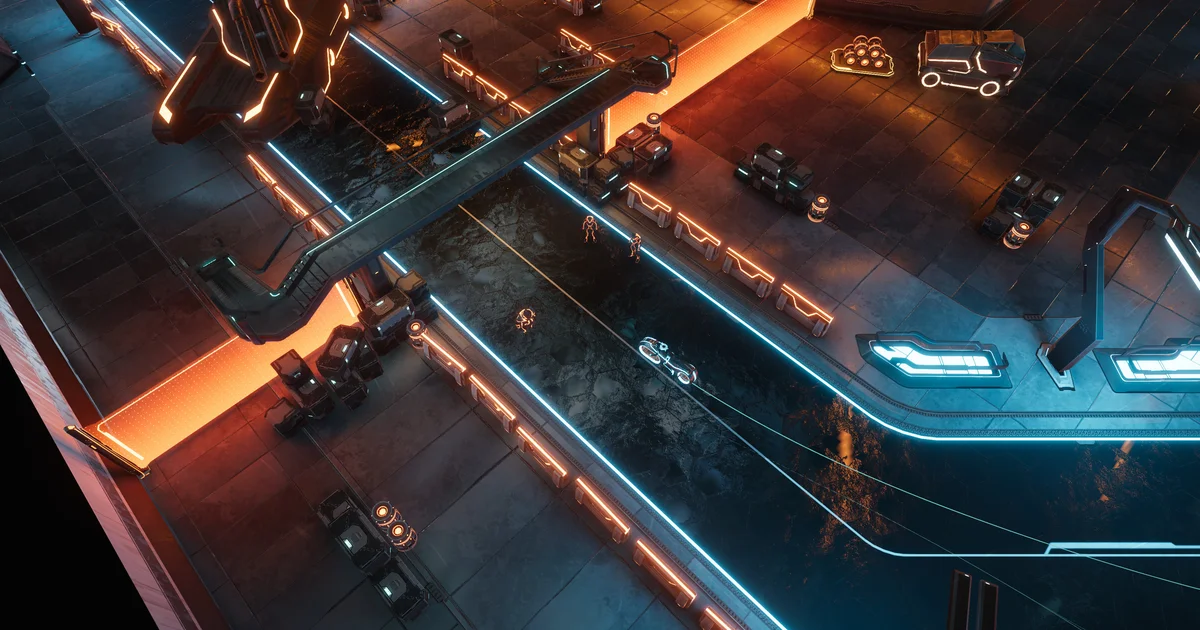
TRON: Catalyst includes Light Cycles, and zipping around the isometric city layout is genuinely entertaining—assuming you aren’t smashing into hazards (a user mistake, admittedly). Early on, your bike mainly functions as quick transportation across the Vertical_Slice city (a slightly amusing label courtesy of Bithell). Later, as the plot shifts into broader, more apocalyptic areas, the vehicle combat becomes a real Light Cycle showdown. In practice, that means fighting against a group of similarly mounted rivals, relying on speed, tactics, and a light wall you can place behind you to bait other riders into crashing into each other.
Catalyst also breathes new life into modern Light Cycles—the version where you can move through believable curves and the movement behaves more like a real motorcycle, instead of the sharp, unrealistic right angles from the original idea. The franchise’s goal, after all, was to turn an ’80s arcade classic into something more cinematic, and trimming the tight turns didn’t feel like the right modernization choice. At least, that’s what I assumed—until Bithell Games reshaped it into a chaotic form of motorcycle combat across the digital world. It goes on to
…the arena grid, where it presents itself as a sort of neon Mad Max.
There’s a practical explanation for why Catalyst doesn’t draw on the original Light Cycles: Bithell Games’ entry into the TRON universe happens well after TRON: Legacy, the franchise’s blandly received second outing. Because of that, Catalyst—unfortunately—must lean on major design choices and visual phrasing from a film that, in the end, landed as mediocre, even if it did have some redeeming beats (particularly Michael Sheen’s exaggerated, Bowie-like club owner and Daft Punk’s infectious soundtrack during that segment).
Within those limits, it delivers admirably. The 2010 movie’s take on TRON—filtered through a gloomy teenage bedroom aesthetic, complete with smoky atmosphere and a dark color scheme—stands in stark contrast to the original film’s strange primer-grey backdrops and fluorescent outfit designs. Neither release is a cinematic masterpiece, though the first one at least carried a nascent spark of wonder. Maybe that was helped along by its accidental influence on the direction of filmmaking, telling an exciting story about how computers work—machines which, back in 1982, were mainly used for payroll and inventory tasks. With that in mind, the antagonist is simply a suited figure (since villains, as a rule, tend to come in suits).
It wouldn’t be honest to claim TRON: Catalyst brings the series back to the stranger, lighter roots fans associate with its earlier spirit. What the game accomplishes—confidently and with genuine charm—is operating inside that mythology, while also borrowing from the real-world vocabulary of technology to carve out fresh paths within the TRON setting. The closest example is time travel. Each chapter of the game is staged in a defined slice of system time called a loop. You play as Exo, who can notice and produce changes that occur beyond those loops, then push time back to an earlier moment to undo specific actions while keeping elements such as character progress, code items (keys and bits of intel), and shortcuts you’ve already unlocked. For a game built around time loops, it’s unusually thoughtful about not becoming trapped in endless repetition.
There are plenty of chances to preserve your progress—unlocking different spawn locations, for example—that soften the irritation of having to reset the world state. That means you can spend more time focusing on the most engaging parts. Sometimes this looks like discovering fresh outcomes replacing what you saw before, and other times it’s a matter of unlocking access to areas that were previously off-limits. This is where its Metroidvania instincts really come through. New abilities don’t just add tools; they open up fresh routes, and older battles start to reveal different angles. When you die, the loop restarts, but your health bar is restored too—so you get one per cycle.
Still, it’s worth being clear that this isn’t a sandbox system you can tinker with the way Deathloop invites you to. For one thing, the game always indicates when a loop will be helpful, and since it doesn’t include immersive simulation mechanics, there’s not much to experiment with. Instead, it makes the standard “death” concept much more interesting than simply punishing you for slipping up. It’s not the only game to treat death and rebirth in this manner, but it integrates neatly into the TRON setup, since “glitching” back to an earlier “restore point” fits like a natural skill within that world.
Both tone and presentation place it firmly in the role of a TRON: Legacy spin-off. Yet it charts a dramatically different route, taking place in an entirely new computer ecosystem—the Arq Grid—complete with its own community and obstacles. In the story, Flynn (Jeff Bridges’ character from the original) built it as a haven for ISOs: programs that emerged inside the system and weren’t written by a human creator. Their very existence is treated as heresy within their home grid, which is hardly hard to understand. Picture being certain that God is real—and that he happens to be Jeff Bridges living just down the road—only to then learn that others show up who have no real connection to him or his intent. Those people used to be targeted simply for having unusual moles.
In the films, these ISOs nearly vanish due to genocide. In these games, the survivors have formed a new society in a different system, and—hundreds of cycles later—that world is now teetering toward collapse in a thin, climate-change-inspired metaphor. At the same time, there’s also a new kind of internal tension between ISOs, who cling to the idea of human users, and a new breed of self-emergent software, Automata, which rejects the premise of intelligent design and denies the existence of human users outright.
Once more, there’s no need to unpack the real-world parallels; however, these allegories are inevitably imperfect, and the source material is distant enough from today’s news that it would be unfair to pull an explicit takeaway from the narrative beyond the general lesson that power corrupts, and that oppressed communities often develop a strong urge to resist their oppressors. And, yes—Light Cycles are impressive.
As is often the case with Bithell Games, the end result is greater than the sum of its parts. Thoughtful, evocative writing with a touch of humor pairs with well-grounded game design that handles the basics expertly. Since this project exists only because a quirky, inventive platformer with geometric shapes lives inside a malfunctioning computer system, it’s no surprise the studio’s first major TRON outing understands what it’s supposed to do.
TRON: Catalyst is polished and streamlined, and it makes good use of its license in ways that feel genuinely inventive. It’s satisfying to play and looks spectacular—particularly if you’re lucky enough to be using an OLED display, where its vivid neon accents really pop. Of course, this owes a lot to the original material, but it’s still worth emphasizing that it supports a thoroughly enjoyable overall experience. On top of that, it demonstrates real ambition. Even if it’s positioned as a budget release, nothing about its plans for these irritable, energetic little computer inhabitants feels cheap.
Code for TRON: Catalyst was provided by the publisher.