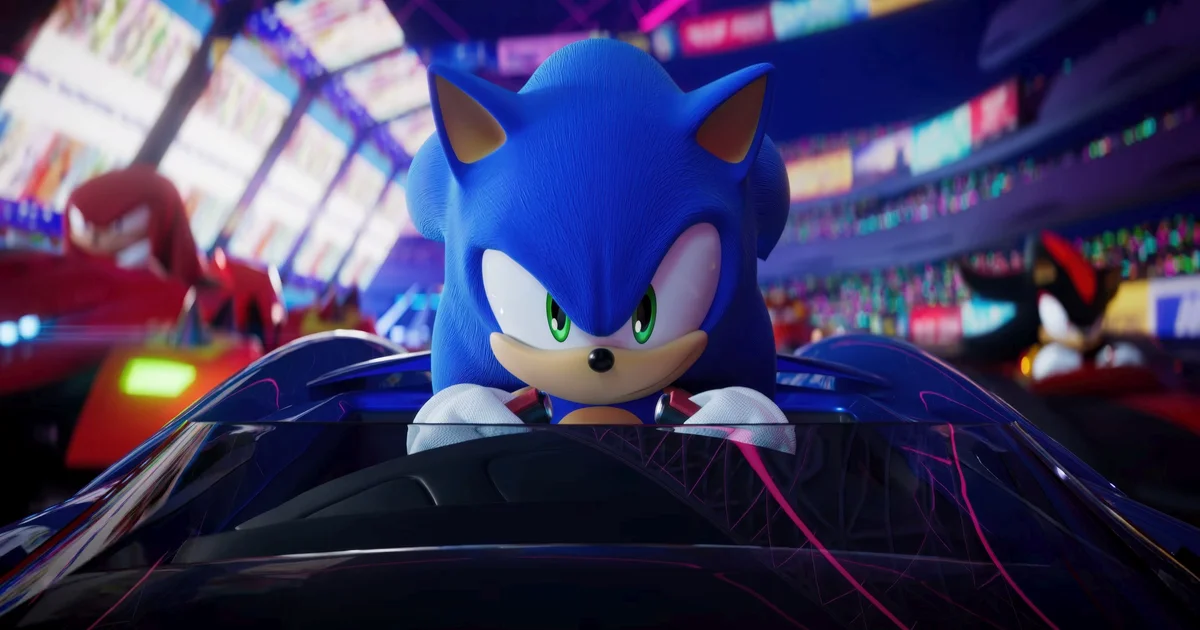
A fun-filled arcade karting romp can feel wildly over-the-top, but a well-tuned handling model with a surprisingly high skill ceiling brings in an unexpected level of substance.
Recently, I decided to throw myself fully into the things I’m into, which meant getting rid of every old polo shirt that had me looking like a wannabe golf pro from the lower-middle class who also ran a carpet shop. In their place, I grabbed a Pac-Man baseball cap and a stack of graphic tees—most of them tied to video games, films, and pop culture. Sure, it might sound like I’ve become the fashion version of Ready Player One, but honestly, several of the shirts are genuinely sharp. Ultimately, my daughter told me to get a Sonic the Hedgehog shirt so it would match her Sonic hoodie, and I went along with it. Yes, I really am a Sonic fan—there, I’ve said it.
One noticeable result is how much more I’m recognized at preschool parties—an age group that seems to love the Blue Blur with real enthusiasm. A few months back, I wore my Sonic t-shirt to a Sonic-themed birthday event by sheer coincidence, and at times I even drew more attention than the magician. Kids’ parties are usually a lot, but this one took it further by adding extra mayhem. It’s a lot like Sonic Racing: CrossWorlds, a kart racer that captures the chaotic thrill of accidentally showing up in themed gear at a five-year-old’s party. To borrow a line that’s probably gone out of style for at least a couple decades: it really hits.
At its core, CrossWorlds delivers exactly what you’d expect from a kart racer built around fun: you pick a character and a vehicle (including cars and hoverboards) to set your baseline stats—things like strength, top speed, acceleration, and more—then race through a grand prix made up of four events with 11 other competitors. Momentum matters, and keeping a good racing line helps, but you’re rarely more than a few seconds away from a power-up landing or a piece of track trouble. On paper, it’s “just” kart racing… though it’s noticeably more punishing than the typical power-up chaos.

Vehicle customization expands through items you can buy (using the easy-to-earn in-game currency), which you fit in the customization menu, plus a range of gadget-style perks that boost stats or grant special effects. At first, those gadgets may seem simple and the choices might feel limited, but you’ll soon unlock more and be able to load up additional gadgets during each race—making them more useful than they initially appear. I found a gadget that helps you gain speed after you get knocked off the track to be especially helpful as I was learning the courses, but over time I shifted my focus toward straightforward stat upgrades and didn’t dig too deeply once I had a build I liked.
Classic kart driving remains the main style, complete with power-slides, boosts, slipstreaming, and more, though at times you’ll also switch into planes and boats. The plane portions act like brief respites from the more intense ground driving, but the boat stretches are noticeably more level. While you’re in the water, a tweaked boost method lets your craft pop into the air, which can create shortcuts if you pull it off, but compared with Mario Kart World’s boat sections, this version feels less spirited and almost flat.
The “CrossWorlds” idea hinted at in the title might be the most memorable part of the game, but it doesn’t meaningfully improve the race itself. In the second lap of every three-lap race, the overall leader can choose whether to teleport both themselves and the entire pack (using a big golden ring) to one specific CrossWorlds course (there are 15 of these, separate from the main tracks you pick from in the course select) or to a random course—similar to Out Run’s branching track choice. The leader doesn’t really gain anything major beyond small benefits from having a vehicle that happens to fit the chosen track, and the teleportation animation feels fairly routine. Still, it’s a smart novelty, and the CrossWorlds elements lean more toward “gimmick” than “essential feature.”
The same concept shows up in the end sequence of the four grand prix events: the three laps correspond to the three courses you’ve already raced, and the track changes after each lap when you teleport again. I’m not especially thrilled by having to replay earlier courses to wrap up a grand prix, and the course swapping doesn’t feel especially original either, so I often found myself drifting during many of these final races—costing me wins on a few occasions. There’s also a rival system that matches you against an opponent to unlock bigger rewards, which adds a bit of extra energy, but after I managed to win every grand prix, my excitement faded quickly.
That said, it’s still a good time overall, and the chaos gets even better when you play against real people—either online or via local four-player split-screen. Multiplayer isn’t limited to grand prix events either, with a slightly overhyped Race Park that includes various team-based
events that reshape the racing experience. One challenge, for example, grants a speed boost for bumping into a teammate, another hands out extra points for grabbing rings, and another restricts play to only the most powerful heavy power-ups. You can win rewards by doing well against the other teams, though overall this is mainly a collection of custom game modes.
I’m not especially taken with the Grand Prix mode (to be clear, it’s the headline offering here—there’s no open world to roam and no story campaign). That said, there’s a Time Trial option that lets you race against the world’s top competitors. I enjoy modes like this, and CrossWorlds delivers a notably polished handling feel—one you only start to appreciate once you’re not constantly being knocked off your intended line. I understand that racing purely for the quickest times won’t appeal to everyone, and it’s probably not the top priority for many kart-racing fans, but if that’s your preference, there’s plenty to like.
Don’t let the slower racing pace discourage you, since it can feel as sticky as driving through molasses. Sonic Speed (the third choice available in most modes) and Super Sonic Speed are the only options for Time Trial, which is perfectly fine—especially if you’re after something more thrilling. Combine that pace with more precise boost controls tied to drifts and maneuvers, plus course shortcuts and smart racing lines, and you’ve got everything you need to put together an entertaining run. In short, drifting builds your boost gauge up to 3 tiers, but you can hold onto your boost while switching directions by chaining one drift straight into another, and you can also boost by pulling off simple midair stunts. To post top times, you’ll need to learn exactly when to create a boost versus when to spend it, and when to take a route that opens up trick opportunities—even when it isn’t the most straightforward path.
If die-hard Sonic fans want to roll their eyes at my Sonic t-shirt for saying this, that’s fair—but I’ve always found the modern soundtracks to be a bit uneven. Sonic Racing: CrossWorlds includes a broad set of classic tracks, ranging from pop tunes that are almost annoyingly catchy to pieces that nearly made my ears uncomfortable. That same mismatch shows up in the visuals as well: the tracks look huge and eye-catching, yet the fine details seem rougher than I expected from a game aimed at modern consoles, especially one released after five years on the market. On top of that, the CrossWorlds portal rings mentioned earlier run at lower frame rates and resolutions than the rest of the game, giving them the sense of being held back by older Switch hardware.
It’s a small criticism, but I’m not fond of how every crossover element tied to non-SEGA properties is packaged as paid DLC. Pac-Man, Minecraft, and SpongeBob SquarePants have all been announced, with each one tied to the Season Pass—racers and tracks included. SEGA is preparing free updates as well, but so far the details only point to new racers such as Joker (from Persona), Ichiban Kasuga (from Yakuza), and Hatsune Miku (not owned by SEGA, though SEGA has created games featuring the character). The main game already has plenty of racers and tracks, but these crossover stages do come across as among the more visually engaging choices.
How much you get out of Sonic Racing: CrossWorlds depends a lot on what you’re looking for in an arcade racer. If Mario Kart (for instance World—though the point holds for any of them) is like Jaws, a polished and celebrated take on the shark-attack style, then Sonic Racing: CrossWorlds feels more like Under Paris: a wilder entry in the same broad idea, leaning into exaggeration without much concern for restraint. That comparison may sound odd at first, since Mario Kart World is a cheerful tribute to kart racing, but at times CrossWorlds can make you feel like you’re really in a no-frills arcade setup—buckled into a hydraulic moving seat—while also having to contend with a steering wheel being pushed around by an overenthusiastic young child. A child who loves Sonic, and who just so happens to be wearing a trendy Sonic t-shirt.
A review copy of Sonic Racing: CrossWorlds was provided by Sega.