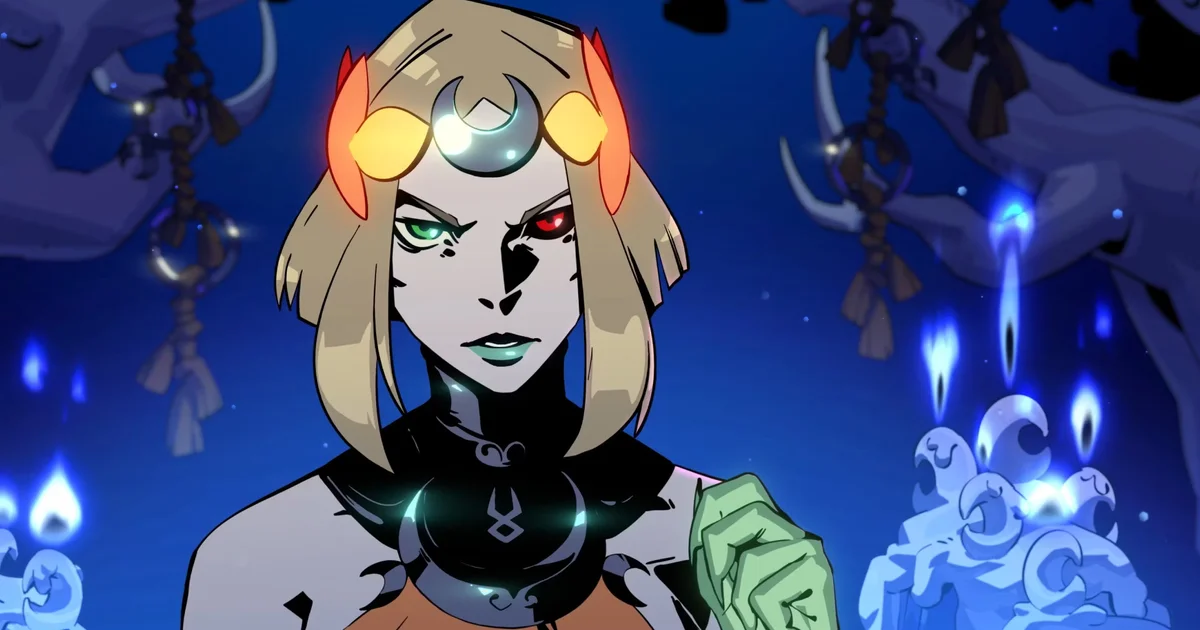
Maybe it’s sorcery. Maybe it’s enchantment. Either way, Supergiant pulls off the impressive feat of pulling the moon into view with its massive set-piece action and sweeping narrative in Hades 2.
In Hades, you meet Sisyphus, the former founder and ruler of Ephyra, who’s now banished to the underworld and sentenced to push a boulder up a hill for all eternity after Zeus’s displeasure. He’s an unexpected ally; a cheerful presence who seems oddly comfortable with his endless sentence, ready to offer counsel, blessings, and the occasional smart remark. In the original game, Sisyphus is a natural mirror for Zagreus: even if his task never ends, he still treats it like something worth doing—no matter how often the boulder crashes back down, he rolls up his sleeves and meets the challenge again with genuine energy.
Did Supergiant mean to shape this unusually upbeat take on Sisyphus into a powerful (even if it isn’t exactly subtle) emblem of the roguelike style? Possibly. And if so, what legendary figure might the sequel introduce instead? Could it be Arachne, the silk-obsessed spider who personifies a cautionary lesson about pride—an invitation to acknowledge your boundaries and respect them? Or perhaps Prometheus, the destined Titan renowned for defying the gods and serving as a champion of human culture, the one who dared to steal fire from the heights of Mount Olympus? His tale warns against pushing too far, pointing to unexpected repercussions—an almost Socratic lesson, ultimately, in knowing your place.
Still, I’d argue the most fitting Greek metaphor for Hades 2 doesn’t show up directly in the game. It’s the ship of Theseus (and no, I’m not alluding to a fan fiction romance between the original game’s third boss and his bovine companion). Supergiant hasn’t released a sequel before, and I can’t pretend that the task of following up one of the most beloved roguelikes ever made is easy—especially when the experience is packed with history, mythology, deep lore, and serious technical craft. Yet that’s where the contradiction hits: Hades 2 feels strangely almost the same as the first entry, even though every piece of it is new. Everything seems untouched, but nothing is truly identical… it’s a philosophical knot.
The approach will feel familiar to anyone who’s even dipped into the 2020 original. You take control of Melinoë—a quick, often talkative heroine with a clear goal—and fight your way through multiple realms to face the game’s new primary threat, Chronos, the Titan of Time. Along the route, you meet a supporting cast of intriguing, surprising characters pulled from Greek mythology’s deeper pockets. Some help you with boons that reshape your abilities or items that strengthen your power, while others throw up roadblocks through boss fights, gauntlets, and other interactive surprises I won’t spoil here.

Good Apollo, I need more.
So far, it’s very much in line with Hades. But it’s the finer details that make Melinoë stand out from her hot-blooded brother. Zagreus was all nerves—(a kind of) teenage rebel, desperate to break free from his family’s home and seize control of his future. He acted on impulse, spoke plainly, and often lacked subtlety. Melinoë is nearly the reverse: a young woman whose path has already been set, with her conflict driven by urgent need rather than a fiery urge to strike back. In play, that translates into a cooler, steadier tone. Where Zagreus would charge into combat and carve out victory in a blur of momentum, Melinoë leans more toward planning and careful thought.
As a child, Melinoë was brought under the wing of Hecate, ruler of the Crossroads. The witch trained her, and now Melinoë uses power that mirrors Zagreus—further strengthened by her bond to the occult. Alongside a spectral hand that lets her channel magic through a Tarot-inspired system overlaying a refined deck-building layer on top of her weapons, Melinoë can also funnel her mana into Omega attacks—charge-based techniques backed by a controlled resource that forces you to think about positioning, timing, and decision-making while the fight is still raging.
It’s genuinely impressive how these mechanical differences clarify Melinoë’s identity. When I first tried Hades 2, I kept running into trouble because I’m used to playing as Zagreus, who—at least in my head—is a “rushdown” character. You dive in, unload huge damage as fast as possible, then disengage. That’s who he is. At the start, Melinoë felt much more fragile—she’s a mage, after all—and I ended up getting knocked down in Erebus and beyond more often than I ever did in Tartarus or Asphodel. Then it clicked: I had to play like Melinoë. Stay composed, use your cast to slow down enemies, build up your attacks, and take out targets with measured accuracy rather than going in headfirst. Your mana recovers between encounters, and once you learn that rhythm, you see the balance Supergiant built into this game. Spend your resources wisely, don’t rush, and stay alert.
Once you internalize the basics, you can start focusing on the fun parts. Figuring out which Gods’ boons matter most for your run is your first real job—your wand gains special offensive upgrades, while an axe you can unlock depends on boosts to its standard combo strike. Some weapons, including a living skull that’s also a serious bomb, pull you to pay attention to your cast: it freezes enemies and sets them up like cannon fodder while you maneuver and dodge hazards. Matching weapon upgrades with Boon effects, then deciding whether to bring a ‘Hex’ (special moves you might consider like those from a fighting game) into the mix, makes each choice during a run more important than ever—and one mistaken decision can put your entire build at risk.
Okay, now it’s starting to click. Suddenly, I’m clearing runs, moving the story forward, and spotting more connections in that detailed tapestry as it keeps unfolding. There’s far more to unravel here than in Hades: the sequel grows both sideways and upward, with nearly every NPC featuring their own valuable side chapter, plus a more urgent central narrative that frames almost every moment you spend. From the plots and tense alliances you uncover in the Crossroads hub to the one-way notes sent down from the Gods above, Supergiant’s writing continues to stand out. There just aren’t other roguelikes that can match it. It’s grand—truly grand: as much a fresh reimagining and retelling of Greek myth as it is a sincere tribute. And that the studio can keep delivering that level of writing while also providing the right direction for its voice cast is, frankly, remarkable. I used to think Hades was mostly luck, but
Hades 2 also debunks that idea.
One complaint I have about roguelikes — from Enter the Gungeon to Binding of Isaac and everything between — is the fatigue that often comes from doing the same things over and over. The whole Sisyphean business of hauling the boulder up the slope can be satisfying, but every now and then (especially after one brutally unlucky room in an otherwise strong run), your enthusiasm starts to wane. Usually, it’s because you already know that boss or that room is waiting for you about half an hour down the line. So Hades 2 proposes a different rhythm. Rather than going back down to face Chronos, why not head up to reconnect with your family on Mount Olympus? Of course, it’s not quite that simple — the legions of the departed block your route — but by widening the portion of the game that happens in an action-packed stretch, Supergiant pulls off two things at once: it gives you more to do and, at the same time, creates space to breathe.
At first glance, the two approaches might look straightforward, but each path comes with its own bosses, adversaries, story threads, and — in some cases — even its own distinctive boons. From my time playing, I noticed that certain characters effectively encouraged me to hang around longer in a particular area, while other rewards and my desire to shape builds steered me elsewhere. That’s the classic roguelike magic at work: if Supergiant took the genre’s familiar template and powered it up in Hades, then in Hades 2 it now feels taken even further, like it’s been raised to the next degree.
I’ve found Melinoë’s trials to be tougher than what Zagreus faces. Still, her journey includes extra options thanks to her background, the sheer breadth of the world you can explore, and Supergiant’s willingness to trust the audience. I end up resenting fewer deaths, because I understand that there’s more happening even when I’m not actively in a run. The rewards feel especially meaningful when a run cuts off early. I keep feeling that drive building, even when my opening boons aren’t particularly strong. I just can’t put this game down.
In this family, there’s clearly a taste for romance. Melinoë seems just as focused on cultivating relationships as she is on taking Chronos down. Giving gifts, having conversations, and flirting all work in the familiar way — just with the deeper treatment Hades 2 is known for — and there are a number of fresh ways to connect with your romantic interests in the Crossroads that weren’t present in the House of Hades. You can tend a garden (maybe the inner Persephone in you is coming through). You can recruit animal friends to join you in battles, or train with Schelemeus (previously known as Skelly) so you can get comfortable with any new weapons you’ve unlocked. You can share a duet with Artemis. You can hang out at a bar. You can collect litter left behind by one of your less considerate allies. Or you can simply take in the breathtaking views, while Hypnos gently snores as he rocks in a hammock.
There are countless smaller elements of Hades 2 that I’m excited to talk about here. One of the biggest achievements across all of Supergiant’s games is how much the music elevates the experience: whether you’re looking at Bastion, Pyre, Transistor, or Hades, in-house composer Darren Korb consistently makes sure the audio matters as much as what you see. Hades 2 not only holds that same standard, but also offers another layer of immersion. One boss even delivers a showdown set to music — and that’s impressive on its own — but defeating certain enemies also affects the soundtrack. At times, you’ll be swinging your sickles to hit just the drummer while the bass and vocals fade away. Other moments have you going head-to-head a cappella. And how about the slow satisfaction of hearing the siren call grow clearer and louder as you descend into the abyss room by room? That’s just one example of the small, carefully made touches packed into every part of the Hades 2 adventure. I’m also fairly sure the lyrics shift depending on the choices you make beforehand — and while I can only guess at how complex the development process must be for that kind of feature, the result is genuinely remarkable.
I’ve gone beyond the credits and I’m now chasing the ‘true’ ending, and I’m still amazed by what the game keeps uncovering beneath the surface of Hades 2. Supergiant’s fresh take on storytelling and roguelike structure hasn’t been dulled by the success of Hades; if anything, it’s been sharpened. The studio’s ability to keep surprising players after the depth and richness of Hades is striking, and I’m still impressed by the ambition, the attention to detail, the craft, the technical execution, and the willingness to hand players agency even after 60-plus hours. Maybe it’s sorcery. Maybe it’s magic. Either way, it’s something special.
A copy of Hades 2 was provided for this review by Supergiant.