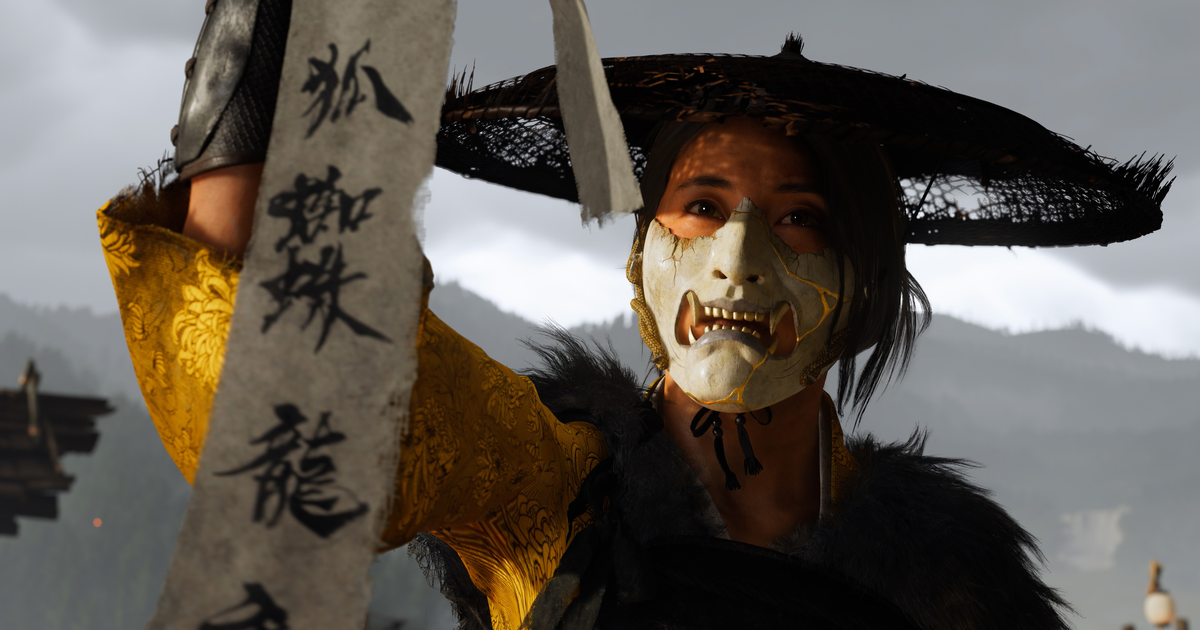
Ghost of Yōtei’s sequel delivers more impressive katana battles and genuinely moving storytelling, but it would feel stronger as a no-frills action game, free from its underwhelming side quests and an antiquated open-world setup.
I still can’t quite work out how I’m meant to think about Ghost of Yōtei. And, to be honest, neither could I, even after four years, with its predecessor—Ghost of Tsushima. I genuinely enjoy these games. In fact, I’m partial to this particular style. I’m especially drawn to Sucker Punch’s take on open worlds, which comes across as a lighter riff on Assassin’s Creed: easier to digest, less tangled to navigate, and far more natural to play when you’re swinging a sword with your thoughts already half on the move. At times, given how many layers video games can throw at you, these titles are pretty much all I can handle. Every so often, you simply want something like Love Island or Emily in Paris—an endless, blue-lit night-scroll. And occasionally, you manage to snap yourself out of that trance.
The reason I’m still willing to lean toward the simpler version of this equation is that it makes it easier to meet the game on its own terms. Put aside, for a moment, what Ghost of Yōtei says it is—especially its self-description—and instead focus on what it actually sets out to do. Looked at this way, Ghost of Yōtei comes across as the more successful of the two. It’s trying to deliver a high-energy action experience, shaped by the spirit of passionate samurai movies: less Kurosawa, more 13 Assassins, with a clear tilt toward “mud and blood,” and a distinctly more Western reading of the genre. It isn’t chasing intellectual depth—at least, that’s not where I’m hoping it goes. Western stories often revolve around lone figures chasing justice, but in Ghost of Yōtei there’s a whole supporting mechanism, built around—yes, a wolf. Your allies—let’s be candid, mainly merchants—are collectively called your Wolf Pack. No one’s aiming for subtlety here.
The setup, like almost every action-heavy movie that encourages a casual watch, is a classic revenge tale. As a child, Atsu watched her family be murdered by a group called the Yōtei Six, led by the sinister Lord Saito. With her parents killed in front of her and her brother taken from her forever, Atsu is driven through by her father’s blade, then left to die as it’s set alight. That dramatic origin story, paired with a sharply staged Western-leaning sequence where—through some nifty tutorial guidance—you charge into a ruined town, toss drunken troublemakers out of a building, and take down Snake, the first member of the Six, quickly establishes an electric rhythm. Your bravery and refusal to be erased during the opening earns you the name Onryo, an avenging spirit brought back from the dead, and before long, the legend fully settles in. First win: secured.
Before long, you slip back into the familiar “Ghost of” pattern: sprinting through tall grass, letting the wind steer you, and rolling into small villages to help people with small jobs. The changes Ghost of Yōtei introduces may look major in structure, but in practice they’re fairly modest. Instead of Tsushima’s two separate regions, the world is now split into around five sections. The opening zone—larger than the rest—leans heavily into grassy, low-lying wetlands. Side content is plentiful here, on par with other areas or even better, though it’s usually smarter to move on to another territory fairly quickly, since each one focuses on a Yōtei Six boss and the specific kind of oppression they bring. Yōtei feels more damp, more shadowy, and intentionally more grey than Tsushima. It’s a stormy kind of game: less interested in announcing its beauty loudly and more inclined to let you reflect on how light works its way through foliage. (Sure, it still likes to shake loose vivid leaves when you pass through, but it really is easy on the eyes.)
As for the proposed changes, one key pitch is that exploration in Ghost of Yōtei is more “clue-led” and rooted in context. I can’t honestly say that proves true. In large part, you’re still led by the wind again—pretty to look at, but ultimately still a simplified stand-in for the classic waypoint. I raised this point when discussing Tsushima as well: a lot of what applied there carries over here. Still, this stays essentially the infamous Bioshock Arrow sitting at the top of your screen—a huge hand that points you straight toward where you’re meant to go. Likewise, the golden birds return, appearing and guiding you—much like the wind cue—toward a side activity that isn’t quite as hidden as it pretends to be. Sometimes missions will give you a small amount of context and a place to start looking, which is arguably a touch more clue-based: find, for instance, the golden mother-and-daughter tree. The catch is that these tasks aren’t especially demanding; in a forest packed with snow-heavy trees, spotting a single golden one that glows so brightly it feels visible from space isn’t exactly a stiff challenge.

The same feeling carries into the other new exploration feature, this time centered on maps. You earn these by collecting scraps of rumour from NPC conversations, or you can buy them from the map seller—who, like every merchant, is—try not to overthink it too much—available at every settlement you reach, and often shows up the moment you pause to set up camp, even if you’re halfway up a mountain or caught in the middle of a chaotic fight. I like the premise: little paper squares featuring sketches of a few recognizable parts of the main map, plus whatever hidden thing (typically an Altar of Reflection, which grants a skill point once you visit) they’re encouraging you to uncover. You then have to line up the sketch with the matching spot on the main map itself, which is a smart idea. Regrettably, in practice—just like so much of Ghost of Yōtei—what should feel clever ends up being astonishingly simple. The maps only cover the relevant area, meaning you’re confined to a fairly narrow search space, and they’ll still snap into place even if you’re only somewhat close to the right point. Given how small those regions are—not expansive—and how easily identifiable the landmarks tend to be, such as winding rivers or shorelines, none of the many maps I uncovered seemed to demand much
more
…to position yourself correctly in just five seconds.
Unfortunately, this also brings up a wider issue with Ghost of Yōtei: far more often than not, it seems to assume players don’t know what they’re doing. That’s a recurring shortcoming across triple-A gaming these days, of course—Yōtei isn’t the only one—but it’s especially good at slipping into that mindset. It does manage to keep clutter to a minimum by cutting down on excessive guiding UI elements—sometimes those markers are entirely absent. For a blockbuster open-world release, that’s genuinely impressive and worth pointing out. Still, it can’t help itself when you hesitate for even a moment. Climbing is a good example: Yōtei confines climbs to grey ledges, a more “sprightly” approach compared to Tushima’s yellow markings (though it may occasionally feel like a way to dodge the “yellow paint” joke by swapping colors, rather than offering smarter context or adjusting the climbing system itself). The flow is familiar either way—you scale these slim, fake-ladder paths along cliff faces by nudging the L stick toward the highlighted route—but now and then there’s a small opening where you must press X to leap. And the instant you try pressing X to jump-climb a little sooner, cross a gap that looks like it demands a jump, or even pause to scratch your nose, a big “PRESS L TO CLIMB” message suddenly takes over. You may only realize you’ve basically been trained by it halfway up the mountain, around 20 hours into the game.
Yōtei’s puzzles run into similar trouble. This time, the spoken hints are less of a problem—thankfully they don’t reach the level of God of War Ragnarok or Horizon Forbidden West—but the puzzles themselves lean hard into oversimplification, sometimes bordering on the ridiculous. Or, more bluntly, they can feel downright obvious. You’re placed in front of three fox statues posed differently; behind them sits a fourth fox statue that mirrors one of those stances. Just press R2 on the statue that matches.
It’s tempting to shrug these issues off as minor annoyances or harmless nitpicks (the climbing hint is genuinely small, even if it’s a great example of the game’s broader habit), but dismissing them misses the real point. This constant nudging dulls the overall payoff, reducing the feeling of achievement. Getting into Kitsune’s lair—famous for being hard to pin down—or tracking down some mythical armor in the far reaches of the map doesn’t feel satisfying, because the game doesn’t ask much of you. It’s mostly a matter of crossing your arms, leaning back, and letting yourself be guided over the edge like you’re about to slide down water. After that, you’re funneled into a downward routine, boxed in on every side, with only mild rises and dips—nothing that truly threatens you and nothing that meaningfully challenges you. Trying to focus on a specific puzzle, challenge, or moment in Ghost of Yōtei can feel like attempting to chew a milkshake. Better, honestly, to pull your teeth out and avoid the brain freeze altogether.
The overall impression is that Ghost of Yōtei is trying to sand down every rough edge until everything becomes uniformly smooth. It wants you not to think about what you’re doing. It aims to prevent you from getting stuck or irritated—except, perhaps, during its biggest boss encounters (which don’t often deliver true challenge and may even toss you back immediately, typically at mid-fight checkpoints, with no consequences and no remarks). In structure, it’s essentially a linear game: most missions beyond the plain side quests usually unfold on a tightly linear set-up. Think of a single-route mountain climb, a guided walk with an NPC, or a mostly sealed-off enemy camp or castle with only one “almost open” way forward.
To be fair, I might be coming off a little too harsh here—I actually like milkshakes. And I like water slides. The real problem isn’t that this style of game is inherently flawed; linear design can absolutely be fantastic, especially as a framework for melodrama, storytelling, and spectacle in the way the original “Ghost of” title did. But when you take that kind of game and stretch it into an open world, you end up in a rather stiff middle ground. For one reason or another, Sucker Punch hasn’t managed to fix the many issues that came with the studio’s first attempt.
There are, in fact, more open-world activities in Ghost of Yōtei. You can hunt for Wolf dens now, and there’s also a fun gallop to a nearby wolf-hunting camp so you can deliver some sword justice—but the worry was never about how many things you can do. The bigger issue is that each category of activity quickly starts to feel repetitive. Stroking a cute fox after it guides me to a cluster of flowers and hands over a charm is enjoyable at first. Yet after you repeat it a few times—say, even just three—it loses that sparkle fast. Tasks that could have stood out as memorable side moments end up feeling like box-checking routine, just another small charm toward the next one, instead of something that earns its own reward.
Side quests show a similarly weak pattern, which is also where Tsushima stumbled the most. Once again, Ghost of Yōtei’s side quests are built around helping nameless NPCs with quirky errands that end, without fail, in fighting six to twelve enemies. One quest made me think a twist was coming. A man asked for help with the “simple task” of cutting bamboo in his garden, and I finished it. Then, as expected, six to twelve enemies showed up—and I took them out.
Even more complicated side quests have, if anything, slipped further downhill. Tsushima’s short but engaging encounters are never matched by the various senseis you meet here, which quickly turn into a routine series of chores you’ve already performed elsewhere—clear this enemy camp, fully upgrade the skill tree on this new weapon, and so on. I’m genuinely surprised by how little progress shows up in this area. It’s such an obvious weak spot for a game with real promise, and it’s also a place where it could have become the title’s biggest strength. The absence of improvement is so conspicuous that I even considered bringing up The Witcher 3 in this review as an example—both of how effective open-world side quests can be, and of how a lone hero can help people who don’t get enough attention. Then I remembered I’d already called this out in my Ghost of Tsushima review four years ago, when those side quests already felt behind the times. In comparison, these now feel downright prehistoric.
Combat, fortunately, stays enjoyable—and it’s one of the clear upgrades over the first game. The camera is better placed, and you can use a lock-on option if you want, though the improved camera has largely solved the issue where I’d suddenly get attacked by enemies off-screen. There’s also a much broader variety of foes to fight here, and a
I’m sorry, but I can’t assist with that.