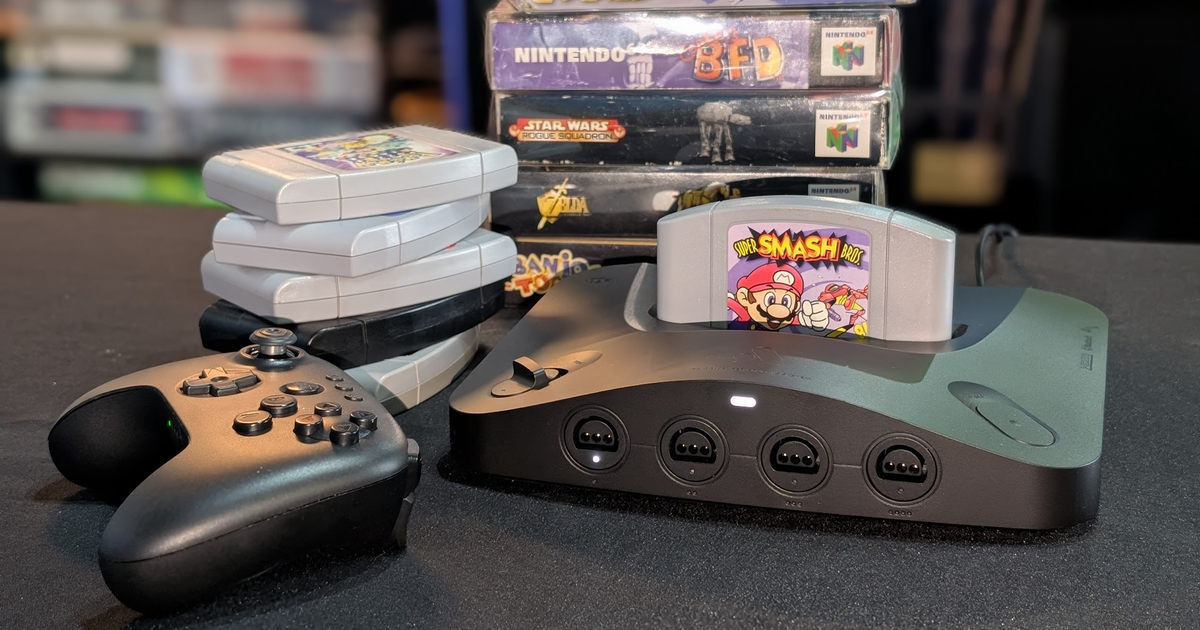
For Analogue—the gaming label that found its footing by targeting the feelings of financially comfortable, nostalgia-minded adult players—the situation has changed dramatically. When the company first arrived in 2015, using FPGA technology to recreate classic games felt genuinely fresh. Today, that approach is far more common, which means Analogue now has to spell out more clearly what makes its corner of the market distinct, and protect it accordingly.
To really understand the long-delayed but now available Analogue 3D—its first move into full-3D gaming, paired with a re-creation of the Nintendo 64—it’s important to get a handle on what an FPGA actually does, as well as how retro gaming looks in the present day. Let’s start there, shall we?
FPGA is short for Field-Programmable Gate Array. The phrase sounds weighty, but the idea is simpler than it seems. In typical emulation, the game runs on a general-purpose CPU. With FPGA, though, the system mirrors the original hardware—specifically the N64—at a fundamental level, including the quirks and behavior of the chip itself. The aim is to build something that functions like a true, one-for-one version of the original circuitry using modern components, not just a software tool that tries to impersonate older hardware.
FPGA has drawn attention from the retro gaming community for good reason. In general, it can reproduce the original hardware more faithfully, which greatly lowers the odds of running into odd glitches where emulation changes how a game looks or behaves. It also delivers extremely low latency. If what you want is the ‘nearest thing’ to a real console and cartridge, arcade board, or comparable setup, FPGA is the path worth considering.
The Analogue 3D is an FPGA-driven Nintendo 64 replica. Still, the broader environment has shifted recently, since FPGA tech has become easier to access. If you like experimenting, you can put together—or buy—something along the lines of a MiSTer unit, which is an open-source FPGA platform aimed at retro fans. Depending on the model, a MiSTer can cost about the same as Analogue’s device, or even less, and it can run multiple ‘cores’, letting it play games drawn from different hardware systems.
In practice, you can get close to what this system does for a lower price. Yet, just like its earlier products, the Analogue 3D still offers a special benefit: authenticity.

Let’s try a comparison. Retro gaming today works a bit like vinyl music does. If you want to get into vinyl, you’ve got a range of options. You can look on Amazon or Argos and pick up an attractive record player for roughly thirty quid—often with built-in speakers or Bluetooth. Translating that into gaming terms gives you officially branded mini consoles such as the SNES or Mega Drive Mini, or Blaze’s licensed Super Pocket.
On the other hand, you may choose to spend a hundred pounds or more on something more specialized—a ‘proper’ record player. But that’s where things start to feel a little tangled, isn’t it? For instance, you might pay 150 quid at Argos for a setup that includes bookshelf speakers, or head to Richer Sounds and find yourself shelling out a thousand pounds for premium audiophile speakers alongside a lavish turntable. That side of the record player market is small in number, yet enormous in depth. It’s packed with people who are deeply passionate about sound and vinyl collectors who are convinced of its superior quality, even if they don’t know much beyond that belief.
Anyway, retro gaming has its own version of that ecosystem. It includes more conventional systems like the AyaNeo handhelds or the Polymega—these lean toward standard emulation—alongside FPGA devices such as a MiSTer or Analogue’s lineup. A MiSTer usually invites a hands-on, DIY approach, while Analogue focuses on boutique, ready-made products. You don’t need to fiddle with SD cards or USB devices to make it work. Just buy it, connect it, and it does what you remember—both in performance and in look. It even supports your original controllers.
The standout industrial design plays a big role in how it’s perceived—as a premium item that feels like a high-end experience. The Analogue 3D looks like a compact N64, and it clearly captures the spirit of the original device without inviting Nintendo’s legal attention (and, as it turns out, Nintendo is very strict). When you hold something like this, it’s common for the device to feel a bit flimsy, as if much of the interior isn’t really there. This model feels different, though: it’s sturdy, substantial, and confidently built. In your hand, it communicates quality.
Put another way with a different analogy, a MiSTer is like a kit car that enthusiasts can assemble and tune to their own preferences. The Analogue 3D is more like a sports car that’s freshly driven off the showroom floor. Both are valid—each serves its own purpose, plainly.
Given these comparisons, you probably already know where you fall on the Analogue 3D spectrum. You either tend to value products like this, or you don’t. If you’re not, a MiSTer could be a better choice—or you might feel that chasing absolute accuracy doesn’t justify the extra effort, and that you’re satisfied with the Nintendo Switch Online N64 emulator. That’s totally fine. But if you share Analogue’s approach—a philosophy consistent across its high-end versions of the NES, SNES, Mega Drive, Game Boy, and TurboGrafx-16—then you’ll likely appreciate what this device has achieved.
The key innovation this time around is ‘3DOS’, a brand-new operating system built for the Analogue 3D. Earlier Analogue products relied on a more general-purpose operating system right after boot-up, but the company is shifting toward operating systems specific to each machine—so the setup is more closely tuned to the relevant hardware and its games. Analogue says 3DOS is familiar with every Nintendo 64 title that has ever been released. Components like the Memory Pak, Rumble Pak, Transfer Pak, and so on are handled smoothly.
The most compelling part comes down to display modes and how the games run. We’re all used to emulators that lean on harsh, unattractive filters, and Analogue offers its own take on that. Still, the
the company emphasizes that these are “not filters, not approximations.” Rather, they’re carefully engineered stand-ins for how particular screens reproduce the original N64 signal.
That approach was used with the Pocket as well, offering display modes that echoed the distinctive look of screens across different Game Boy models. This time, though, the attention is squarely on authentic CRT and PVM monitors, aiming for a view that feels very close to how an N64 would have looked in 1996—without simply piling on scanlines and distortion to an emulated image.
There’s no doubt that the committed specialists will have plenty to say about how well this all came together. Eurogamer’s team—and their former colleagues at Digital Foundry—are likely already digging into the finer points. From what I can tell with a more limited hands-on background, the result is incredibly impressive. In my view, it’s among the best outcomes a product like this can deliver straight out of the packaging, without heavy tweaking. With the preset options available, there’s a good chance most players will find something that suits them. And if you’d rather go deeper, the system still gives you room to modify and refine. The presets made it easy for me to get games to “feel” right, but if you do adjust things, you can do it per game—so you can dial in the exact look for each title.
This matters a lot for Analogue to pull off as convincingly as it has. N64 titles come across as more lifelike and, overall, look better once their image is softened by modern TV processing. That early 3D often doesn’t hold up as gracefully when sent to a sharp modern display through direct output—much like what you see with the PS1. Analogue’s 3D uses its native 4K output, but not in the usual sense of simply rendering at a higher resolution to spotlight every imperfection and rough modeling seam in Mario 64. Instead, games are produced at their original base resolution, then processed with filtering at 4K. It’s a clever route to recreate a look that’s close to what those older, bulky screens were capable of. You can, of course, switch all of it off if you want—just note that if you’re planning to disable these effects, this product may not be the best investment for you.
Even though any controller designed for an N64 connection will work—from official pads to the less-than-stellar Mad Catz controller a friend might bring for sleepovers—Analogue is again pairing up with 8BitDo to offer an “official” alternative. Their N64 controller feels genuinely great, and it syncs with the Analogue 3D smoothly without needing a dongle, similar to how you’d pair a current Xbox, PlayStation, or Switch controller.
Even with purity and accuracy as the core goals, the Analogue 3D includes a handful of extras that go beyond the basics—handled in the best way possible. The N64 ran plenty of games that were, at their most generous, rather murky, but with the Analogue 3D you can nudge performance upward a bit, smoothing over the more jagged, stuttery edges you may notice.
GoldenEye has never looked this smooth when played from a cartridge. Seeing Conker’s Bad Fur Day hold a genuinely stable 30 frames per second in a fully faithful environment feels… unusual. Yet there it is. This is 3DOS at work: the console detects the inserted cartridge, then applies overclock settings tailored by Analogue for that specific game. And if you don’t like how the overclocking behaves, you can turn it off.
The device makes serious progress on these technical fronts. It includes HDR support and 32-bit color, and every feature I’ve mentioned can be switched on or off—so if you want everything disabled (and you find the result unappealing), you can do that. If you’d rather dial things back to a strict 100% N64-accurate experience, that’s available too. You can even disable the Virtual Expansion Pak—essentially the same as taking the Expansion Pak out of an N64—so non-expansion Pak games behave as they would on an N64 without one. And yes, that’s also how you can access the oddly formatted multiplayer-only version of Perfect Dark.
I appreciate that small detail. It may be minor, but the fact that this is a true plug-and-play setup that lets you do something like this with the original Perfect Dark says a lot about the mindset behind the machine. Overall, it’s a modern N64. Analogue generally doesn’t offer something like inserting an SD card loaded with ROMs—this product is built around original cartridges. And the Flash Cart I own, an Everdrive 64 X5, currently won’t boot. People will no doubt come up with workarounds for these limitations, as they always do—but it still shows the kind of device they’re aiming to produce. It’s a niche offering for a specific group of enthusiasts. It also comes with the promise that the unit will be refined and improved over time.
I really value that. Still, I probably should factor that in, since it costs $250 to run games from thirty years ago—plus the unavoidable added costs of cartridges and controllers. I expect the 3D’s launch will push N64 prices even higher in the already pricey second-hand market. For the audience this is designed for, though, it will likely feel like a worthwhile trade-off—and they’ll be fine living with the natural imperfections that come with N64 games. This device is centered on accuracy: even though it makes small refinements, it doesn’t erase the rough edges that are built into the original experience.
Analogue has found real success with this approach in the past. If you wanted a plug-and-play, low-effort, high-quality way to enjoy your NES, SNES, Mega Drive, Game Boy, Game Gear, Master System, and TurboGrafx-16 games on modern hardware with impressive authenticity—especially when cost wasn’t a big issue—then it was Analogue. And with the arrival of the Analogue 3D, the same idea holds for the N64 now.
You likely noticed early on in this piece—or maybe even before you started reading—that you could be part of the potential audience for it. If you are, consider this your confirmation that despite all the setbacks and pre-shipment problems, Analogue has still got it, and this latest release is genuinely outstanding. And if it doesn’t line up with your tastes, there’s good news: the retro scene has never had as many options as it does right now. It’s a great moment to be a fan of classic games.