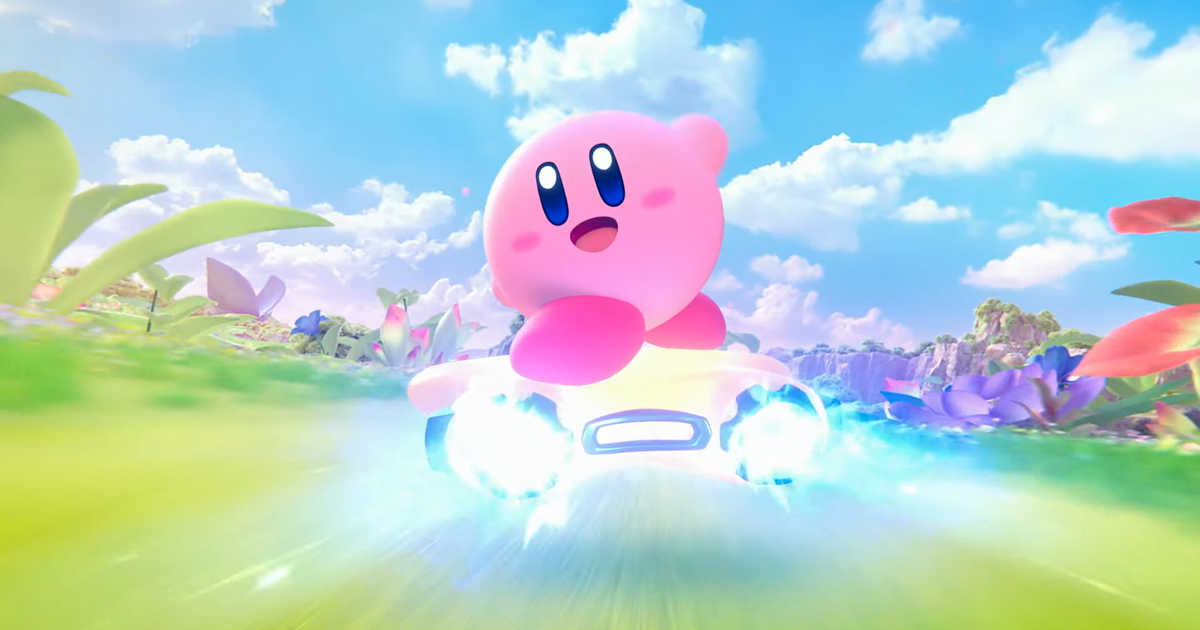
Though the core of Kirby Air Riders is all about speed, it channels the chaotic energy of Smash Bros. to deliver an unexpectedly meaningful one-button adventure—brimming with plenty of activities, visual variety, and unlockable surprises.
I’ve recently figured out why Kirby Air Riders managed to earn two Nintendo Direct spots, together lasting about as long as a full-length movie. A big part of that is almost certainly tied to the detailed, vision-heavy style of its director, Masahiro Sakurai. Still, there’s another, simpler reason: the game is hard to put into words.
Kirby Air Riders enjoys that kind of contradiction. It’s straightforward to pick up, yet difficult to properly explain. Thanks to its simple one-button controls, it’s accessible even for very young kids, but it also has enough depth to keep serious players engaged. It doesn’t fit neatly into typical genre labels either, though if you forced me to categorize it cleanly, I’d call it a “racing” game.
That said… reducing Kirby Air Riders to “just a racer” doesn’t do it justice. Sure, the main premise is “racing.” But underneath that, it’s really an unusual mix of styles. At the center of Kirby’s cheerful, one-button, kid-friendly racing concept is the combative mindset of a fighting game, the social mischief of party play, and even a touch of the unpredictable streak you’d expect from a roguelike. It’s strange. And it’s also a little inspired.
The clearest comparison is, perhaps predictably, to Super Smash Bros. Air Riders director Sakurai is best known for that series—and the moment you launch Air Riders, even before you’re properly playing, the game greets you with a small Smash-like achievement message letting you know it’s your first time starting up. You can feel the influence right away.
The whole presentation echoes Smash, down to every last detail. From the visuals and the wide range of customization, to the menu layout and its irresistibly upbeat soundtrack. Of course, you’ll also hear a high-energy voice calling out at the start and finish of races and mini-games. But it doesn’t stop at the surface. The same careful, exacting design principles that help make Smash special are here too. There’s the same respect for detail and the same pleasure in well-crafted gameplay.

When you look at Air Riders’ main menu, you’ll see four different modes available. Air Ride is probably the first one you expect based on the game’s basic pitch: a straightforward kart-style racer where you pick a stage, character, and vehicle, then race against AI or other players online—or try split-screen—no complications, no strings.
Next is City Trial, a wild battle royale-style scramble that drops everyone into the same arena. You’re given a limited amount of time to speed around, gathering items from the map while also getting in the way of other players who are doing the same. The resources you collect are used to upgrade your “machine”—the vehicle you’re driving—before a final face-off in the form of a mini-game. The twist is that vehicles can be improved in multiple categories, and you won’t learn what the last mini-game will be until you reach the very end. So you’re stuck deciding whether to build something well-rounded, or commit to a particular strength and hope the final challenge rewards you.
City Trial is a fascinating option, especially for party sessions. If you want a closer look at how City Trial works, I suggest checking out our earlier preview, since it’s the mode Nintendo put front and center before the game launched. Staying with the Smash comparisons, City Trial matches the game’s wildest levels when it comes to heavy item usage—pure chaos, where mechanics and systems can collide in fun and unpredictable ways, leading to multiplayer moments that are genuinely laugh-out-loud. Still, it’s notable how intense and fast the buildup can be, even though it often ends in a fairly short mini-game. City Trial is a total blast, but its finish can sometimes feel a bit underwhelming.
For my money, I liked Top Ride—the third mode—the most. You can bring friends along for this one as well, and it’s broadly similar to Air Ride, with a key twist: it’s presented from a top-down angle that, at least for me, brings back the classic 2D Micro Machines games from the nineties. That approach was a recipe for multiplayer fun back then, and it still works now. Interestingly, I think Top Ride is where Kirby Air Riders’ creators do the best job of showing their design craft, especially with the lesson that simplicity is often the right answer.
This doesn’t mean there aren’t plenty more things to uncover. The fourth and final mode—Road Trip—pulls an entire collection of activities together. This is Kirby Air Riders’ single-player offering, and surprisingly it makes me think of a classic title: Out Run! You’ll take on a series of stages that branch in a similar way to that older game, encouraging you to replay and choose alternative routes.
Road Trip is tied together by a story with unexpectedly lavish pre-rendered cutscenes and a narrator that leans a little too hard into melodrama, but at its core it’s about bringing together everything built for the other modes. As you work your way through Road Trip’s stages, you’ll run into different challenges and are frequently offered multiple task options. Those tasks can include Top Ride races, Air Ride races, or the same kind of whimsical mini-games reminiscent of Mario Party that show up at the end of City Trial.
Even though I really enjoy the nostalgic charm of Top Ride, it was Road Trip that ended up taking most of my time—and I have a feeling a lot of players will feel the same. For all the comparisons to Smash, this is the strongest single-player experience I’ve come across in this kind of genre from Sakurai. It truly
captures the finest aspects of everything he could have hoped for. The CG segments…
and its somewhat over-the-top narrative carries echoes of Brawl’s Subspace Emissary. The way stages, races, and mini-games link together through a relaxed sense of continuity gives you flashes of Melee’s adventure-style structure. On top of that, the core racing gameplay is so solid that it holds up perfectly well on its own, even without all this extra single-player flair.
No matter which mode you gravitate toward, a steady stream of dopamine is on the way thanks to an enormous collection of challenges. Each one pays out something, ranging from fairly small rewards to major unlocks for new racers (each with their own quirks and special techniques), vehicles (with distinct characteristics), and tracks. There are literally hundreds of challenges hiding unlocks and collectibles, and you’ll likely keep playing for a long stretch before you finish a race and not walk away with something. As before, if you’ve spent any meaningful time with Smash, this will feel instantly familiar—and it sinks its claws in just as deeply here as it does there.
Just like Smash, none of this would matter if the underlying experience weren’t enjoyable. I can see how the game’s main, single-button acceleration might throw some players at first, and I also expect a few to decide not to stick with Air Riders because of it. It’s trying a bit too hard to be clever, because I don’t feel like this approach dramatically improves the experience. Still, it does work, so it’s hard to justify much complaining. What stands out is the amount of depth and judgment packed into a game that can, to a certain extent, ‘play itself’—even if that automated play isn’t particularly effective—when you walk away.
This is where the unlocks, upgrades, vehicles, riders, and everything in between start to matter. There’s real strategic thinking to dig into, and it feeds directly into the satisfying multiplayer moments the game delivers. The variety is so extensive that it can feel a little overwhelming at times. Kirby Air Riders comes across as a light, fun package—but the depth underneath isn’t shallow. In fact, I’m enjoying the mechanical nuance so much that I only wish I had felt an even stronger attachment to the characters and the tracks; however, that sentiment is dangerously close to hoping for some kind of massive crossover involving Sakurai, and I worry that train of thought could limit creativity.
Whether I’ll have the drive to chase every single one of the many unlocks is still up in the air. What I can say with confidence is that it’s going to earn a permanent spot in my Switch 2 rotation for quick multiplayer sessions with friends. In that respect, it may end up looking even more like its cousin. In earlier preview conversations, Nintendo staff proudly described Air Riders as “Smash on Wheels.” At the time, I nearly rolled my eyes. But honestly? That’s fair. It’s the nearest thing I’ve come across to Smash on Wheels, and it’s an idea that’s genuinely appealing.
A copy of Kirby Air Riders was provided for this review by Nintendo.