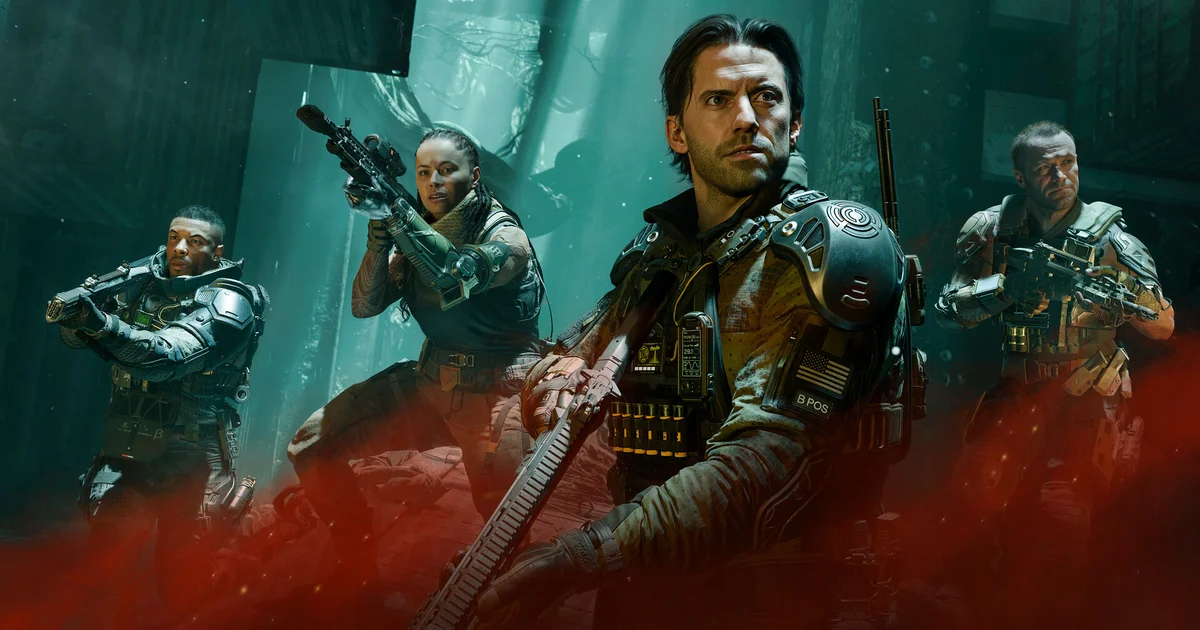
Stepping away from a traditional solo campaign leaves Call of Duty with its most lopsided and repetitive entry in years, yet the experience still lands as reliably fun when you approach it on its own terms.
Early in the latest Call of Duty, Milo Ventimiglia sets a cigar at the grave of the series mainstay Frank Woods. He wanders through a cemetery alongside Troy Marshall, last year’s narrative lead—now with silver hair and a cane. Forty years have passed since the events of Black Ops 6; everything is erased in a blink, just the snap of a trigger.
“Quit dwelling on the past, David,” Marshall tells him. “The only thing that matters is what you do next.”
That approach is what Treyarch and Raven have carried into Black Ops 7, dropping much of what the series had stuck with for years. Almost every year since MySpace first appeared has brought a brand-new single-player Call of Duty tale. Even when their quality varies, they’ve helped shape the medium—a distinctive style of first-person storytelling that drops you into one deadly set piece after another: your own execution; a nuclear blast; even the Eiffel Tower crashing down. In broad strokes, they’ve delivered a memorable spectacle.
But this time, none of that shows up. Yes, you can play Black Ops 7’s story mode by yourself if you want—maybe even power through the early missions while ignoring the three interchangeable protagonists in each cinematic. Still, the campaign is fundamentally built as co-op, plainly labeled on the main menu, and cooperation isn’t just encouraged—it’s essentially non-negotiable. At least, if you’re trying to have a genuinely enjoyable time.
The cinematic staging of a single character in COD—one performer you can steer to specific points, swing from ropes, get blasted from the sky, or pulled through complicated set-piece work—naturally becomes harder to manage once there are two to four players in the mix. That’s why Black Ops 7’s combat plays out in wider, simpler strokes: stealth segments that instantly turn into chaos the moment someone gets spotted, and boss encounters built around big health pools and back-to-back waves of enemies.
So it makes sense that Black Ops 7’s plot revolves around a machine-like threat. Foes show up fully kitted out, giving every participant a fair chance to jump into the fight before they’re knocked down. Thankfully, after Warzone, Activision’s teams have also managed to make these mechanized adversaries satisfying to take down—leaning into strong audio cues, where bullets chew through armor and send fuel tanks popping with a crack and a whoosh. These synthetic enemies detonate with a pleasing concussive force, leading to chain reactions across their units.

Every surge of action is wrapped in wildly impractical piles of gear—like buffet tables of specialized grenades and crates that offer clear-cut choices for boosted weapons. Realism is sidelined in favor of co-op convenience, and the game trims dialogue down as much as possible to keep microphones from getting in the way. As a result, setup and character growth mostly save themselves for the cinematic beats. There’s nothing here that even remotely resembles Black Ops 6’s ambitious immersive highlights—no Hitman-style social simulation, and no wandering through marble floors at a Washington fundraiser while Bill Gates chats in the background. The whole structure is designed to keep the multiplayer experience moving smoothly.
Black Ops 7 leans into the franchise’s darker legacy to make that abstraction work, bringing back the hallucinogenic bioweapon from last year’s campaign and constantly feeding it into the protagonists’ systems. Missions then swing between realistic assaults and complete flights of imagination. Before long, you’re calling up enormous hunting knives as if they were airstrikes, watching them slam into enemies—and then drive into the ground like brand-new skyscrapers.
That sort of surreal framing is also where the campaign starts reflecting on the history of Black Ops characters. It sends you back fifteen years to moments like Vortuka’s forced labor camp and the LA drone strike that wrapped up 2012’s story. While these callbacks do deliver solid fan service, they also create a bit of mental whiplash, because Black Ops 7 feels closer to Destiny than to any of the campaigns it nods toward. Among all the references, Ventimiglia doesn’t really get space to explore what the Black Ops 7 writers would likely treat as a thoughtful look at forgiving your own past missteps.
Treyarch and Raven hit their stride when they sprint down their own distinctive road, as shown by the fast, breathless rush through Tokyo’s arcades and out onto the rooftops. It’s a parkour-like stretch that keeps you springing off billboards while the music plays in step—flutes on one hand, butterflies in the stomach on the other. You’ll find similarly thrilling moments in Avalon, the fictional European country that comes up again and again during the campaign and acts as the endgame. There, the grappling hook returning from Black Ops 6 can launch you out of a firefight and into effortless airborne movement on the momentum of your jumpsuit.
The wall-bounce used to boost the Tokyo mission carries into multiplayer as well, bringing back the boost-jump feel of days gone by without losing the familiar frantic rush of deathmatches. That’s simply how competitive COD is regularly played—like a deathmatch, no matter what.
…the mode you’re stepping into. When the goal is to capture something, it turns into just another distraction inside a deathmatch. That’s the trait that will always set it apart from Battlefield.
Still, the most widely played of the incoming modes adds a fun twist through an “overload device”—basically a ball that one player has to pick up and transport to a destination in their rival’s spawn area. There’s a particular rush in avoiding the fight altogether and sprinting straight to the scoring zone, landing the point just before your angry opponents cut you down.
Skirmish is the new 20v20 mode. It brings wingsuits, grappling hooks, and vehicles to maps that are almost large enough to justify them. It’s easy to place Skirmish within COD’s broader drift toward Warzone-style play, but it actually feels closer to Wolfenstein: Enemy Territory—stretching the tight deathmatch cycle while leaving plenty of space where nothing much is happening. In Skirmish, you’re more likely to get blindsided by events than in other modes, though it can also start to drag.
Zombies, meanwhile, is still Zombies—its own distinctive world, treasured by longtime fans and packed with self-aware nods. It remains a detailed horde mode: as you progress through a larger, intricate map, new routes are gradually opened up, while preferred weapons get stronger over time so you can stand against increasingly brutal waves of rotting bodies.
But this year, co-op COD players are going to run into a fascinating choice. They’ll have to either commit fully to Zombies or shift their attention to the campaign’s endgame. In that alternate mode, several friendly squads push into the broad Avalon world to take on zones that steadily ramp up in difficulty, then leave the area with their rewards. It offers a notably adaptable format that leans hard into Just Cause–style movement and low-stakes goals. Overall, it’s a fun, low-pressure diversion—unless you decide to step into the tougher, higher-tier content.
Activision is already looking at ways to keep improving the Avalon map through updates in coming seasons, and from a business perspective, it’s easy to see why turning the yearly campaign into a live service would be appealing. The thinking is that COD’s studios can convert the spending tied to temporary maps, cinematic sequences, and performance capture into money that keeps coming in over time.
Even so, I think this plan ultimately misses the mark. In an era where blockbuster games are expected to be expansive and endlessly engaging, Activision has already shown it can deliver a proven formula. Each year, Call of Duty presents three separate experiences at once—one aimed at solo players, one built for co-op, and one for competitive fans. When the publisher drops the single-player campaign, it removes a key source of that built-in variety, turning a distinct set of experiences into something more standardized.
Beyond the lacklustre twin-stick top-down gimmick of Dead Ops, I’m not aware of any mode in the 2025 entry of Call of Duty where you can comfortably pause to answer the call of nature, handle a package drop-off, or return a phone call. For me, that’s a design problem.
It’s very likely that next year COD will come back with a solo campaign; I can’t picture Infinity Ward working on anything else. Still, it’s expected that parts of Black Ops 7’s direction will carry over into future releases, and I find that disappointing. As Battlefield 6’s weaker campaign showed, only a small number of studios have the know-how to deliver standalone stories at the same level as Call of Duty. To ignore that legacy right after Black Ops 6—especially when a spy thriller hailed as COD’s best single-player experience in years is being positioned as a direct sequel—is a small but real misstep.
If you’re able to appreciate Black Ops 7’s core formula changes on their own terms, you’ll probably have a good time, even if the psychochemicals are pumping through your system. Still, I’m not convinced these alterations will serve the franchise well going forward.
A copy of Call of Duty: Black Ops 7 was provided for this review by Activision.