If there’s one detail I’d pass along about the ambitions I carried for adult life when I was eleven, it would probably boil down to a single word: henchmen.
Back then, I assumed that growing up meant taking on henchmen. I pictured them as my main preoccupation and the very first thought that would cross my mind when I woke up as an adult.
And I wasn’t the only one thinking that way. During my eleventh year, I moved from primary school to secondary school, and a lot of kids in my class felt the same worry about henchmen. Some of my classmates tried to invent their own martial art so they could have the upper hand in bar fights. One of my mates even brought a wrench to school, just in case he needed something heavy to “deliver justice.” Unfortunately, one day it slid out of his bag while he was digging for his homework in Religious Education. From then on, he was called “Wrench” for the next seven years. (Even as I tell it, I realise it sounds like I’m describing the whole thing from a careful distance. The truth is, my position on the social ladder was so low that I could only dream of having a cool nickname like “Wrench”.)
There were two main reasons all this concern about henchmen felt so intense. First, I’d just moved up to a much bigger school, and I was noticeably smaller than most of the people in my social group. It was intimidating, to say the least. Being born in June didn’t help either, since some of my peers were taller than me by quite a margin.
The second reason was what, at the time, no one really called “the media landscape.” In 1989, henchmen were everywhere in media. That year had an Indiana Jones film, sure, but the summer belonged to Batman—who wasn’t searching for treasure. His mission was to bring down henchmen. He fought henchmen on screen, and he also battled them in American comics that suddenly felt much easier to get hold of.
Still, most of the henchmen we encountered lived in cyberspace, behind the curved, tinted glass of the screens at Computer Planet in town. Computer Planet wasn’t actually the official name, but I feel like I should use some kind of nominative witness protection for it—maybe because of how common henchmen seemed to be. Computer Planet was where everyone from school went at 3:30 PM. It was about a mile and a half away, which wasn’t bad for a bit of exercise. We’d sprint over to pay 50p or whatever the going rate was for a half-hour session on one of the computers, usually alongside a borrowed game.

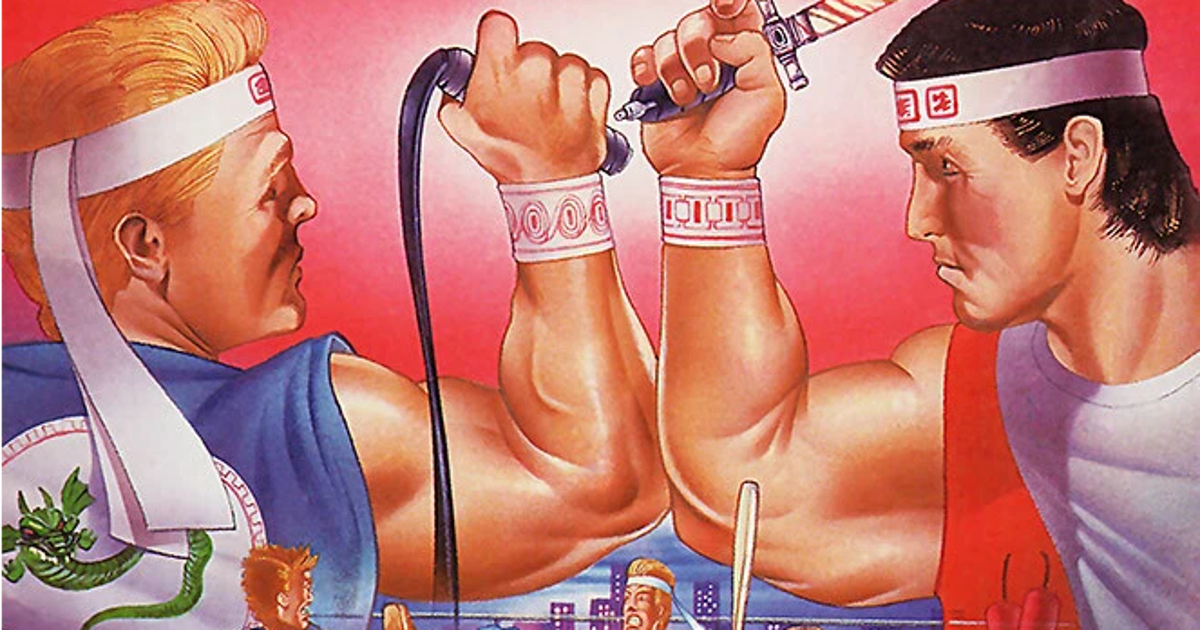
Our go-to game was Double Dragon. It was a two-player cooperative beat-’em-up, and when I heard—just recently—that its creator, Yoshihisa Kishimoto, passed away at the age of 64, I felt a sharp jolt that I now recognise as sadness. Double Dragon isn’t my favourite game now—I haven’t touched it in years—and I can’t honestly say I know much about the lines of tradition or ideas it drew from. But at eleven years old, thousands of miles away from Japan, it briefly became THE game. The only game. The one that mattered above all else.
That’s because it was built entirely around henchmen. It was, basically, an experience reserved for henchmen alone. No smashed bottles? No scary chains catching the light in a strong fist? No padding. It held our attention and kept Computer Planet busy.
Its appeal was simple. After years of playing games about cavemen pedalling stone unicycles or hungover tycoons trying to tidy up their mansions, here was a game set in the modern urban world. We must have seen it as something like “real life.” Looking back, I imagine alleyways, rail yards, and those neglected pockets of space hiding behind a genuinely great biker bar. And the objective was straightforward: defeat every henchman.
Just like Batman, nobody in Double Dragon was hunting for biblical treasure. At least, that’s what I assumed—we were never fully sure about the storyline and simply guessed that something important had been taken. So our job was to move through the locations we found, slowly working our way down whatever alleyway or rail yard we ended up in, and punch anyone we came across.
If there were combos, I can’t recall them. What I do remember is that the characters flickered in and out once you’d finally defeated them, and that the crowd of henchmen seemed to drift side to side before breaking into their attacks—as if they were trapped in a tight, swirling whirlpool. These henchmen felt like they owned small, intensely personal spaces, with their pixelated fists up and their striking leather outfits shining in the 8-bit daylight.
All that plainness and effectiveness captured the imagination of an eleven-year-old perfectly. When we weren’t playing Double Dragon at Computer Planet, we hurried over for a free spot. Or we wrote long, detailed Choose Your Own Adventures about Double Dragon in borrowed, commandeered notebooks. I say “Choose Your Own Adventure,” but really, the adventure we got was largely decided ahead of time by the confident author, and there wasn’t much room for real variation. Turn to page 9: “You hear a barrel topple in the shadows. Henchmen materialize!!!” Turn to page 17: “As the helicopter departs, it releases shadowy figures from below: henchmen swiftly encircle you!!!” Henchmen, every last one, all the time. Roll the dice to take them on. (And maybe a nearby wrench.)
None of this is meant to downplay Double Dragon in any way. It was an ideal match for its audience and its period, and when I look back, I value the memory as much as those recollections of Friday night trips to Blockbuster—when we could rent films that played out a bit like Double Dragon, even if they never quite matched the impact. Looking at it all now, I still recognise the excitement I felt for those experiences, and the pleasure that came from knowing my friends were just as absorbed. School suddenly felt more intimidating. Film heroes took on a darker, more gothic edge. And Double Dragon was there to make sure we got through it all unharmed.
Thank you, Yoshihisa Kishimoto.