Over three decades beyond the debut of the original Legend of Zelda, one of gaming’s most recognizable figures is finally stepping into a story built around her. Longtime fans have urged Nintendo to let them play as Zelda, but the company has often stayed cautious—leaving Link as the quiet lead in most player journeys.
That situation is changing with the upcoming The Legend of Zelda: Echoes of Wisdom—this year’s kind of Nintendo surprise that feels overdue. Why did it take so long for Zelda to move into the spotlight? In my view, it isn’t only about taking control of the beloved princess. The real turning point is the game’s transformative Echo power.
Early on, while Zelda tries to slip away from the depths of Hyrule Castle, she puts on a cloak that once belonged to Link and is briefly mistaken for him. At that moment, I kept waiting for her to pull the Master Sword from some hidden spot and start swinging it. Yet Echoes of Wisdom refuses to follow that familiar script—and the game is better for it.
Where Link’s usual opening tools often focus on hitting enemies, Zelda’s Tri Rod introduces a different approach: it lets you summon Echoes of objects you’ve come across. In practice, you’re not exactly carrying a weapon so much as a problem-solving set of options—useful for puzzles, or for dealing with groups of enemies in ways beyond straightforward attacks. And those options are impressive. You soon build a catalog of items you can summon and dismiss, ranging from simple objects like barrels and boulders to the enemies you run into across the world.
The whole system encourages experimentation. Looking to get over a chasm? One of your earliest Echoes is a bed, handy for bridging gaps and walking across. (It’s also there if you want a quick nap.) Want protection from foes nearby? Raise the Tri Rod and you can bring forth a large potted plant to hide behind.
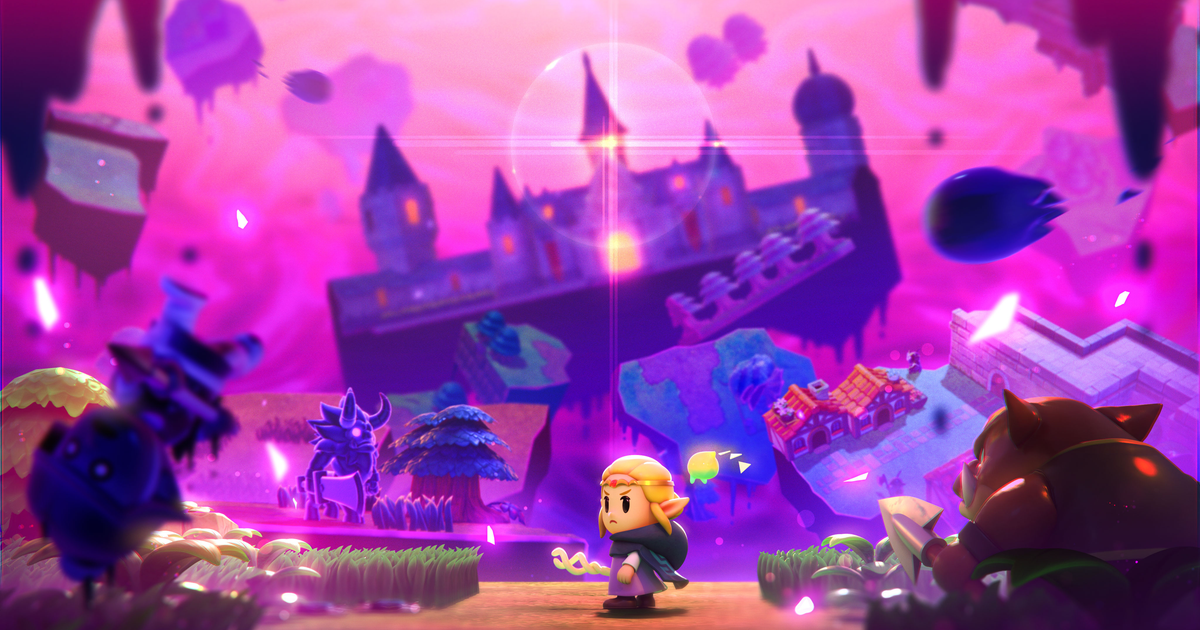
Your new magical staff draws energy through Tri, the latest companion character in the Zelda lineup—and one worth keeping an eye on. Tri’s pixelated tail shows how many Echoes you can create at the same time. You start off able to summon three, though it seems that number can be increased. Every time you generate an Echo, the tail shortens; when you dismiss an Echo, it grows back. It’s a straightforward visual cue for how much summoning you have left to work with.

Echoes open up many ways to handle puzzles, explore new spaces, and fight back, and the overall approach feels both powerful and imaginative. Getting attacked by a flying bat? Summon a Moblin that’s equipped with a bow and arrow and let it shoot the creature down. Alternatively, you can position a spiky critter in front of you and watch the bats dive-bomb that target instead—taking themselves out in the process.
Bat enemies can even help you glide. Spiders can assist with climbing their hanging silk threads. At one point, I gained an Echo tied to a large slab of meat, along with the hint that it could come in handy for distracting a certain kind of foe later. I summoned the meat, expecting an enemy I believed would be drawn to it—but they ignored the feast completely. Still, leaving that huge steak in place ended up trapping the enemy, and it set the stage for me to deploy an armadillo-like adversary. It ricocheted off nearby surfaces, ricocheting around the meat until everything in its path was flattened.
The Echoes system goes even deeper, too, with physics and elemental interactions that might feel at home in Breath of the Wild. For instance, heavy boulders set on top of breakable objects don’t always crush what’s underneath. But if you summon those boulders from a height and then drop them onto something fragile—either directly or onto an enemy below—their momentum carries the impact where you need it.
Using the Bind power you unlock in the game’s first dungeon, you can reposition bigger items in the environment—or Echoes you’ve summoned—from a distance. At one point, I discovered the Echo of a fiery enemy and realized I needed to ignite some crates to move forward. Grabbing that fiery enemy with Bind turned out to be far safer than trying to carry it around myself and risk getting burned, as I quickly learned.
For anyone already familiar with Zelda, the ability to bring objects into play and effectively assemble a small “army” of opponents to carry out your plans makes it feel like you’re playing with cheat codes. Curious who would win if a Darknut squared off against a crowd of Moblins? Summon the Moblins as Echoes and find out. One of the most surprising moments for me—especially since I still vividly remember every corner of Koholint Island—came when I managed to Echo a child’s trampoline. Seconds later, I realized I could finally land on treetops and rooftops that were previously out of reach. It would have amazed me, as I replayed Link’s Awakening over and over when I was younger.
Even with how striking Echoes feel, Nintendo has introduced them in a way that still preserves the spirit of a classic top-down Zelda. Leaving aside the franchise’s complicated timeline, this is clearly a direct follow-up in technical terms to the Nintendo Switch remake of Link’s Awakening: you get many familiar foes and elements, the same visual presentation, and the same underlying game engine—along with the unfortunate frame-rate slowdown. There are also side-scrolling platform sections, though I didn’t encounter any goombas. You can still spin to cut grass.
The game’s dungeons remain fairly traditional as well. They take place within the rifts that have swallowed parts of Hyrule, an area Nintendo calls the Still World. Inside, you initially move through zones where Zelda must hop between broken pieces of land—somewhat reminiscent of Dragon Age’s Fade. But before long, you’ll spend more time in settings that feel more familiar, clearing rooms filled with distinct puzzles and using the dungeon map to navigate.
Then there’s Swordfighter Mode, which finally lets Zelda wield a blade. After such an engaging introduction to Echoes as the main tool for interacting with the world, part of me wondered what the sword adds—after all, it’s the sharp part. Still, this option stands on its own: it’s a time-limited attack technique you use until an upgradable energy bar runs out. It also gives the princess an additional toolset piece within her arsenal.
It took a long time, but Nintendo has finally responded to the desire to let players spend time as Zelda—delivering gameplay distinct enough that it won’t simply feel like another Link outing. At the same time, Echoes of Wisdom does something clever: it keeps the heart of what makes a proper Zelda game feel like Zelda, instead of turning into a disposable, princess-led side entry such as Princess Peach: Showtime. I’m eager to see more from Echoes of Wisdom, a title that reflects the inventiveness of Tears of the Kingdom while staying within what may be more approachable limits, blending that inspiration with the DNA of classic top-down adventures like Link’s Awakening—and, above all, positioning itself to be a standout addition to the series’ main canon. For the first time in a long while, this really is Zelda’s moment to shine.