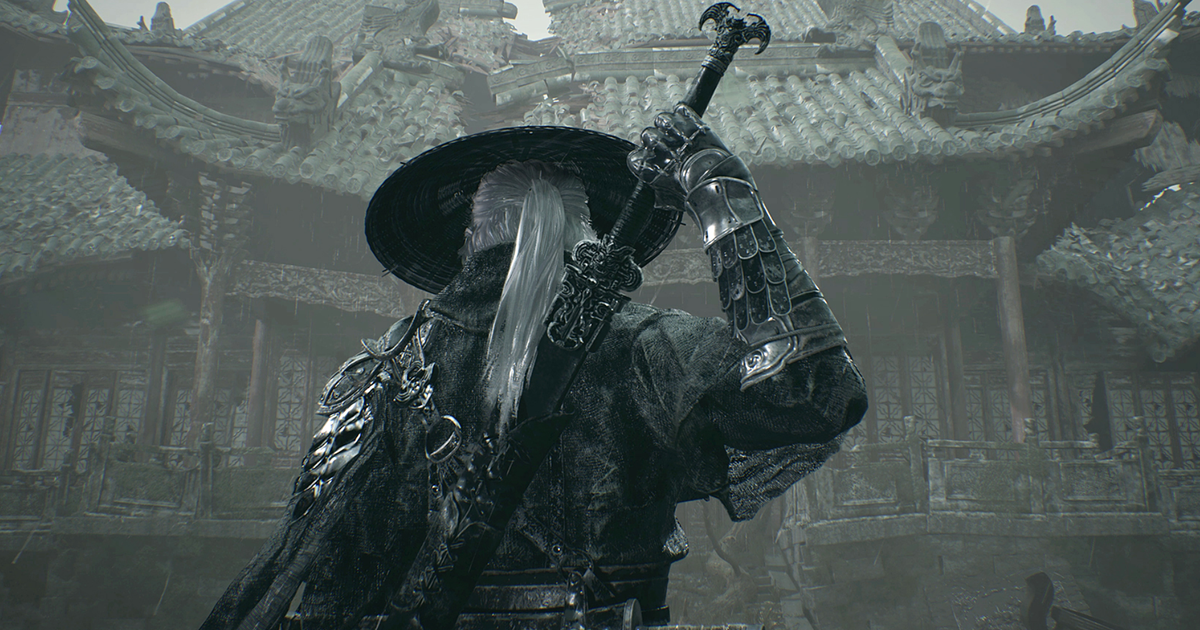
It’s basically become a familiar running joke. The moment another action game is revealed, people quickly start drawing comparisons to FromSoftware’s catalog, usually with the same question: “Sure, it looks great, but is it a Soulslike?” That happened with Black Myth: Wukong, and now it’s resurfaced around Phantom Blade Zero—prompting the developer to step in and clarify that it isn’t a Soulslike. In their interview, they even pointed out that, as a newcomer studio, they don’t “have the luxury of FromSoftware to make you feel frustrated during gameplay.”
Still, this doesn’t mean there’s zero influence. In the same explanation, Developer S-Game described the setting as “much like the Souls games prior to Elden Ring.” At Gamescom, I finally got to play Phantom Blade Zero, which immediately caught my attention after its announcement at the 2023 PlayStation Showcase. That said, the demo mostly focused on three boss encounters. As a result, I didn’t fully get a sense of how the world is built—though the good news is that normal enemies don’t respawn, and you don’t lose currency when you die.
What I could feel clearly, though, was the game’s tactical combat and its strong parry system, which brings to mind FromSoftware’s Sekiro, along with this year’s Stellar Blade. Phantom Blade Zero is a fast, stylish action experience, and its challenge mode may turn out to be a real game-changer.
At first, I had some trouble. Like any title in this genre, it takes a little time to get used to its specific pacing. In Phantom Blade Zero, attacks are mapped to the face buttons, while dodging and parrying use the triggers. After sinking too many hours into Elden Ring, I kept instinctively hitting circle to evade—something that, for me, led to a string of missteps.
Even so, dodging and parrying are essential. Beyond the usual enemy strikes, special attacks are announced with a brief burst of bright light: blue Brutal Moves are meant to be parried, while red Killer Moves call for dodging. The timing on both options felt forgiving, and when it clicks, you get a Ghostep—a slow-motion spin behind your opponent—setting you up for a relentless sequence of cutting attacks. The color cues reminded me of Stellar Blade, but the overall flow feels like a mix of Sekiro and Ninja Gaiden: tight, rhythmic parries create openings, and light and heavy attacks can chain together into lots of flashier combinations.
Another key detail is the Sha-Chi gauge, which works much like stamina. Combo swings (with heavy attacks) and continuous blocking will reduce Sha-Chi, but simple attacks, dodges, and parries don’t. This structure discourages mindless button mashing and instead pushes careful decision-making and precise parry timing. Enemies also have their own gauge that shrinks as you land hits; once it’s drained, the game opens the door to full-on offense—combo strings plus a dramatic Power Surge of chaotic swipes and thrusts.

The main character also has a solid set of tools at his disposal. He can smoothly switch between a slightly slower longsword that hits harder and a pair of faster short blades. He also gets ranged options, including a stealthy yet deadly bow and the explosive Tiger Cannon. Both can be charged to deal heavier damage, trading that power for Sha-Chi—making them especially useful for careful crowd control rather than for dueling one-on-one.
With all of that in mind, I worked my way through three separate boss fights against armored warriors, all presented against muted, nearly monochrome visuals. Phantom Blade Zero seems intent on taking itself seriously, and I’d love to see space in the finished version for more surprise and color beyond its “Kungfupunk” look. It may borrow elements from wuxia in both its presentation and animations, but so far there’s no room for romance—though that’s available elsewhere, in Where Winds Meet.
The final boss in the demo was Huangxing, the Sunken Pillar of Kunlun. After I stepped into a small temple framed by wooden pillars, he rises with menace and flexes his mechanical arm, topped with a chained spiked helmet. He turns toward me and begins spinning the chain. I try to time a perfect dodge, but I keep falling short—and the helmet drops on me for an instant defeat. Eventually, my persistence pays off, and the demo comes to an end.
“Want to take on hard mode?” I’m asked. Why not. I brace myself for a brutal challenge, knowing my inexperience would be even more obvious on a large screen. Somehow, though, everything starts to click.
The first boss, Tie Sha the Frenzy, charges in with an axe, but I parry cleanly and spin away, then unleash a rapid storm of sword strikes. After that, I even parry back some kind of projectile—an unexpected reflex that helps me—then land a series of more decisive blows until the boss finally goes down. It happens fast, but I’m fully aligned with its rhythm now. I’m in control.
Next is the masked Commander Cleave, a fitting name for someone who glides a hand along a thick serrated blade built for serious, bloody damage. Yet I’m the one setting the pace. I hop out of range of his spinning attacks and move back in quickly, finishing the fight without taking so much as a hit.
Finally, I had to face Huangxing again. This time, I learned that you can sprint up the pillars to avoid that helmet swing, then drop back down on the boss like a tornado. With my dodges and parries now under control, Huangxing falls quickly. Altogether, I finished the demo a second time in nine minutes, clearing these hard-mode bosses with surprising ease.
Was it just luck? Is Phantom Blade Zero truly too straightforward? Or are these simply bosses from an early part of the game? It could be any—and maybe all—of those. Still, I can’t deny the experience was exhilarating, with the Ghostep slow-motion spin serving as the heart of its rewarding combat.
There’s a chance Phantom Blade Zero could grow into the next Black Myth: Wukong—an impressive, stylish boss rush with little else in between. But purely from a combat standpoint, Phantom Blade Zero delivered some of the best action I played at Gamescom. Just—please—don’t call it a Soulslike.