A striking idea hidden beneath repetitive, uninspired gameplay patterns.
When I was growing up, my father would sit down with me every night and read. One evening, I asked whether he could go over The Lion, The Witch and The Wardrobe again, only to hear that he’d grown tired of “Jesus Lion.” Instead, he handed me a book that showed a dragon flying over a town lit up by flames. The title was The Hobbit. I was hooked almost immediately by Bilbo’s journey—talking eagles, riddles lurking in the dark, Smaug—and, just as importantly, it felt like there was still so much more waiting to be found.
Then The Fellowship of The Ring arrived, and it quickly built an unmistakable sense of adventure as the landscapes of Middle Earth kept opening up. I even laughed along with Tom Bombadil. I felt a wave of relief when the hobbits slipped away from the Barrow-downs. But I got genuinely spooked when, during a thunderstorm power outage, my Dad ended our story at Weatherstop with, “he felt a pain like a dart of poisoned ice pierce his left shoulder.” I was five, and in my mind, Frodo was already gone.
Even so—maybe even because it helped set me up for nearly lifelong insomnia—I still genuinely value Tolkien’s world. Without his writing, I wouldn’t have developed the same love for literature and for putting words on a page. And that brings us to Tales of the Shire. Hobbits? Absolutely. A life-sim that includes farming? I’m in for both. The real question is how it all plays out. Here’s the thing: when I first started shaping this review in my head, I meant for this section to end with a comparison pulled straight from Tolkien’s legendarium—something along the lines of “as disastrous as the fall of Gondolin,” or “as glorious as the caverns of Aglarand.” But I can’t bring myself to do it. Tales of the Shire just isn’t interesting enough to earn that kind of contrast.
Everything looked promising when I first arrived in Bywater. Gandalf appeared right when I expected him to; the character creation felt basic, though there was room for it to grow, and even if it never did, I still had my own hobbit hole to call home. Sure, it wasn’t the cleanest smial imaginable—but that actually made it perfect for renovations. Time to tap into my inner hobbit. Still, as the hours passed, Tales started to show its limitations: while it borrows plenty of the usual trappings from life simulators, it doesn’t offer the kind of depth that makes those ideas truly fun.

The gardening section was where things began to slip. Since I’ve already spent time with a number of farming simulators, I wasn’t expecting anything wildly complex beyond “water your plants and take care of your animals.” Tales follows that familiar approach, but it tries to add variety by requiring you to leave spacing for each seed. Because you have to purchase extra plant pots, you’re pushed to think carefully about where every seed goes if you want your garden to thrive. There’s also Companion Planting, letting certain crops earn a higher star rating when they share a pot with a compatible plant. In theory, those systems should combine into a farming routine where you plan ahead to draw out each seed’s potential. So what’s wrong with it?
In practice, Tales undercuts itself by allowing crops to grow during off-season periods. It’s true that plants advance more slowly during that overlap, and you can’t sow seeds that are out of season. Still, it removes a crucial piece of time-management that farming mechanics depend on: the pressure of a season’s closing days. Will the crop finish before the weather changes? Should I stick with seeds that take three days, or gamble on one that needs five? How will my decision affect me when the next season begins? Removing that tension might sound relaxing, but it actually drains the motivation I had for planning my garden. Why track a seed’s growth when I already know it will comfortably carry over from summer into autumn? What’s the point of building a seasonal vegetable patch if there are no real consequences for mistakes? Even gardening should have some stakes. It’s especially frustrating because gardening ties directly into Tales of the Shire’s core mechanic: cooking.
Unsurprisingly, if the game is built around hobbits, you end up doing a lot of cooking. In fact, it takes up the majority of your time, because earning a hobbit’s affection is best done with a truly tasty meal. (We’ll get to that part in a moment.) Much like gardening, the game tries to make cooking more than a simple checklist. Instead of just throwing ingredients into a bowl and calling it a full dish (which, honestly, would be nice in real life), you’re trying to place a disk into a small golden square positioned among four categories: smooth, chunky, crisp, and tender. You can also tweak the flavor of an ingredient by using seasonings. Keep doing that, and you can shift the overall taste of the meal.
At the start of my hobbit life, I was limited to tenderizing certain ingredients and controlling their smoothness by chopping them with my knife. But even after I unlocked additional kitchen tools, I still wasn’t able to free
from the trial-and-error nature of the whole procedure. There was no practical way to tell how near my meal was to landing on the “golden square,” and while I cooked I’d sometimes struggle to even confirm it had changed. In the end, preparing food felt like carrying out steps for an arbitrary span of time, then hoping—through sheer luck—that the Valar would deliver a good result.
Matters don’t improve when you consider that, in my own playthrough, Tales gave me no opening to stray from the recipe book. It’s odd, too: when cooking is such a core part of the experience—so much so that it’s frequently needed to push the story forward—you’d expect more room for creative experimentation. Instead of inventing a recipe through your own instincts, you’re funneled into building connections with everyone in Bywater. Even so, the biggest downside is that cooking becomes the most mind-numbingly important chore in Tales of the Shire.
Shared Meals happen when you eat with other hobbits in order to raise their Friendship Levels by serving a dish, or something with the flavor they’re looking for. Still, don’t get carried away.
Dialogue? No. Moments that feel genuinely engaging? Also no. You mostly get the same cutscene over and over, with the only differences being the spot where it plays and whether a hobbit seems to enjoy the food. Can you skip it? Thankfully, yes.
I can’t stress enough how fast I started to dread arranging Shared Meals. The pattern—‘send invitation, wait for the next day, check mail for their cravings, cook, head to the venue, sit at the table, set the dish in front of the hobbit, wordless cutscene’—slowly drained all the life out of my thoughts. Even though other places can be unlocked for these meals, I kept hosting them in my hobbit hole simply because it was easier. Get the meal done, then return to my day.
Sadly, Shared Meals are the only meaningful way to raise any Friendship Level, and a lot of the extra systems rely on that—whether it’s expanding your hobbit hole or bringing chickens into the mix. On top of that, you can’t really avoid hosting, since characters may grow unhappy if too much time slips between meals, pushing you to feed them through the local postman. Even when I felt tempted to ignore a few hobbits and their complaints, it usually backfired: unhappy hobbits refuse invitations. That becomes a real issue when they’re required to attend one in order to move the story forward.
The endless run of Shared Meals might have been easier to stomach if Bywater’s residents weren’t as dull as the plain walls in my rented studio apartment. Still, here are a few of them:
Sandyman is grumpy and can’t stand Farmer Cotton. Nefi is a dwarf. Farmer Cotton is friendly, dislikes Sandyman, and has a head that I found uncomfortably smooth. Rosie Cotton eventually marries Samwise Gamgee, so we should all be especially thrilled to see her here.
Even the short cutscenes that offer glimpses of life in Bywater—sprinkled around the map—don’t really build out the characters past their basic traits. They rarely show anything beyond cheerfulness and optimism. This isn’t aimed at Sandyman, but at times it nearly turned into something nauseating. The lack of substance in the main cast is amplified by the many silent NPCs scattered throughout Bywater. The lucky ones meander along rural paths, while the unlucky are left standing frozen in their gardens from morning until midnight. Their eyes drift blankly into the distance, and only occasional dialogue boxes hint that they’re “alive.” The sheer number of these non-interactive figures made me stop my usual habit from other farming simulators—speaking to every character before moving on—because I couldn’t tell who was meant to function as a real character versus who wasn’t. Eventually, I gave up and waited for whoever I might have missed to show up in a story cutscene. It’s a disappointing state of affairs for a game where a major selling point is, quite literally, forming friendships with hobbits. But after I encountered
Thankfully, there’s…
Other pursuits besides chatting with hobbits include, for example, gathering food. Even when you have to move around the map, you can collect whatever plants you spot—then most likely put them up for sale. You can also take part in fishing, and I have to applaud Tales for not copying Stardew Valley’s fishing system, unlike so many other farming simulators over the past few years. Still, that doesn’t make it completely unique; the only real twist is that you pull the line in the opposite direction of the fish’s motion.
My favorite part of Tales of the Shire—and the feature that really sets it apart—is decorating the hobbit hole. There’s a wide range of furniture and ornaments to pick up, and you can tweak almost every aspect of the smial’s layout. You can adjust the ceilings, the floorboards, the front doorway, and even the interior archways, each with their own choices. You’re also able to rework the hallways connecting the main rooms, no matter their size. Best of all, the customization comes together smoothly, so it’s easy to decide what furniture to move and what structures to reshape. The work put into these decorating mechanics shows, and honestly, it might even stand on its own as a full game.
One unexpected party crasher in Tales is, simply put, the bugs—and they’re absolutely an unwelcome guest, like an odd case of lag. I ran into bits of scenery clipping, random text boxes popping up above my character, and occasional graphical hiccups. None of it, though, was as irritating as the two progression issues I hit: one where a quest item never appeared, and another that showed up after a story-related Shared Meal, which left me staring at a blank screen. In both cases, the fix was to keep closing and reopening the game until it finally let me move forward. Every time I shut it down, there was that brief moment where my eyes met the emptiness of my monitor. “What are you doing?” the reflection seemed to ask. “You could be doing anything else in the world.” I always answered the same way: by launching the game again. I don’t want to assume, but I doubt that’s the reaction the developers wanted.
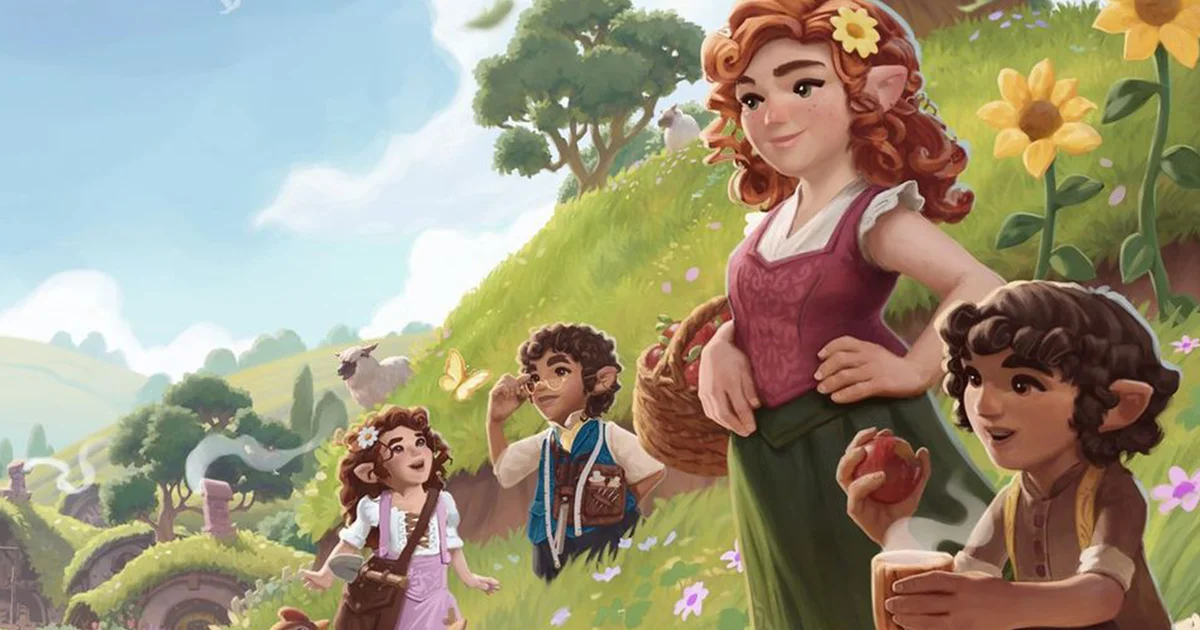
What could have redeemed Tales is the Shire itself. If the team had managed to recreate the mix of peaceful countryside and the marvelous side that makes the Shire feel so vivid in Tolkien’s writing, they’d be close. The architecture, drawn from Peter Jackson’s films, does succeed in capturing the atmosphere of a British fairy tale. I also like how the wooden dragon outside the Green Dragon nearly wraps around the pub, as if it’s about to spring free and sweep the building up with its tail. That said, a lot of the surrounding landscape feels flat. The colors and the plants don’t have enough texture to really bring the area to life. When I left, it felt more like I’d been wandering through a world pulled from a half-finished picture book than a fully realized fantasy.
What genuinely baffles me is that Tales’ Bywater isn’t geographically accurate. (Yes, I’m going full Middle Earth lore enthusiast mode here—and yes, that’s exactly why I agreed to write this review.) As indicated on the Shire’s original map sketch, Bywater sits on the southern side of The Water, at the edge of Bywater Pool. Later, Christopher Tolkien redrew this map while leaving Bywater’s position alone. Notice anything? Exactly! Unlike in Tales of the Shire, there aren’t any rivers connecting The Water to the east of Bywater. A geography slip? Absolutely. I get why they might add the river to break up the scenery and add more fishing spots, but this is the hill I’m choosing to stand on. (Also, the mill is placed in the wrong spot.)
(And based on my own rough calculation, this game seems to occur sometime between 2994 and 2999 in the Third Age, assuming Rosie Cotton is about 10 to 15 years old. That means the scouring of the Shire is roughly 20 years away. I couldn’t shake the feeling that everything I do would eventually disappear because of a certain wizard. Silly, I know.)
Tales of the Shire tells a story of unrealized promise. It’s also a rather bittersweet one, because a “Shire farming simulator” is arguably the strongest non-combat idea a Middle Earth game could have. (Pippa Funnel’s Rohan Ranch Rescue is, sadly, still just a dream.) Beyond the hobbit hole customization, Tales doesn’t manage to add much spark to its gameplay. I went in with high expectations, assuming I’d find a calm escape in the Shire—especially as someone who loves Middle Earth and farming simulators. What I got instead was a dull walk through the countryside, along with a renewed urge to return to the Shire in Lord of the Rings Online, which is, in my opinion, the best Tolkien-inspired game. Perhaps someday someone will build a truly excellent simulator about everyday hobbit life. I genuinely think it’s possible. But right now, Tales of the Shire feels like it’s destined to fade into nothing more than a shadow of what it could have been.
A copy of Tales of the Shire was supplied for review by Private Division.