“Just so you know, I’m not exactly skilled when it comes to games like this.” “No worries—I’m sure you’ll manage just fine.” “No, honestly, I’m not known for being subtle… Stealth is genuinely hard for me.” “Trust me, you’ll be okay.”
Plays for roughly two minutes.
“Hmmm, yeah, it looks like you could use a bit of support. Want to go through the tutorial together?”
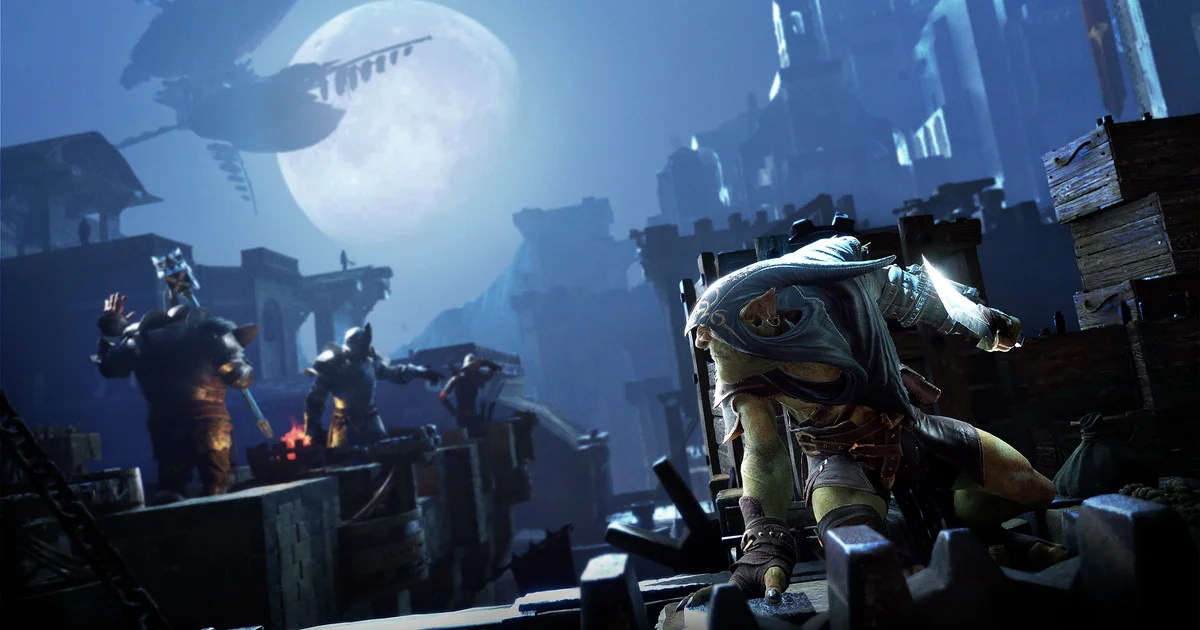
I’m giving Styx: Blades of Greed a quick hands-on test with the team at Cyanide Studio. If you’re not familiar with the Styx series, these stealth games put you in the role of a sharp-tongued goblin—yes, that’s right—Styx. Blades of Greed is set to be the third entry, and the goal is to use maximum stealth while hunting down Quartz, a valuable, powerful resource. There’s also the matter of an oncoming showdown involving elves, humans, and orcs.
The story kicks off after Styx: Shards of Darkness, though you don’t need to have played the earlier games to enjoy what’s coming. And, as you may already suspect, it didn’t go well for me at first. In fact, I was pretty awful. Still, I genuinely had an amazing time with it.
When I started the game, I was pulled into a dark medieval fantasy world, lit by flickering lights and thick with tension and hostility. Before long, I found myself in The Wall, a heavily fortified military stronghold. It’s a towering complex of concrete and steel, and—crucially for stealth gameplay—packed with surveillance, patrol routes for guards, and aggressive groups moving across its many layers. Naturally, it’s the kind of place that doesn’t react kindly to a stray goblin getting comfortable nearby. My job was to climb the fortress, convince an ethically cloudy sky pirate to back me up, and win access to his zeppelin. How hard could that really be?
Turns out: pretty hard. So, I—along with the incredibly patient developers who had to watch me repeatedly topple off ledges, accidentally set myself alight while trying to hide behind a brazier, and then get stabbed in the abdomen after walking straight into the open with misplaced confidence—made the brave call to pull back from The Wall. Instead, I headed for the mines to get familiar with the core mechanics of Blades of Greed.

There, I quickly picked up how to stay in the shadows, look through doors, step on carpets to dampen my footsteps, throw sand from a distance to extinguish torches, and use movement to line myself up for that flawless silent assassination. I also learned how effectively the setting can be used to my advantage. For a while, I became a proper shadow—blending into the night—until I clipped a table and immediately drew the focus of several guards. Then I learned what panic looks like, along with wildly swinging my blade. Everything went off the rails fast, but I was genuinely grateful for the quick save option.
I was equally thankful for the many tricks Styx brings into the fight. Eventually, Blades of Greed opens up a range of dangerous abilities, including mind control. With a bit of behind-the-scenes wizardry from a developer who seemed sympathetic to my situation (shh, don’t tell anyone), I was able to use the power early and convince a guard to turn on his fellow comrades for me. I also briefly tried another skill that let Styx go invisible. Once I finally made it into a tavern inside The Wall, I activated a lever and watched a huge chandelier—stacked with candles—crash down on the patrons without them ever realizing I was there. Honestly, they had it coming, and it was wonderfully satisfying.
The additional ability I got to test was Clone, which creates a deceptive double of Styx that you can control. I sent my look-alike sneaking up on another guard, and I found it just as enjoyable to watch how things played out from my hiding spot—me, crouched invisibly behind a large crate. Wait… was I actually starting to understand stealth?
Of course not. I was absolutely not getting the hang of it, because soon enough I was once again sprinting away from multiple furious pursuers desperate to get a closer look at my insides. It was thrilling.
After my time at The Wall, I explored Blades of Greed’s Turquoise Dawn. Compared with The Wall, this area is greener and full of life. Still, it was extremely suuuuper unfriendly. Here, I could try out some of Styx’s equipment, including his grapple hook. I used it to make a quick exit after deciding—apparently on a whim—that it was a good idea to pop out of an underground tunnel right by the feet of a heavily armed guard. Oops.
I also got to play around with Styx’s glider, a fresh addition to the series. I used it again to escape heroically, though this time it was from a chaotic rush of advancing, massive (okay, they weren’t actually that big) bug-like creatures. Honestly, this game seemed determined to kill me at every turn—and for the most part, it really worked. So I bolted away like the wind as a swarm of legs pounded behind me, leapt off a lush cliff at the last moment, and glided to safety. Before long, I turned back around to climb again toward the Quartz I was desperate to find—only this time with a different plan. Believe me, I was hooked.
We don’t have a release date for Styx: Blades of Greed yet, but the developer has confirmed it’s launching this year. When that day comes, you can be sure I’ll be jumping back into the chaos (as quietly as possible, of course).
Things can only go well from here… right?!
This article is based on a trip to gamescom 2025. Nacon provided travel and accommodation.