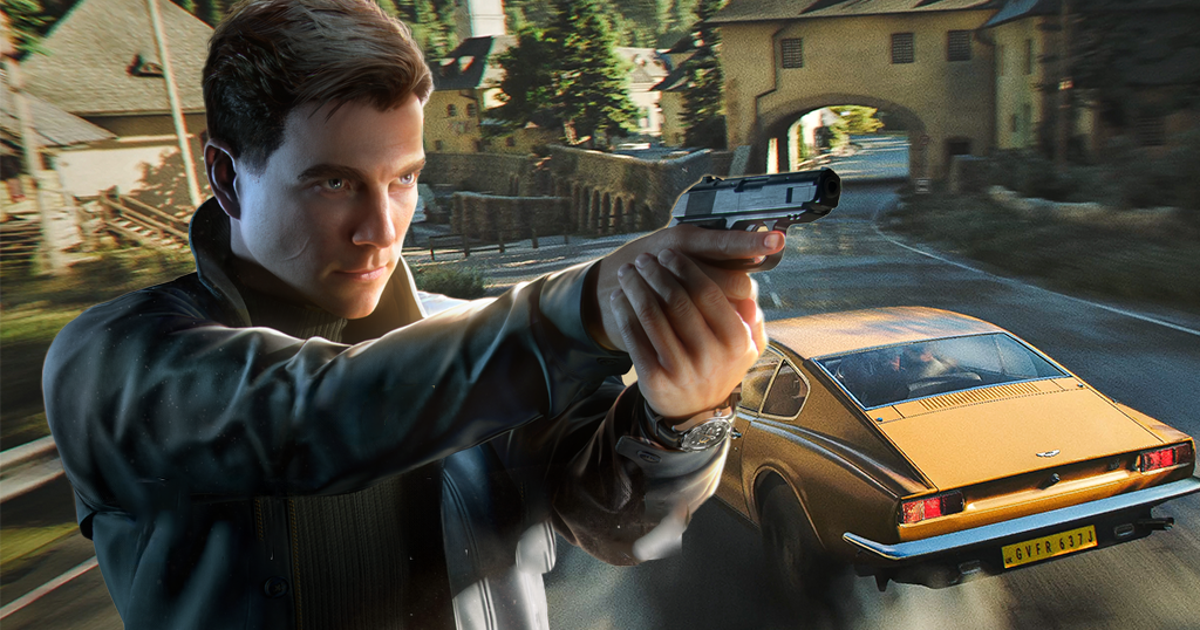
When IO Interactive first confirmed it was moving into what used to be called “Project 007,” the online crowd immediately went into overdrive. The reaction was overwhelmingly positive: this is a match made in heaven.
I agree—almost. Not quite. Or rather: it both is and isn’t. That’s the strange, lively tension at the heart of the Bond series. In some ways, it clicks naturally with Hitman’s elegant espionage style and the seductive yet hollow cynicism of “World of Assassination.” Still, Agent 007 isn’t the same kind of character as Agent 47. The way Hitman plays in your hands is distinctly different, and even if IOI can blend concepts in other areas, I worried about whether that feel would truly carry over into Bond.
Because of that, I figured IO’s take on Bond would either succeed or fall apart depending on whether the studio could turn that difference into a strength, not a weakness. After seeing a slice of the hands-off 007: First Light gameplay at IO Interactive’s Copenhagen headquarters, I’m persuaded the team has pulled it off. Mission accomplished. You keep the best parts of Hitman—without giving up the key qualities that make Bond feel like Bond.

At the center of all this is Bond himself. Casting matters, too—Patrick Gibson being named as gaming’s official 007 is an important piece—but most of it comes down to how the systems behave. Agent 47 moves with purpose and a stiff, almost machine-like presence. He’s, in a sense, a built-for-this programmed assassin, which is why he can seem a touch robotic. That style fits Hitman’s mechanics well: the movement is consistent enough that it tells you what’s safe to attempt, whether you’re visible or hidden, and so on. But that’s not Bond.
007 is spontaneous and smooth. He shouldn’t move with rigid intent, but with natural, instinctive flow. IO has addressed that right from the foundation—Bond is noticeably more agile than 47, even when you’re just picking something up from a table—yet the distinction shows up in the mechanics as well. When you’re playing stealth as 47 and you get spotted, your options narrow to using force or slipping away. As Bond, if you have enough Instinct (a limited resource), you can talk your way out of trouble. Bond can’t toss coins, but he can deliver a carefully aimed voice cue to redirect a guard. If a confrontation runs out of ammunition, one last option is to hurl his weapon directly at the head of the person coming for him. And if things turn messy and he needs to grab a rifle off the floor, he’ll kickflip it into his hands with flair.
There’s a lot of mechanical detail working behind the scenes here, and part of the reason is that, in many ways, First Light feels like the kind of hybrid game I’d describe as a blend of mechanics, ideas, and systems. When IO Interactive co-founder and First Light director Hakan Abrak breaks down the game, it becomes clearer how those mechanics are separated—making the structure less free-flowing than Hitman’s sweeping “Rube Goldberg” style sandbox environments, but still just as lively.
Deep Breath
“It breathes,” Abrak says of First Light.
That short line is striking enough on its own, without needing to restate his longer explanation. Picture your abdomen moving as you breathe—when you draw in, your body tightens. I do that without thinking when a photo is taken, so I look a bit leaner. When First Light “inhales,” it tightens in a mechanical sense.
You may find yourself in an exposition-heavy walk-and-talk, with Moneypenny close to Bond as a beautifully crafted location opens up around you. You might also be pulled into a confined, pre-set gun exchange where you can choose whether to edge left or right, aim high or low, but you’re still stuck inside that built scenario. Or it could be a tightly scripted stealth moment. Internally, IO Interactive calls these portions—the “inhale”—“guided.” In those stretches, First Light starts to look a lot like many action-adventure games I’ve played before, from Uncharted all the way to earlier Bond entries such as EA’s Everything or Nothing.
Then comes the “exhale.” Everything eases off—your muscles loosen—and if you’re anything like me, you feel a little more comfortable. IO Interactive names these parts of Bond as “core,” and it’s here that the Hitman legacy truly comes through. You’re given open spaces to work in, with a clear objective, but the way you reach it is up to you.
Some of these segments may be much smaller than a typical Hitman level. In the State of Play showcase’s publicly available early mission, we see Bond pull up to a dramatic venue packed with influential guests. He has to get in. The building entrance plays like a condensed mini Hitman level: there are several different ways to gain access, yet your route is still your decision. Once you’re inside, the game “inhales” again, steering you along a more focused path to keep the story moving smoothly.
Even in this quick example, the line between Hitman and Bond is obvious, with similarities as well. Bond is a bit more restricted than 47. For instance, Bond won’t go after civilian security staff without reason. He also won’t behave recklessly. If you approach a ledge that could be climbed over to reach an open window while a guard is watching, the game simply won’t let you do it. You’ll see the “vault” control appear, but it’s carefully crossed out. In Hitman, you could hit the button and let chaos unfold as guards react. That’s part of Hitman’s design philosophy: even an unintentional input—like firing a shot by mistake or opening a door accidentally—can knock your run off track. For Bond, the whole experience feels more contained. You can vault the wall, but you’ll need to create a distraction first.
The same idea carries over to taking someone down. In what I think is a smart use of Bond’s iconic branding, you can’t just light up enemies whenever you want. When Bond encounters opponents who are clearly trying to kill him, a flashy UI prompt appears on screen that reads: [LICENSE TO KILL]. At that point, Bond is authorized to use weapons. It’s another major way First Light distinguishes itself from Hitman, too—because at a big party, you can’t simply pick up an assault rifle and start spraying the room; that’s not how he operates.
That said, there’s still plenty of room for imagination—it just takes a different shape of creativity with
less chances of causing unnecessary collateral damage. Imagine you have to slip into a hidden area — Bond isn’t relying on disguises (at least, not the way 47 does; you’ll still see story-specific outfits here and there), so you’ll need other options. In some ways, it echoes Hitman: when you’re in that game’s Paris setting, you might decide to pass as part of a film crew. For…
that you’ll have to actively involve the presenter through dialogue choices, convincing her that you really are her stand-in camera operator. You’ll also need to find a camera somewhere in the venue to use — and that task can be completed in at least three separate ways. To even spot the chance, you’ll have to listen for everyday chatter, eavesdropping as you move through the space where a TV producer is missing a cameraman. Alternatively, you can simply slip in under the radar — or, if you’re sharp enough, steal a pass from another guest. From there, the game keeps reshaping itself, adjusting based on your objectives and the route you take to reach them.
All of this points to a game that shifts from one mode to the next. If you manage to stay hidden while alerting enemies, but then quickly remove everyone who’s been alerted, a UI message will confirm that it’s [SITUATION CONTROLLED]. Again, that’s a small but meaningful difference from Hitman, where similar setups could spiral fast, and it wasn’t always obvious right away whether you were truly safe. A good deal of that Hitman-style tension and messiness seems to be missing here — replaced instead with assurance, which fits Bond, of course. The notification also helps you understand that you’ve moved cleanly from one game state to another, in a way.
When you’re dealing with these kinds of scenarios, Bond has flashier options than 47. He’s stocked with Q gadgets for creating distractions — smoke bombs, knockout darts, and more. He can also lean on his bold confidence to convince a doubtful guard that he belongs there (even if Hitman’s “enforcer” type guards still exist and will catch on to Bond’s act). And if a situation turns into direct conflict without triggering the right to kill, the resulting brawls unfold in a tactile, high-energy combat system that leans on using an enemy’s momentum against them — throwing them around, countering, parrying. It feels wonderfully physical, with touches that bring Batman Arkham and Mad Max to mind. It’s a big step away from 47’s QTE-based, do-it-in-a-moment close-quarters fighting.
Can you feel the whole blend coming together? In some segments, you still get Hitman’s mix of stealth and open-ended freedom. Then the counter-focused combat shows up, along with Uncharted-like set-piece spectacle, plus that tight-but-gritty third-person shooting. And there are also those arcade-inspired drifting driving mechanics. Even in the areas where it resembles Hitman, the character-level interaction changes things: Bond can engage more directly with people, and you’ll have dialogue options and branching exchanges that let you steer scenarios using 007’s signature charm instead of leaning on stealth or misdirection alone.
Going 360
I really dislike marketing hype. Still, every so often a specific line cuts through — and for Bond, IOI has a phrase that’s even more eye-catching than a watch with an integrated circular saw. “We aspire to create a 360-degree Bond experience,” Abrak says, in one of the many moments where he uses that geometry-minded expression. Sure, it’s corporate language — but it does capture something real about James Bond.
In GoldenEye 007, Bond is essentially the Doom Guy. Sure, there are occasional gadgets and some hacking sprinkled in, but mostly he’s mowing through wave after wave of Soviet soldiers or terrorists. In Everything or Nothing, the studio gradually added elements like car chases and perhaps the occasional espionage sequence, yet the emphasis remained on action. IO wants to take a wider lens on the character, looking at Bond from every angle rather than centering only on combat — that’s where the “360-degree” idea comes from.
So what defines Bond? He’s charming, and he’s inventive. IOI wants its game to reflect all of that, which is why you may find yourself spending plenty of time in a “social space” instead of only taking part in a straight-line shootout. Those social spaces also work differently from Hitman’s — they can feel tighter in some respects, yet more adaptable in others, especially when Bond talks with key NPCs. Much of this is something 47 would never attempt to this degree — if he ever did at all. That’s why I’m reluctant to call it simply “Hitman, but with more action,” and I’m even more cautious about anyone who reduces it to that. It’s far more than that.
There was another buzz-worthy phrase I found particularly compelling during this studio visit, and it felt less like a polished marketing slogan and more like a distinct turn of phrase — one that the team actually uses. I heard staff members from major parts of the production pipeline — narrative, gameplay, audio — all say they want to “put it on the sticks.” In this context, “it” means the feeling of being Bond. Bond is among the most captivating figures across all media, and naturally, IOI wants players to take the reins of him as he carries out his most impressive moments.
I’m fully behind that, but in a case like this, the real test is the experience itself. The biggest open challenge Agent 007 still needs to clear is: being playable. IOI is making confident claims and showing off visuals that look fantastic. And sure, World of Assassination suggests it can deliver on those promises. Yet I keep hearing the idea that this fun, kinetic action is “on the sticks,” and I can’t shake the thought that… I haven’t actually touched those sticks.
I’ve spent enough time in this space to know that gunplay can look slick and well-crafted on video while still feeling terrible once you try it for real. A “social space” can seem effortless in a polished, edited clip, but in the actual game it might feel awkward. All of this has to be tested. I need, in the words used by IO folks, to get “on the sticks.” If IO Interactive’s execution captures Bond’s smooth confidence and is as solid as their statements, though, I can absolutely see it turning into a classic. As a Bond fan, I’m keeping my fingers crossed — and I’m more optimistic than ever.
This preview is based on a visit to IO Interactive’s HQ in Copenhagen. IOI provided travel and accommodation.