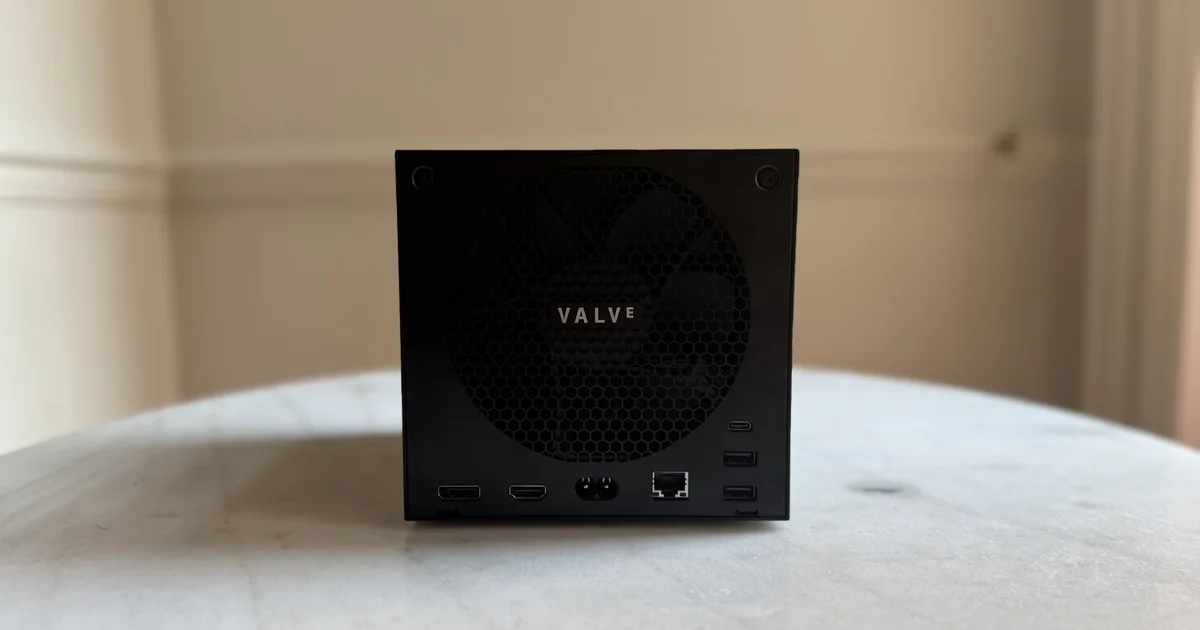
The Steam Machine is finally up for sale! Naturally, it comes with a rather steep price tag for 2026—whether you view that year through the lens of our lord or our dark lord. We’ve put together a detailed, people-first review of the Steam Machine on our own, by my good self; still, I should be upfront about one thing: I’m not a technical expert, and I never will be.
Luckily, James Archer is. James is the deputy editor at our excellent, PC-focused sister site RPS, and he’s also a genuine hardware specialist who previously managed that site’s hardware coverage. So instead of sticking to what’s comfortable, I’ve taken a different approach: I’m teaming up with our friendly rivals over at RPS for the Steam Machine reporting, so you get clear answers to the most pressing technical questions we think are on everyone’s mind.
Keep reading for all of that, and—just as importantly—make sure you also check the review we linked earlier, plus James’ review of the Steam Machine for an even broader set of viewpoints on this fascinating, appealing bit of technology.

When it comes to value: if you build a PC with comparable performance to the Steam Machine, will it end up costing less, more, or roughly the same? And would it be smarter to just put together something like a mini ITX?
James: ‘True’ budget gaming PCs have largely disappeared, but at the price of a Steam Machine, you could assemble a stronger mini ITX setup—potentially with something like Nvidia’s RTX 5050. If your top priority is performance per dollar, that route clearly looks more attractive. The trade-off is that it won’t be as compact, and it probably won’t be as quiet as a Steam Machine—so it might still be worth accepting a drop in frame rate if you specifically want a low-profile PC for the living room.
How quickly does the Steam Machine fall behind in performance? It looks capable of running triple-A games at 1080/60, but for how long? And how does it compare to the typical gaming PC when you look at Steam hardware survey numbers?
James: It looks like the performance demands of modern games have flattened to a degree. With particularly heavy titles, you’re probably looking at games like STALKER 2 or Indiana Jones and the Great Circle—both released in 2024—and both should run on the Steam Machine with the right settings. That could change once the next console generation arrives, but that’s likely a ways off, largely because component prices remain chaotic, which affects the Steam Machine…
I wouldn’t be shocked if it’s around average. More capable, newer mid-range GPUs are the most common on Steam, yet the count of players still using older, cheaper hardware typically outnumbers people on high-end rigs. For example, there are more GTX 1060 users than RTX 5080 owners.
Is it reasonable to expect it to handle any of the newest major games at 4K?
James: It’s built with 1080p in mind for sure, but if you dial back settings and use enough upscaling, you may still be pleasantly surprised. Resident Evil Requiem can hit roughly 70fps on Low with FSR in Performance mode, and I’d say it still looks quite good. Forza Horizon 6 averages about 57fps on Medium with FSR Performance, while 007 First Light—at least, I initially feared it would stumble the way Roger Moore’s knees apparently did—usually stays above 40fps as long as you choose Low. Again, this is with FSR set to Performance.
Will FSR 4 meaningfully boost results—could it close any gap toward a PC/PS5 Pro level experience?
James: FSR 4 isn’t just about delivering higher performance relative to FSR 3; it also looks far better. That makes it a welcome improvement if you want to play at higher resolutions (or higher settings) without the upscaler creating too much blur.
How easy is it to handle other everyday PC gaming activities on this device—like installing mods or running non-Steam games?
James: It’s pretty much in line with the Steam Deck experience. Most tasks are doable, even if you sometimes have to switch over to SteamOS’ Desktop Mode. Lutris, in particular, remains an excellent (almost) one-stop solution for adding non-Steam launchers and their games without a lot of hassle.
What exactly can you customize on the hardware side—storage, RAM, and anything else?
James: Most home DIY users probably won’t feel the need to take anything apart except the memory and storage. That said, there’s also a microSD slot for extra, relatively affordable space to install games. When it comes to the overall case design, the Steam Machine stands out as one of the more flexible choices visually as well: you can swap the RGB light strip, change the faceplates, or even cover the entire unit with a quirky alternative, like Dbrand’s Companion Cube case.
Can you install Windows in a way that bypasses anti-cheat complications in major multiplayer games—and how difficult is that process?
James: I haven’t tried it directly on the Machine, but it should follow the same approach as the Steam Deck. On the Deck, you can install Windows onto a microSD card, then boot from it while keeping SteamOS on the main SSD. It’s not completely effortless, though Nerdzap has put together a helpful guide to make the setup smoother.
Do you have any concerns about heat or noise?
James: Actually, it’s the opposite. The Steam Machine’s quiet operation is a major reason people consider it as a living room PC rather than a typical desktop setup—and it doesn’t seem to hurt cooling performance either. The highest temperature I’ve seen for an internal component is the CPU at 81°c, which is perfectly safe. Meanwhile, the external front, top, and side panels only ever feel a little warm to the touch.
For even more details about the Steam Machine, be sure to look at both our Steam Machine review and the RPS review, along with the key takeaways from our conversation with Valve’s designers—covering pricing, components, and how it stacks up against other consoles, including Xbox’s Project Helix.
We’ve also published a guide that explains how to order the Steam Machine, including the fact that the ordering process is a bit unusual. You can also find a full breakdown of the Steam Machine’s specifications, plus a comprehensive overview of everything you need to know to cover the essentials.