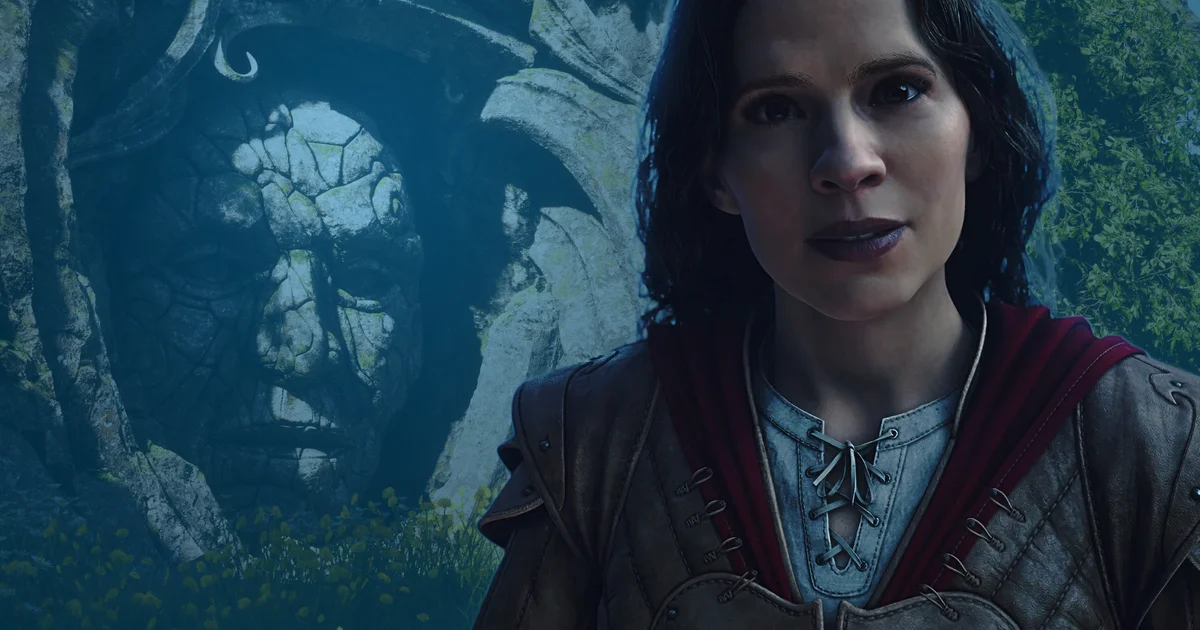
If this were not a Fable preview, I wouldn’t hesitate for a moment about how much I wanted to set your expectations. Still, forgive me—I’m going to raise them anyway. I’ve watched around thirty uninterrupted minutes of gameplay, and even with any caveats in mind, it genuinely stood out. Playground Games’ Fable reboot comes across as playful, daring, unmistakably British, visually striking, intricately layered, and—maybe—slightly too ambitious. In short, it feels like Fable. After all, what better way to capture the series than promising the cosmos: 1,000 unique NPCs you can romance, shaped by morality-driven systems—each with their own reactive character and behavior—while also leaving players wondering whether that promise can really hold up? This early look suggests Playground might be able to pull it off. Even more telling, it seems its team truly understands Fable well enough to realize they’ll have to work to earn that faith.
The closed-door showing took place soon after Xbox’s big summer presentation, and Playground’s two associate directors—Craig Littler and Will Kennedy—were on hand to present it. Littler, while steering the gameplay as he spoke, framed Fable as “a game within a game.” At the same time, he described it as “a life simulation, a social simulation, and an economic simulation.” Peter Molyneux may not be directly tied to this release—Littler told me that although “Peter is a legend,” the new Fable team hasn’t spoken with him “at all” for this project (and they’re not especially worried about his next game called Masters of Albion: “To be honest, I’ve got my own Albion to think about.”)—but the spirit of sweeping ideas and bold declarations still comes through. And once again, you could argue it simply wouldn’t feel like Fable without that kind of aspiration.
As for what the demo actually showed, it leaned heavily into the idea of “crafting an extraordinary life.” In more down-to-earth terms than the usual ‘key design pillar’ PowerPoint language, that means demonstrating how many connected systems you can tinker with away from the main storyline. When asked about the central plot—prominent in Fable’s grand showcase trailer—Littler and Kennedy stayed a bit cautious, promising more information later. As Littler put it, “I think it’s essential to clarify that this isn’t Fable 4. This is very much Playground’s interpretation of what Fable signifies to us; it involved constructing a narrative that integrates the elements we consider vital to our vision of Fable. However, it isn’t directly linked to any of the previous Fables [released before].”
In this version of Fable, we started our journey riding horseback to the village of Silverbrook, a farming community where vegetables seem to earn an almost obsessive level of admiration—visible in its overall look—set among the scenic fields of Oakshire. The opening gives you that lush, classic rural vibe; Oakshire’s rolling green hills and drifting wheat fields could easily have been lifted from a Tory campaign poster. And if that weren’t enough, one of our very first interactions in town involves a pig.
Colin, the talking pig, is scheduled to be slaughtered for an upcoming feast. A young boy pleads with you to stop the killing, while the pig’s owner—who seems, at best, morally questionable—insists on going through with it. His reasoning is that even though Colin is friendly enough, the boy still had to pay to get him. That kicks off the demo’s first of many meaningful decisions: you choose what happens to Colin, and the game then splits into ways to convince the owner to spare him. You can challenge him directly, back down, or offer a bribe—we went with the latter. Colin is freed, and we immediately receive one of many artistic messages in elegant cursive letting us know we’ve earned a reputation for being Virtuous.
Not far away, you meet Jack the Beggar, and like every NPC, he has a small information panel that appears as soon as you talk to him. He’s introduced as a hard-working commoner who likes you because of your Virtuous reputation—meaning he sees you as principled. It’s a clear example of Fable’s unusually thoughtful morality system: almost everything you do in the game, from how you handle routine conversations to the outcomes of romances and even how much money you spend, feeds into your reputations. And there seem to be plenty of them—virtuous, wealthy, cruel, and more.
Your reputation is tied to the particular town where you earned it, and it can be adjusted in most cases, even after you trigger a familiar “what if I just attack a few villagers with my sword” moment—so long as you put in the work to rebuild goodwill with the people involved, or you pay the local town crier to spread a specific narrative about you.

On top of that, each NPC comes with their own moral outlook, shaped by their individual traits—whether they’re a hardworking commoner, an ambitious commoner, and so on. The demo is built to highlight exactly this. We hand Jack the Beggar some money, boosting our reputation for being Kind. Nearby sits a general store, where Megan the Merchant works. She already seems to have a favorable opinion of us because she thinks we’re shrewd and capable after negotiating with the farmer to get Colin freed. Littler chooses the romance option from the dialogue menu, and she lets us know she’d consider a date—assuming we satisfy a few extra requirements: dress sharply, own a home, and prove we’re serious about entrepreneurship. No one will ever claim Megan doesn’t know what she wants from a partner.
You can buy a home for a set price, and once you’ve acquired one, you choose how you want to run it as a new landlord. That includes evicting current residents, increasing rent, or offering some kind of financial incentive to get them to move—each approach influencing your reputation in its own way. To become an entrepreneur, we had to own a business. As with homes, we’re told that any business in the game can be purchased, so Littler naturally selects the local pub. To afford the pub, we needed extra cash, so we took a nearby job as a blacksmith, working through a shortened version of a smithing minigame. The task is to land precise strikes on specific parts of the heated metal, and doing the work properly earns more money.
We bought the pub for roughly a hundred grand, and afterward we gain access to a separate menu filled with controls for it: decisions on staffing, setting prices, wages for employees, and more. Our current bartender, Susan, gives a +10% income boost because, as a compassionate commoner, she’s excellent with customers.
Since Jack the Beggar is a diligent commoner, we decide he’d make an excellent addition to the team, and we extend an offer—he’s now known as Jack the Bartender, and
is especially thankful. In the interim, we’re treated like budding entrepreneurs and seen as well-off, since we’ve just splashed out a considerable sum.
That clearly wins us some goodwill from Megan, but not everyone—Rhiannon the Tailor included—is equally impressed. She’s a regular commoner who openly resents you for your wealth, and she thinks you’re completely out of touch with reality (you can see that reflected in the dialogue boxes when you speak with different NPCs). As a result, she bumps her prices up by an eye-watering 80%, and her attitude is downright unpleasant—yet because we’re wealthy, it barely bothers us. Afterward, when you switch into the outfit—at any wardrobe across the game—you can also tweak your look, including skin tone, hair, body type, and voice, though we opt to keep our current appearance. Now, back to Megan! Time for our date.
The latest screenshots from June 2026.
The date itself is pretty simple, and it may even highlight the boundaries of these interconnected systems. It includes a short cutscene of the two of us chatting, and then—once we talk to her again—we’re given choices that can make things official. During this moment, I noticed a pop-up suggesting our parents are now considering allowing our marriage once they provide their approval. A similar question comes up about whether your reputation influences your performance with customers, and Kennedy’s answer is a bit murky, hinting that it probably doesn’t. Still, he did reassure us that there will be “a multitude of other ways the system will react to reputation” beyond what we saw here.
On a lighter note about relationships, Littler recounted, “One of our developers walked over to the design team one day and asked, ‘Where’s Helen?’ The design team replied, ‘Who’s Helen?’ ‘The barmaid in the tavern! I’ve been working on the pub, and she’s disappeared.’ Turns out, Helen was only a placeholder. Helen will not be included in the game.”
Meanwhile, our pub hides a classic video-game idea: down in the basement, there’s a magical chest where you can access and pull in all the income from your businesses. I also spotted a smaller door tucked into the front entrance, which felt a little odd. Could it mean we’re able to keep pets in the game? Littler laughed and said, “That door is actually for Colin.” And on the idea of pets and these little doors: “Not every pub will have a Colin.” Take that as somewhere between a firm no and a maybe.
After a successful date, Littler switches to a villainous streak and ends things with the unfortunate Megan, dismisses the delightful Susan, and then goes on a rampage of chaos. Megan now sees you as a heartbreaker and refers to you as Out of Order—a clever line that’s also pretty accurate, since we just asked her out. Susan describes you as cold and uncaring and isn’t impressed, though others may well be drawn to you because of your ruthlessness. That brings us right back to the core concept of the refined, location-specific morality system.
Instead of functioning as a simple good-versus-bad spectrum or a single moral score that’s applied the same way every time, morality in the Fable reboot depends on how other people view you. Every character has a slightly different take—much like in real life. “I remember in the early parts of the project,” Littler said, “we talked about how this might show up. We looked at different frameworks to understand how it could be portrayed. A point we kept returning to was that not everyone perceives things in the same way. That difference is visible in today’s world, and even during our own conversations we ran into distinct viewpoints. We felt there was something especially compelling there, so we leaned into it—eventually shaping the reputation system you see today, which captures that subjective, multi-layered understanding of morality.”
Elsewhere, combat offers a quick look, and it really stands out. During a run-in with town guards, we see crossbow fire alongside flashy swordplay, backed up by a variety of magical powers. One ability lets you hoist enemies using a magical vine, lifting them by their ankles—later, we’re shown you can slam them back down with a heavy impact. Another is a familiar fireball, but rendered with gorgeous visuals. In close-quarters sword fights, you can flip through the air or cover huge distances almost instantly. It’s hard to judge combat fully when you’re not the one controlling it, but from a distance it looks energetic and full of personality, with plenty of room for humor.
As the guards keep chasing us, we bolt away, galloping into another field, and we catch a glimpse of the bounty system. You can settle your bounty, which removes your criminal status—but it won’t magically erase everyone’s memory of what you did as a heartless heartbreaker (that’s where the town crier comes in). Alternatively, you can head to another region where the penalty is lower and your reputation doesn’t follow you, so you can start anew. “I’ve built up a reputation in Silverbrook, but if I move to a new settlement, the locals won’t have heard of me,” Littler explains. “So, in the next place, I might be seen entirely differently. I could be viewed as an odd killer, a criminal, and promiscuous.”
Back in Silverbrook, as shown on the map screen, we’re being labeled all at once: a killer, shrewd, wealthy, a criminal, charming, and an entrepreneur. In under half an hour, as Littler is quick to point out, we’ve done an impressive amount—saved a talking pig, bought a home and a business, changed our appearance, handled a relationship, landed a job, and even shifted into a murderous villain.
This strong demo seems designed to showcase the on-the-fly loop of choices, where you might decide to pursue ‘X’ and then do ‘Y’ and ‘Z’ afterward to reach that objective. That fits perfectly with what Fable is about. Of course, a few caveats and unanswered questions remain. Fable looks visually stunning, but the lip syncing is clearly off and will need work before launch in early 2027 (which is likely tied to the fact that many NPCs are voiced individually—the voice acting is entertaining and has a suitably British feel). Similarly, while I thought Fable looked fantastic, I expect there are still improvements needed in how the game runs. Littler said the demo held steady at 30 frames per second, apparently on a Series X development kit, and mentioned that “there will also be a performance mode available at launch” when I asked how the Series S optimization is progressing.
Beyond that, it’s still a bit unclear just how broad these systems really are. It’s genuinely impressive how many systems you can encounter within half an hour, but it also makes you wonder how much real depth each one has. My guess is that the depth will become clearer during actual gameplay—once you start hiring staff to increase earnings and build increasingly detailed reputations over time—rather than experiencing it all through a single opening village. In a lot of ways, this light, breezy pacing is part of Fable’s charm. The date involving the unfortunate, rejected Megan felt a little underwhelming, especially without a possible minigame or even a genuinely comedic moment.
Even so, the overall impression is one of authentic excitement about where this take on Fable could go. The project has always leaned on ideas we already know—local humor, quirky fantasy, and morality systems—but beyond that, it has also meant taking bold chances and backing them up with a real sense of playful creativity from the developers. And putting everything else aside, it’s hard not to see that Fable is already on track to be a major success.