Avowed is a fascinating, yet stubbornly difficult project to pin down. Obsidian’s newest fantasy RPG was initially rumored to be the studio’s answer to Skyrim—a comparison the developer has repeatedly dismissed. Even so, the game’s polished, modern look places it at odds with the older identity of that franchise. Unlike some of Obsidian’s more recent releases, including the small-scale survival experience Grounded or the medieval mystery Pentiment, Avowed doesn’t come with a single standout hook beyond its genre and its developer (though some might say that alone is enough).
After spending a few hours with Avowed, I can see why it’s been hard to summarize what the game is “about.” It’s a fantasy RPG that doesn’t lean on one big, instantly recognizable signature. Instead, it folds a collection of smaller ideas into the genre’s familiar structure. It plays in a way that echoes Mirror’s Edge, handles combat with the flavor of Dishonored, delivers conversations that feel like Mass Effect, and carries a mood reminiscent of Skyrim. Still, once you look at it as a full package, it doesn’t map cleanly onto any of those games—it blends those influences alongside the meticulous worldbuilding and intricate dialogue systems Obsidian is known for.
The plot, at least, is refreshingly direct. Taking place in Eora from Pillars of Eternity, Avowed casts you as the Emperor of Aedyr’s envoy, sent to The Living Lands. This untamed island sits on the far side of the world from the Deadfire Archipelago in Pillars of Eternity 2, and it’s home to pirates, anti-imperial fighters, and the lingering remnants of failed colonial attempts. Your assignment is to dig into the dreamscourge—an unusual affliction that escalates over time and is spreading across the island.
After a short segment covering character creation—during which I chose they/them pronouns and added oversized mushrooms to my character’s face—my Envoy quickly found themselves stranded after a shipwreck on a remote islet near The Living Lands. Once I’d shaken off the initial chaos, I hooked up with a small, furry blue creature called Garryck, whose look suggests something that could pop out of a novelty toy. Together, we climbed up to an abandoned fort to look for a way out.
This quick introductory run-through covers the fundamentals of Avowed’s open-class roleplaying approach, including both melee and ranged combat, a highly responsive magic system, and a touch of stealth play. We’ll dig into those systems later, but the most immediate impression is how smoothly your character moves. The game is remarkably nimble: your Envoy can jump, scale, and slide around obstacles with ease, making exploration feel lively rather than restricted.

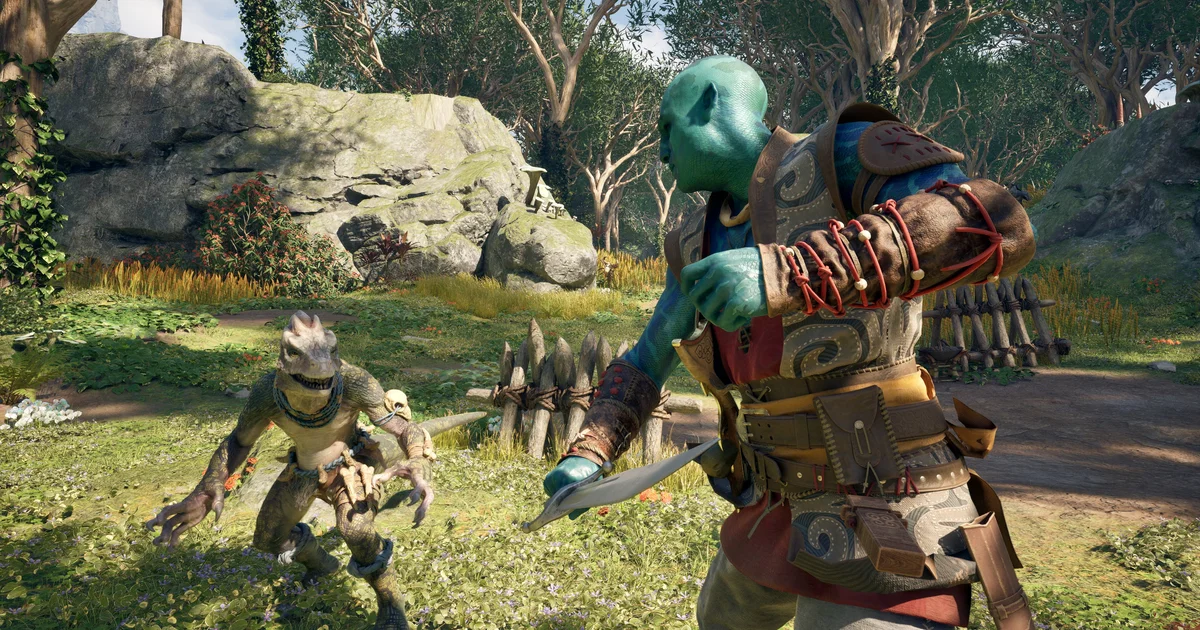
Once we reached the fort, we fought a handful of lizard-like Xaurips, and then rescued a lively Scottish woman named Ilora from her cell. After that, we escaped the islet by rowing to Dawnshore, which serves as Avowed’s first major destination. Just like The Outer Worlds, The Living Lands is organized into distinct areas you travel between, rather than presenting a single, fully connected open world.
It’s worth pointing out that this structure wasn’t always the intended direction. “There was an earlier concept of creating a seamless open world,” says Carrie Patel, Avowed’s game director. “When I joined the project in January 2021, we underwent a creative shift, and one of the choices that came with that was transitioning to distinct open zones.” Patel adds that there were technical considerations involved, but the change also gave Obsidian “a very unique sense of separate regions with diverse biomes.”
I can’t say I fully buy that explanation—plenty of open-world titles still manage to make biomes feel meaningfully different—but the larger takeaway is what matters more here. Whether the game is seamless or not, Dawnshore still comes across as comfortably large. The region is built around a wide, oval-shaped stretch of lush green plains and flourishing forests, framed by mountains to the north and coastal cliffs to the west. At the center stands a massive, ancient metropolis, its towering walls acting as a constant presence as you move through the surrounding open countryside.
That said, Dawnshore’s greenery doesn’t tell the whole story. The region carries a strong feeling that the natural world is actively pushing back against civilization. The harbor town, with timber-framed buildings and the first area you reach, looks like it’s breaking down as you play, while farther north lies something closer to a whole village made of thorns—the Strangleroot.
Mushrooms show up everywhere across the region. In fantasy settings, they often function as a quick visual shorthand for “something strange,” and aesthetically, I’m not sure Avowed’s choice feels as distinctive as the team seems to believe. Still, the mushrooms in Avowed aren’t just decorative oddities. “[They] symbolize the encroaching dreamscourge, which is linked to the metaphysics of the world,” explains region designer Berto Ritger. “You’re sent to The Living Lands to examine that soul plague, the dreamscourge. Thus, we wanted this visual element to be intertwined with the themes of the narrative.”
Sadly, it’s within the Strangleroot that the Ambassador to The Living Lands—the person our Envoy was meant to meet on arrival—has disappeared. On the bright side, Kai, a local Aumaua (aquatic humanoids with shimmering skin), has their own business to handle in that area and is willing to help us track the Ambassador down.
Kai is the first genuine NPC companion you recruit in The Living Lands, voiced by Brandon Keener (best known for playing Garrus in Mass Effect). Maybe because of that, Kai quickly earns their place as a genuinely enjoyable partner—an instant friend who feels open and personable. They’re easy to like, and you can share a laugh without leaning on jokes just to fill space. Someone could
Some might argue that bringing Garrus into your RPG is a relatively simple way to spark players’ curiosity, but aside from the fact that it’s slightly hard on Kai as a character, it absolutely does the job.
On the whole, Avowed’s storytelling lands with a stronger sense of realism when placed beside the wildly unrestrained oddness of The Outer Worlds, which I found personally more engaging. That said, this doesn’t mean Avowed is relentlessly serious—Obsidian’s signature humor is still there—but the dialogue feels more natural, with less pressure to be clever or offbeat for its own sake. As you’d expect from an Obsidian game, you also get plenty of dialogue options during any conversation. It’s tough to judge how reactive Avowed’s main story will be after only a few hours, but many of the NPCs I ran into openly remarked on my Envoy’s facial fungus, which bodes well.
As I head out of the harbor with Kai, I can’t help noticing how consistently he’s involved—he comments on the places we pass, from an abandoned lighthouse just outside town to the moments when things break into combat. More often than not, he feels like a true companion rather than someone quietly hanging back while I handle everything. “We want [companions] to feel significantly present in the story,” says senior narrative designer Kate Dollarhyde. “To get there, we look closely at where they show up on screen during talks, how much they comment on what’s around them, how frequently they interact with NPCs, and how they approach you at party camp to discuss what you’ve been doing.”
I decide to check out the lighthouse Kai points me toward, trying out parkour-like movement before happily dropping from the top into the sea below. In this moment, and across the surrounding spaces, Avowed’s terrain feels rougher and more organically shaped than what I saw in The Outer Worlds. There are lots of elevation changes that pull you forward and make use of the game’s smooth first-person platforming. “One of the aspects we aimed to enhance with Avowed compared to The Outer Worlds is the sense of verticality in space,” explains art director Matt Hansen. “It’s considerably harder to nail, but we were standing on foundations set by giants. The Outer Worlds gave us a lot, and New Vegas provided the groundwork even earlier than that.”
“One of the aspects we aimed to enhance with Avowed compared to The Outer Worlds is the sense of verticality.”
After wandering through a few caves beneath the lighthouse and grabbing a hidden treasure chest, I start making my way toward the Strangleroot. Before long, though, I’m pulled into a quest that asks for help—an area of a woman’s home has been taken over by xaurips. That means pushing through an area closely watched by the small lizardmen, which is a clear cue that combat is next.
The combat system is arguably the most hotly debated part of Avowed, largely because of how it was showcased in an earlier trailer. I also had doubts about the way Obsidian initially presented its fights, but the combat I experienced myself was genuinely fun, satisfying, and full of personality. In battle, your character moves with the same nimbleness as they do while traveling—smartly dodging enemy attacks and striking back with heavy lunges that can break through defenses. Even the basic starting dagger hits with real authority when you thrust, while bigger weapons bring more weight, though at the cost of some maneuverability. Overall, it felt a bit more “sticky” than I’d prefer: your attacks sometimes lock you onto a specific foe for a moment before you can disengage.
“We took this matter very seriously,” gameplay director Gabe Paramo says. “It was urgent to address the fact that players were unsatisfied, and we wanted to respond swiftly.” Since then, Paramo notes that the team has been working to improve “the sensation of impact, the feedback of hit reactions, and the timing between the strike and the corresponding reaction,” with a much closer look “more frame-by-frame.”
Along with that stronger physical presence, the combat itself offers plenty of variety. You can dual-wield almost any mix of one-handed weapons, and if you prefer range, options like bows and arquebuses let you aim at enemy weak points. As you progress, you also unlock more specialized combat techniques that you can tailor across the three core class archetypes: warrior, ranger, and mage. The character I used in the preview leaned heavily into magic, thwip-thwip-ing enemies from a distance with a wand. Still, I did pick up the fighter’s “Charge” ability, which lets you rush any opponent that closes in for melee and send them flying into a ragdoll heap.
When it comes to magic, one of Avowed’s most compelling elements is its grimoires. These equipped spellbooks hold a variety of spells you can cast immediately during fights—like a burst of ice bolts that traps enemies in place, or a lightning strike that jolts a pool of water that’s already standing there. They work in a way that’s comparable to Bioshock, though grimoires are entirely optional, and combat seems driven more by stats than the system used in Irrational’s game.
This isn’t the only place where Avowed takes on ideas from immersive sims. After reaching the house overrun by xaurips, I handle the outside guard and then look around the building. Sure enough, there’s a way to slip in from the back, and I manage to take out a few xaurips with a special stealth kill technique before the lizards realize I’m there. I ask the developers how extensive Avowed’s stealth approach will be. They explain that you can use it to skip parts of a dungeon or avoid certain encounters, but you won’t be able to stealth through the entire game. “It’s akin to a conversation. You can have dialogue choices that allow you to skip combat based on your invested stats,” says Paramo.
“Not every interaction will put you in a position to use that choice, yet there will still be plenty of encounters that open up these kinds of options.”
The more time I spent with Avowed, the clearer it became that “variety” might be its standout trait. Within only a few hours, I’d already unlocked a wide selection of weapons and spells, and I genuinely enjoyed trying them out—each one felt like a real route worth exploring. Even the movement between play modes feels right, too. You can climb the side of a building to slip into an opening on the rooftop, jump into a tense skirmish with whatever waits inside, search the loot-filled treasure chests, and take the quest item you came for, then hurry back to town for a fluid conversation sequence, with Kai adding context as you talk.
Any drawbacks? Yes, definitely. Combat was entertaining, but it also leaned toward the straightforward end of the spectrum, and I handed the (fairly early) boss inside the Strangleroot without much trouble. Also, as I mentioned earlier, I’m not fully convinced The Living Lands will feel quite as distinctive to players as Obsidian is aiming for—particularly when games like Elden Ring and Baldur’s Gate 3 are delivering their own brand of unusual surprises within their fantasy worlds. That said, I’ve only scratched the surface of the wider setting, and the Pillars titles, too, turned out to be more offbeat than they first appeared.
Finally, there’s still the absence of a clear, memorable hook. Avowed brings in a number of things I really like, and I found myself enjoying it—more than I did with The Outer Worlds. Still, nothing I ran into felt especially distinctive, or like it was uniquely Avowed in a way that couldn’t be replicated elsewhere. This doesn’t mean there’s no such element at all, nor that Avowed needs one. Even so, there’s an unmistakable mystery sitting at the center of Avowed. The question heading into launch is simple: will it all come together?