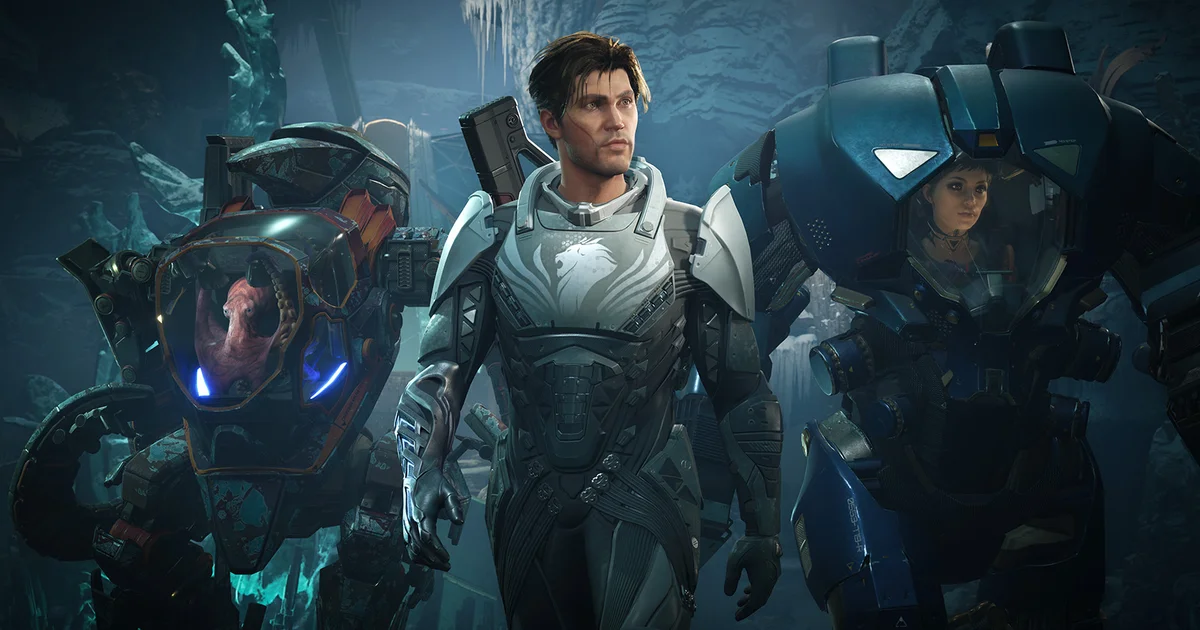
Even if the sci-fi RPG Exodus already felt uncomfortably close to Mass Effect, Archetype’s team has now laid out a binary morality model that works in a notably comparable way—only this time, instead of tallying Paragon and Renegade points, we’ll be collecting Paladin and Immortal points.
This oath-driven setup was revealed during a lengthy Exodus gameplay video shared tonight as part of the Future Games Show, offering close to 20 minutes of footage spanning multiple parts of the journey and giving us our most detailed look at the game so far.
What’s especially interesting is that your moral alignment is chosen right at the start. Paladins are described as “noble,” while Immortals are framed as “ambitious.” Much like in Mass Effect and other BioWare games—especially Star Wars: Knights of the Old Republic and Jade Empire—your alignment can shift depending on the decisions you make throughout the story.
The gameplay trailer spotlights a few of these turning points. One moment places us on a bridge during an encounter involving a firearm, with a demand that we surrender our weapons. You can respond by calmly showing your ID and talking your way through (a Paladin option), or you can take an aggressive route and push the conflict further (an Immortal option).
Another decision moment is shown even more clearly—one that seems meant to have real consequences—when we’re asked to decide whether to activate a massive airlock to vent enemies out into the vacuum of space, even if doing so could endanger innocents. In that case, each companion suggests a different course, meaning that beyond earning Paladin or Immortal points, you can also build standing with your companions.
“There will be rewards that are only unlocked if you go all one way or another” -Chris King
So, the structure will feel familiar. In a press briefing I attended before the Future Games Show, I learned that certain rewards are tied to committing fully to one alignment—similar to Mass Effect, KOTOR, and Jade Empire. “There will be rewards that are only unlocked if you go all one way or another,” said game director Chris King. “However, we also have rewards that are exclusive if you opt for a hybrid philosophy.” That means staying in the middle doesn’t automatically put you at a disadvantage. King also added that your Paladin or Immortal standing will improve your ability to persuade or intimidate others, respectively.
The extended trailer offers a thorough look at the kinds of action you’ll do in Exodus, moving through a range of in-game locations and demonstrating how we can use our upgradeable, quasi-magical gauntlet—passed down from our missing father—to take cover, build bridges, and call forth blades to cut down enemies. This link to ancient Celestial technology through the gauntlet helps explain what sets Jun Aslan apart in the narrative.

A selection of new Exodus screenshots.
We also see conversations between Jun and the companions we meet, which sheds light on the plot and on how we can steer it. While Exodus isn’t a direct copy of Mass Effect, it’s the overall mood of the experience that makes the comparison feel so natural. Exodus is shaped by the pull of space, while also carrying the emotional weight of its bold, adventure-forward narrative.
As studio general manager Chad Robertson explained during the press briefing: “One element that truly distinguishes us is emotional resonance — that’s crucial for our team. We frequently discuss this theme. We anticipate those moments in games when you must set down the controller, where the weight of a profound decision confronts you, and that’s the type of experience we’re striving to offer with Exodus.”
Robertson said the story draws from sweeping sci-fi that “feel larger than any singular moment you are experiencing.” He added: “Whether it’s Luke’s transformation from a farmer to a Jedi in Star Wars; or Paul’s influence on the future of Arrakis in Dune; or Cooper, in Interstellar, making the heart-wrenching decision to leave Murphy behind. All these narratives carry significant emotional heft, which profoundly impacts us and something we’ve endeavored to instill in what we’re creating with Exodus.”
One of the biggest ways Exodus pulls away from Mass Effect involves a time-dilation feature—something I’ve covered previously. During an “Exodus” mission, as they’re called, you’ll be traveling at nearly light speed, and time moves differently for you compared to people back home. The faster you go, the more time passes for them while you stay in the present. If you want an analogy, think along the lines of Interstellar—using Robertson’s comparison.
I’m genuinely excited by this idea for a role-playing game, since it makes room for long-lasting consequences without necessarily showing much time-dilation during the gameplay trailer. There’s a quick sequence where Jun sprints toward a statue in a town or city; the environment shifts while the narration discusses time-dilation and its possible effects, but there isn’t enough to pull clear details from it.
“You can travel in your spaceship and explore the immediate cluster without time-dilation, but there are moments you must venture really, really deep into space…” -Chris King
Still, the time-dilation system has sparked questions among players following Exodus, especially when the stakes rise—particularly for characters we grow close to, and who we do form relationships with. The worry is that a normal trip could lead to them aging and possibly dying. On this point, Chris King offered important clarification.
“We considered numerous approaches to the time-dilation concept,” King said in the press briefing. “Should we implement it all the time? Just occasionally? Is it dynamic? However, the idea we settled on was to utilize it for very, very special scenarios. You can travel in your spaceship and navigate the immediate vicinity without affecting time-dilation, but there are instances when you must journey exceptionally deep into space.” In other words, it’s during those trips that time-dilation becomes relevant.
“The reason we prefer this approach is that it builds up tension and amplifies the significance of those decisions, allowing you to witness drastic changes upon your return. Therefore, we are very meticulous about when we deploy it, but when we do, it has a profound impact.”
Narrative director Drew Karpyshyn agreed—incidentally, he served as lead writer for KOTOR and the first two Mass Effect games. “Chris truly captured the essence,” Karpyshyn said. “That’s our strategy. It’s something you plan for, prepare for, and anticipate. You recognize its potential for a significant impact and then strive to manage it in a way that doesn’t impose a terrible cost. Yet there will always be some form of sacrifice; this is a vital element of the game.”
Several additional elements caught my attention in the trailer, including what appears to be a more limited character creation setup. It seems to provide a number of pre-made male or female builds rather than letting us fine-tune everything manually. We also got a glimpse of a set of fascinating sentient animals within the world.
Two of those sentient animals serve as companions: a big wolf named Houston, who travels with us from the beginning, and Salt, an octopus that rides alongside us in a water tank inside a mech suit. The trailer also features a awakened elephant, and Archetype teased an awakened bear and raccoon as well. And to answer the curiosity up front: yes, Exodus includes romance, but it’s not likely to involve them.
Exodus is expected to launch on PC, PlayStation 5, and Xbox Series S/X in early 2027.