Over the last several months—more accurately, the last several years—one question has kept resurfacing: what happens next? Video games have arguably faced their most dramatic shift yet as a medium, driven by a pullback from investors and a hollowing out of talent, especially across North America and Europe. The result is a troubling shortage of the high-cost blockbuster releases that have typically kept the industry moving over the past year and beyond.
This year, momentum has at least improved—though it may be somewhat manufactured, since the weeks around GTA 6 encouraged other studios to awkwardly crowd into September and October, much like anxious teens gripping the walls at their first school dance. Still, the same concern stays with me. What do you do when things get genuinely bleak, when money is scarce and profit margins feel tighter than ever?
My worry has been that games may take the safer route again: fewer risks, steadier bets, more familiar genres and well-known mechanics, along with a steady stream of sequels, remasters, remakes, and revivals. If this year’s Summer Game Fest says anything about the industry at large—and it’s important to remember how fragile the assumption is when using it as a stand-in, even if it remains the biggest publicly visible event in the absence of E3—then that expectation largely held true. This year’s showcase was genuinely enjoyable. From where I sat, the audience seemed engaged and upbeat. The announcement schedule never slowed down. The mood was hopeful; a recovery is in progress. Still, one clear thread kept showing up: for the most part, the video games felt familiar.
For all the talk about innovation and creative daring in the opening remarks of these Geoff-themed gatherings, a lot of this year’s Summer Game Fest leaned on the idea of looking backward. If the overall reaction—along with the hype footage and those viral little clips of people’s reactions layered over the streams—has a message, it’s that nothing sparks as much energy as running into something you already recognize.
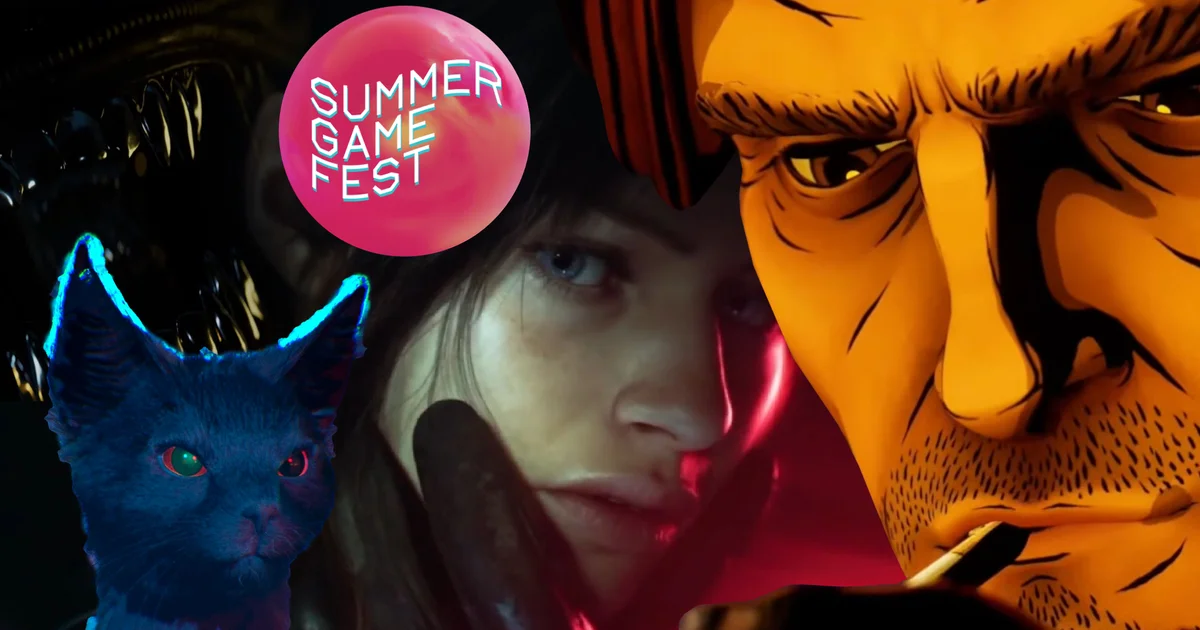
That showed up everywhere. Resident Evil opened the show to cheers, nodding back to 2000’s Resident Evil – Code: Veronica. We saw Virtua Fighter come back, along with The Wolf Among Us and Turok. New collaborations were announced with Teenage Mutant Ninja Turtles, Attack on Titan, Star Wars, and Saw. Sequels were unveiled for Alien Isolation, Cuphead, Mortal Shell, Control, Guild Wars, Grounded, Lords of the Fallen, Aion, Hot Wheels, Stellar Blade, and The Wolf Among Us once more. There were remakes of Final Fantasy 7 and Assassin’s Creed Black Flag, re-releases of RuneScape Dragonwilds, adaptations of Among Us, and recognizable, returning faces in Street Fighter 6—Tifa—and Mafia: The Old Country’s young Don Salieri. And yes, Tupac also appears, naturally, in Stranger than Heaven.
Of course, there are exceptions. It would be too simple—and ultimately wrong—to frame the entire event—or the medium itself—as purely retrospective. Patrice Désilet’s 1666 Amsterdam, Konrad Tomaszkiewicz’s The Blood of Dawnwalker, That’s No Moon’s Crossfire, and Fumito Ueda’s Gen Atlas point to meaningful, mostly innovative work. Even the mix of odd curiosities scattered throughout—An Eggstremely Hard Game earns bonus points for the wordplay—helps disrupt that narrative. And many of those sequels and remakes are genuinely exciting too—Alien Isolation 2, for instance, looks set to be outstanding. It’s also worth saying that this isn’t a fresh pattern. As a medium, games have often drawn from their own past, and when done well that can be a strength—Resident Evil is a strong example, especially with Requiem arriving earlier this year.
Even so, among the more inventive releases, familiarity still runs through everything. Those four headline “new” blockbuster games in fresh franchises—though we’re not calling them “new IPs” here, folks—pull at least some of their buzz from being built by creators people already know. The Assassin’s Creed guy. The Witcher 3 guy. The Naughty Dog and Call of Duty teams. Even the Shadow of the Colossus creator. I’m not standing apart from it either: I’m genuinely thrilled by Ueda’s return with genDesign, a developer and studio with a singular vision. And my interest in the rest is exactly what you’d expect, given the track record behind them—and, of course, because each of them looks spectacular in its own right.
Ultimately, the biggest driver here is how much recognition matters. (There’s also a bit of irony in pinning hopes for innovation on Ueda’s specific project—around this time last year, he praised Keita Takahashi’s To a T while musing over whether we’re “no longer in an era where we must provide new devices or new game mechanics every single game,” which came with a touch of wistfulness.)
So this feeling of looking back—at a moment when innovation and creative risk are rightly being treated as the way forward—lands especially hard. Games have been shaken hard over the last few years. Fueled by nostalgia, and a Peter Pan-like refusal to grow up, games—like anything else that feels under threat—have retreated to safer ground. Dust off the references. Unload the brand partnership pitch like it’s a cannon. Dig up the cult classic franchises you once buried without ceremony. Reintroduce that person you parted ways with and hand them whatever scraps you can find from your pockets, plus several million dollars from—well, I don’t know—China. Lean into the conservative angle for an easier stamp of approval. Rework the stalled mechanics from yesterday. And get a zombie in there, right now! Video games are heading back to the future, folks. Let’s just hope that what’s familiar can still feel exciting tomorrow.