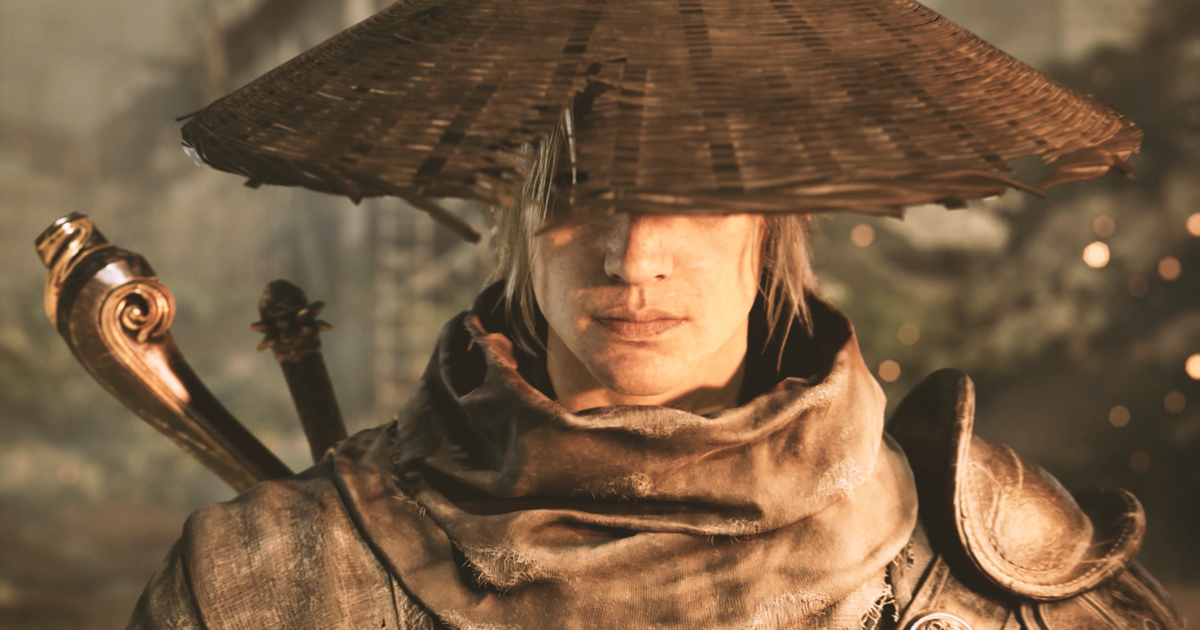
When the Chinese action game Phantom Blade Zero was first revealed to the public, it sparked a wave of comparisons to FromSoftware’s Souls franchise. That prompted its director—nicknamed “Soulframe” Liang—to repeatedly play down those parallels. More recently, as additional gameplay clips for Phantom Blade Zero have surfaced, another set of comparisons has come to the foreground: the game’s combo-driven brawling has many people thinking of Ninja Gaiden. With all that in mind, where does it actually land?
According to the team, it really is both. Speaking with Liang and the S-Game crew at this year’s Game Developers Conference (GDC), I learned that Phantom Blade Zero draws on three main sources of inspiration. First, its combo-focused combat echoes Devil May Cry, though it’s meant to be easier to pick up thanks to simpler control inputs. Second, its environments borrow the connected layout approach associated with Dark Souls, but without the punishing consequences that typically follow death. Third, it channels the unsettling, tightly packed tone of Resident Evil 4 and Alan Wake, while wrapping it in a new visual identity the developers describe as “kung fu punk.”
“I don’t think of it as something that frustrates people—it’s just meant to help players understand what the game is,” Liang told me when I asked whether the constant Soulslike tag bothers him. “There was some early confusion, and now more people are drawing comparisons to Ninja Gaiden and Devil May Cry. If that helps another group of players better understand—or even predict—what we’re offering, then that’s a good thing. There’s something here for everyone.”
“From our perspective, it’s hard to label our game as either a Souls experience or a pure hack-and-slash. It’s simply situated between those categories. In that way, it becomes a framework for storytelling.”
Liang also cautioned that copying what other games already do could easily make Phantom Blade Zero feel generic. Instead, he wants the finished product to feel like a “complete work of art,” guided by two core ideas.
The first idea is building a game that functions like a kung fu movie you can play. “Our goal is to bring back the golden age of Hong Kong kung fu cinema from the 1970s—starting with Bruce Lee and moving through Jackie Chan, Jet Li, and Donnie Yen,” he said. “That wave faded after the early 2000s, so we want to revisit it and help bring the genre back to life.”
As a Chinese studio, S-Game approaches the mission with an eye toward authenticity, from its motion capture process to its broader cinematic influences. Liang points to the kung fu action game Sifu by the French studio Sloclap as a reference point: “If a French studio can pull off something like this, why can’t we create an even more genuine experience shaped by Chinese culture?” In the same way Sifu includes a side-scrolling combat segment inspired by the 2003 Korean film Oldboy, Phantom Blade Zero will also feature distinctive fights set inside its own “alley of death.”
The second guiding principle is drawn from game development trends in the 1990s, designed to keep the project’s scale under control. “We want to return to the PlayStation 1 and PlayStation 2 era,” Liang said. “Back then, games were smaller, budgets were more realistic, teams were tighter, and everyone involved was passionate, inventive, and seasoned. It’s similar to a bigger indie project—just supported with funding, know-how, and steady direction—so that everything feels connected from the moment you hit Start all the way through the credits.”
That said, last year’s Black Myth Wukong also deserves attention. Liang admitted that Phantom Blade Zero’s development team has benefited from both increased resources and greater expectations following Wukong’s success—both games received support from Tencent. “Now everybody understands the possibility of a Chinese-made title selling 30 million copies within just half a year,” he noted.
With that, enthusiasm has risen, and early signals look encouraging. At the GDC presentation, the S-Game team shared a roundup of public reactions to Phantom Blade Zero on social media since its announcement. Within China, Wukong’s trailers naturally dominate viewership, but Phantom Blade Zero performs even stronger on a global scale. For context, Wukong’s launch trailer reached 2.8 million views on the game’s YouTube channel and 3 million views on the PlayStation channel. By comparison, Phantom Blade Zero’s announcement trailer on the PlayStation channel has already tallied 5.3 million views.

So far, Phantom Blade Zero appears set to match those expectations. I previously played the game at last year’s Gamescom, and I was immediately taken by its fast, polished combat. It blends quick combo strings with precise parry and dodge timing, letting the protagonist—when timed right—turn behind enemies in slow motion to land counterattacks.
At GDC, I took on a different boss: the Chief Disciple of the Seven Stars. It’s essentially a puppet master figure, with minions that have to be dealt with to prevent healing, and it also let the team show off a few new weapons, all highlighted in the latest Year of the Snake trailer (above). The first part of the fight was still within reach, but the second phase changes things dramatically—the boss hangs from strings and uses some unusual animations. While that phase acts like a checkpoint to keep the encounter approachable, it doesn’t mean the battle is simple. Still, once the parry and dodge rhythms finally clicked for me, the combat became genuinely thrilling.
One major reason for the impact is how smoothly the animations flow. S-Game has built a dedicated movement library designed to keep transitions seamless between combat actions and the shifting reactions that happen during fights. On top of that, the team captured these animations using real martial artists to preserve an authentic kung fu feel—even for the puppet master suspended on a wire. The finished game will also include 30 primary weapons and 20 secondary weapons, all modeled on historically accurate armaments but reworked with punk-inspired touches. S-Game has further announced an Extreme difficulty option that strips away attack pattern tells in favor of smarter AI designed to mimic a PvP-style experience—added after player feedback asking for a tougher challenge.
Beyond these elements, there’s another point worth noting: the studio has shared very little about the storyline behind the combat-first focus. In fact, Liang said that every combat sequence shown so far—including the puppet master boss—comes from optional side content. So even though what we’ve seen is already impressive enough to stand alongside one of the biggest success stories from recent years, there’s still plenty left to discover. And with that, it’s no surprise that the game doesn’t yet have a release date.