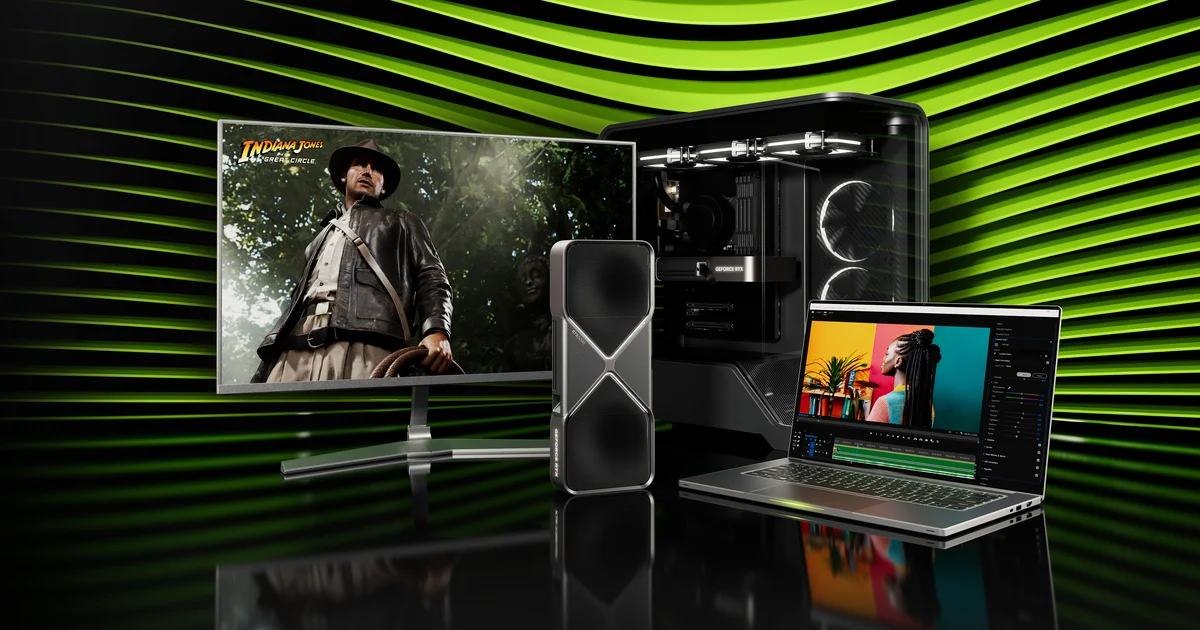
As expected, Nvidia unveiled its newest RTX 50-series desktop graphics cards during its CES 2025 keynote, which aired in the early hours by UK time. The current catalog includes four models: an RTX 5090 priced at $1999/£1939, an RTX 5080 at $999/£979, an RTX 5070 Ti at $749/£729, and an RTX 5070 at $549/£539. Each “Blackwell” card comes with GDDR7 memory, and Nvidia is positioning the lineup for standout frame-rate performance along with DLSS 4 multi-frame generation. The two flagship versions are scheduled for release on January 30th, while the higher mid-range models should arrive in February.
Some of Nvidia’s “relative performance” claims are genuinely striking, so first we’ll set expectations for likely frame rates on each card. After that, we’ll outline how DLSS 4 multi-frame generation works, before moving on to the architectural updates.
The $1999 RTX 5090 naturally takes the top spot, appearing as a prosumer-focused option with 32GB of GDDR7 memory. It’s built around the GB202 GPU, which includes 92 billion transistors—up from 76 billion on the 4090—and offers 21,760 CUDA cores. Nvidia’s materials state that it delivers double the frame rates of the RTX 4090, including a steady 4K 240Hz experience with full ray tracing and maximum settings in games that support the multi-frame generation (MFG) feature.

Before we go any further, it helps to spell out what MFG changes. With multi-frame generation, up to three frames are produced for every frame that would normally be rendered. That can raise effective frame rates and improve perceived smoothness, but it doesn’t automatically mean better performance, since latency depends on the “base” frame rate rather than the final “output” frame rate. This idea is similar to the frame generation (FG) approach used on RTX 40-series cards, and for it to work well it depends on developer support as well as Nvidia’s Reflex 2 latency-reduction technology.
It’s also interesting that, despite the RTX 5090 being rated at a total graphics power of 575W—very close to the PCIe 5.0 600W ceiling, and 125W higher than the RTX 4090—its Founders Edition cooler is reportedly slimmer than the RTX 4090 FE. This is a two-slot card that may work in smaller PC cases (as long as you pair it with the required 1000W power supply), using two flow-through fans and placing the PCB in the middle. It will be fascinating to see how the final design performs, especially since earlier 5090 prototype coolers were said to be quad-slot monsters.
The $999 RTX 5080 is designed to deliver double the frame rates of the RTX 4080, with Nvidia claiming results that exceed 2x in demanding ray tracing titles such as Cyberpunk 2077, Alan Wake 2, and Black Myth: Wukong. This model uses the smaller GB203 die and includes 16GB of GDDR7, 10,752 CUDA cores, and a rated power of 360W, with Nvidia recommending an 850W power supply. Pricing is aligned with the RTX 4080 Super, which makes it especially interesting to compare how these cards stack up for direct performance when FG or MFG isn’t being used.
| Nvidia | RTX 5090 | RTX 5080 | RTX 5070 Ti | RTX 5070 |
|---|---|---|---|---|
| GPU | GB202 | GB203 | GB203 | GB205 |
| Cores | 21,760 | 10,752 | 8,960 | 6,144 |
| Boost clock | 2.41GHz | 2.62GHz | 2.45GHz | 2.51GHz |
| Tensor core TOPS | 3,352 | 1,801 | 1,406 | 988 |
| RT core TFLOPS | 318 | 171 | 133 | 94 |
| Memory | 32 GB GDDR7 | 16 GB GDDR7 | 16 GB GDDR7 | 12 GB GDDR7 |
| Memory bus width | 512-bit | 256-bit | 256-bit | 192-bit |
| Memory bandwidth | 1,792GB/s | 960GB/s | 896GB/s | 672GB/s |
| Total Graphics Power | 575W | 360W | 300W | 250W |
| PSU recommendation | 1000W | 850W | 750W | 650W |
| Power connector | 600W PCIe 5.0 (4x 8-pin) | 450W PCIe 5.0 (3x 8-pin) | 300W PCIe 5.0 (2x 8-pin) | 300W PCIe 5.0 (2x 8-pin) |
| Price | $1999/£1939 | $999/£979 | $749/£729 | $549/£539 |
| Release Date | January 30th | January 30th | February | February |
The two February releases, the RTX 5070 Ti 16GB and the RTX 5070 12GB, are set at $749 and $549, respectively. The 5070 Ti uses a reduced version of the GB203 GPU, with 8,960 CUDA cores, while the 5070 relies on the GB205 with 6,144 cores. It’s still somewhat disappointing that the $549 RTX 5070 sticks with 12GB of GDDR7 in 2025, though Nvidia would have needed a 256-bit bus (or a hybrid VRAM design) to reach 16GB—so the outcome isn’t entirely surprising.
On performance, the message stays consistent across the board: the 5070 Ti is expected to double the frame rate of the 4070 Ti, and the 5070 aims for the same uplift over the 4070. Nvidia also noted that this positioning would mean the 5070 could reach frame rates similar to the RTX 4090—an impressive result given it’s priced at roughly one-third. Since this comparison depends on different MFG versus FG scenarios, we’ll need to wait for thorough third-party testing to verify the claim and to examine how the cards perform in scenarios without FG and even without DLSS/non-RT effects.
Along with its desktop lineup, Nvidia also announced RTX 50-series laptop GPUs. These will be on sale starting in March and will come with smaller memory options, including RTX 5090 24GB, RTX 5080 16GB, RTX 5070 Ti 12GB, and RTX 5070 8GB.
Now that the lineup is clear, it’s worth touching on the key architectural improvements that are intended to boost both general speed and important gains for RT and AI workloads. Nvidia attributes these changes to stronger SMs offering higher throughput, along with better integration of Tensor cores, refinements to shader execution reordering, and added acceleration for FP4 computation. There’s also upgraded hardware flip metering that’s needed for multi-frame generation, new RT cores delivering double the ray-triangle intersection rate, and improved compression. Finally, the cards support the PCIe 5.0 standard and include DisplayPort 2.1b UHBR20 ports, aligning with AMD’s prior-generation cards.
If you’d like to dig deeper into the Blackwell architecture, Nvidia’s blog provides additional details on these architectural points, and we expect well-established technology outlets such as Gamers Nexus or TechSpot to publish thorough breakdowns once they’ve had time to review the information.
As for our coverage, we plan to put out more information about DLSS 4 multi-frame generation soon—so keep an eye out. We’re also eager to test the new GPUs with our updated testing suite as soon as possible.