Moza offers some of the most impressive (and best-value) sim racing gear on the market, from cost-conscious starter bundles to ever more advanced wheel bases, rims, and pedals. In this review, we’re zooming in on the high end of the lineup: the Moza R25 Ultra, which was revealed at Gamescom in August.
The £899/$899 R25 Ultra is Moza’s most powerful wheel base. It features a 25Nm constant torque specification that edges past the strongest models from Logitech and Thrustmaster. It also brings a brand-new 21-bit magnetic encoder along with a zero-cogging flat wire motor—both designed to deliver smoother force feedback and a more refined feel, even if you’re running it at gentler power settings.
Do these updates and others add up to something genuinely different from the older Moza R9 wheel base I’ve been using for the past few months? And how does the R25 Ultra compare with the similarly priced Logitech Pro Racing Wheel and Thrustmaster T818? Moza’s pricing has definitely impressed me—so the real question is what that extra strength actually changes in practice.
Moza R25 Ultra Review: Hardware Overview
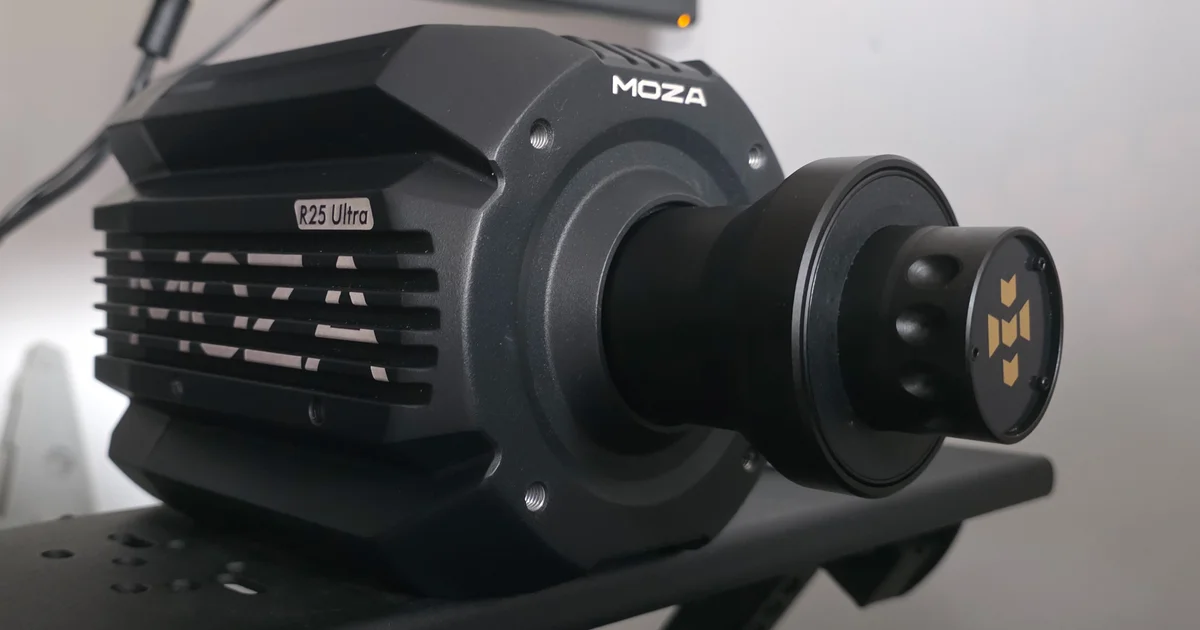
The Moza R25 Ultra drops the wider, more streamlined look of the previous flagship R21 and instead uses a rigid, boxy design. It also comes in noticeably shorter than most other wheel bases in the 25Nm class, while staying cool during my time with it—its better heat dispersal is likely helped by the extra surface area. Also worth noticing are the RGB LEDs along the left and right edges. These can be completely switched off, set manually, or configured to show race information like yellow flags, gear changes, or ABS activation.
You get support for all three common wheel base mounting styles here: standard pattern bolts on the underside, plus side and front mounting options. There are also a few smaller bolt points for attaching a Moza dash on top. I chose a bottom mount since my Next Level Racing GTTrack cockpit is set up for it, but it’s great to see every option included—especially because these alternate mounting methods show up more often in higher-end cockpits. As you’d expect from a premium wheel base, there’s no desk clamp included.

There’s no USB pass-through for third-party wheel rims, but you can attach a range of Moza add-ons, including pedals, shifters, handbrakes, and more. A USB-B connection is used to link back to your PC, which is a little less convenient when compared to the USB-C setup used on the PXN VD10 wheel base I reviewed recently—finding compatible third-party cables feels slightly more of a hassle. You also get a dedicated power input and an on/off switch. An emergency stop button isn’t provided, though it can be wired in.
All in all, it comes across as a very polished piece of equipment, particularly when compared with the older R21. After seeing it in person and getting it mounted to my rig, I was impressed by how light and low-profile it feels despite the performance on offer.
Moza R25 Ultra Review: Software Overview
Moza’s Pit House software has steadily matured from a fairly basic starting point, and it’s now arguably one of the strongest sim racing packages around. Making the big adjustments most players want is usually straightforward—things like capping maximum force feedback output, applying firmware updates, and setting a maximum steering rotation. You can even select supported games directly from the main screen to configure them with a single click. If you do prefer manual tweaking, the process is clearly explained and offered in a proactive, well-presented way.
You can also dig into force feedback tuning, including advanced options such as speed-based damping and steering inertia. There’s also a new graphical equalizer that lets you change the strength of force feedback at particular frequencies. This is a genuinely useful addition, because it helps you remove effects you don’t care for and boost details you may otherwise miss—like the feel of your tires slipping or losing grip.
In the games I tried—F1 23, F1 25, iRacing, Rennsport, and Assetto Corsa Evo—everything worked properly right from the start. I only needed a handful of small tweaks to bring the force feedback and related settings to a level I was happy with. (Rennsport initially felt a bit off, but fixing it was thankfully simple: I just changed one in-game option by inverting the force feedback.) In general, Pit House’s recommendations mostly centered on dialing down damping and interpolation to achieve a more direct, connected sensation. Presets are available for most popular titles, and they aligned well with what I expected based on my testing. You can also export and import your own setups, or those created by other users online (the Moza Discord includes a channel for sharing—though not every wheel and game combination has configurations listed).
When you look at competitors like Logitech and Thrustmaster, Pit House seems to be the most capable overall. That said, offering more detailed tooltips and perhaps some additional structure could make it even easier for newcomers to get comfortable.
Moza R25 Ultra Review: Gaming Performance
Once I had the Moza R25 Ultra installed alongside my existing GS V2P GT wheel, I set out to complete my long-running F1 23 campaign and revisit my Assetto Corsa Evo license impressions as this early access release reached version 0.4.
I was happy to see that I ended up at Suzuka in my final F1 23 session, and the switch immediately felt natural. Using the familiar wheel with a stronger base gave me confidence right away. Compared with the PXN VD10 I’d used earlier, I felt more in command of the car—especially when driving with both ABS and traction control turned off, where reading the edge of grip matters far more. While F1 23 isn’t typically viewed as the best option for delivering distinct force
With that extra bit of context, I felt confident enough to smash a handful of long-standing personal lap records in time trial mode. I’d previously set those using the Moza R9, the Thrustmaster T818, or the Logitech Pro Racing Wheel, so seeing that kind of improvement mattered.
I was
Even more surprising to me was the force feedback in AC Evo. The brief moment of weightlessness when the sturdy BMW M2 popped off the ground during the later stretch of the Mount Panorama circuit, or the vibration from the Ferrari SF-25 when I tried to floor it too soon after a corner, was simply remarkable. The curb impacts did feel a touch too strong, though that’s the kind of thing you can easily dial down in most games (or through the Pit House software). I kept beating the lap times I’d posted the week before with the PXN VD10, especially when driving higher-powered cars like the Ferrari 296 GTB. And I felt the wheelbase was delivering even more useful information about exactly when I was starting to lose grip.
Most of my testing time was spent running the base at roughly 80 percent of its maximum capability, or 20Nm. That level felt completely adequate to keep me engaged across both AC Evo and F1 23. If I were going to settle in for a full evening of multiplayer F1 racing—or bring friends over for a few laps—I’d probably drop it even further, maybe to 50 percent. Still, I didn’t feel like the wheelbase was dangerously forceful. When I intentionally took my hands off the wheel, its motion was limited as expected, but I’d welcome the addition of an emergency stop button up front.
I also put time into multiplayer sessions on iRacing and Rennsport, where I found the R25 Ultra to be a little more forceful and easier to live with around the 50 percent setting. On iRacing in particular, I’m still learning—my focus is on staying on the racing line and steering clear of crashes rather than trying risky overtakes. Having more guidance coming through the steering wheel lowered the intimidation factor of picking up new tracks and cars. The lighting strips within my field of view were especially handy too, particularly for indicating track conditions, since I could spot them in my peripheral vision without having to take my eyes off the road ahead.
Moza R25 Ultra review: conclusion
As should be obvious from the earlier sections, I’ve had a great time moving back to a Moza setup with the R25 Ultra. The force feedback quality here is the best I’ve personally experienced, packed with plenty of detail and useful tools for fine-tuning. I also appreciate how little setup is typically needed to get a satisfying feel in each game.
The Moza lineup is in a strong place right now, and it’s been great to watch the company grow from its earlier budget/value focus into noticeably more premium options. There may be a small gap in the number of comparable higher-end wheel rims available from Moza to choose from, and there’s still no USB pass-through for straightforward connections with more advanced options from other brands. Even so, when you look at overall value, pairing the R25 Ultra with the GS V2P GT wheel delivers an excellent circuit racing experience. With plenty of mounting options, a compact power brick, and a relatively short, low-profile build, fitting the R25 Ultra into your rig is straightforward.
That said, I don’t think most people truly need a wheelbase that can provide 25Nm of continuous torque—including me. I can absolutely tell the difference in fidelity and output when switching from last week’s PXN 10Nm wheelbase to the 25Nm R25 Ultra this week. However, for most situations, anything in the 15Nm range and up starts to feel like more strength than necessary. That could make the R21 Ultra at $699 a more attractive option, or the older non-Ultra R16 and R21 models if you can find them discounted. The R9 also continues to be a strong budget pick at $299, though it doesn’t quite match the R25 Ultra’s level of force feedback detail and punch.
On the other hand, if you’re in the good position to fit the R25 Ultra within your budget and you value the wider Moza ecosystem—its wheel rims, pedals, shifters, and more—then the R25 Ultra is a clear recommendation. It delivers the best force feedback of any wheelbase I’ve tested, it’s easy to use, and it comes with excellent software support.
Next time, we’ll take a look at something that’s more budget-friendly: the new Logitech RS50, which comes as a package including the wheelbase, the RS Track Wheel, and the RS Pedals. Priced together at $859/£720, the complete setup costs less than the R25 Ultra by itself—but how does it stack up? Keep watching.